Just to add to a bad week for RTÉ, many people have expressed their disappointment at the fact that two of this weekend’s All Ireland senior football quarter finals will not be shown live on RTÉ television but will be behind a paywall on the GAAGO channel – the joint enterprise between RTÉ and the GAA. Indeed, the two controversies are not unconnected in many people’s minds.
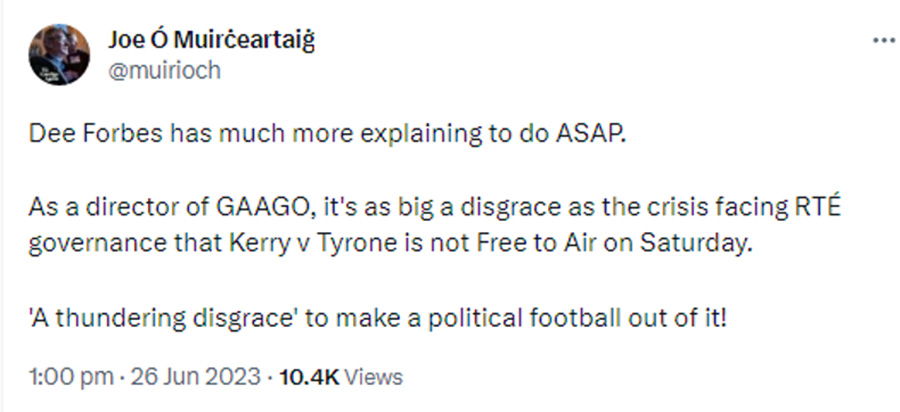
The main gripe has come from the participating counties; Kerry, Tyrone. Armagh and Monaghan. Given that Kerry are the current and defending All Ireland champions it might be taken as a bit of an insult to them, or a downgrading of that status, that the game is not being shown as something that the public broadcaster might feel would be of national interest.
Alternatively, it might cynically be seen as another attempt by the GAA and RTÉ to capitalise on the huge demand to see the two games by moving them to their pay per view channel.
To watch either game separately will set you back €12. Not a huge tariff, but given that RTÉ is already involuntarily supported by people who own a television and a TV licence and that there are hundreds of thousands of GAA members who pay club memberships, and contribute of their time voluntarily, it might also be regarded as stretching the patience on both fronts.
The controversy has highlighted a curious division within the national psyche. There are, it seems, people who will justify more or less anything if it can be shown to turn a few bob. Thus, in the debate among members and supporters of the GAA over GAAGO, there are a sizeable number of people who dismiss appeals to any sense of community, or the fact that many old people might have financial or even logistical difficulties in accessing online games, on the basis of “Oh, sure the GAA has to make money.”
Well, as former President of the Association, and current Fine Gael MEP Seán Kelly pointed out in an interview on Raidió na Gaeltachta, the GAA is not short of money, and has never been short of volunteers who have kept the whole thing going for the guts of 150 years. There are many who regard that as rather quaint at this stage, and many who probably look on anyone who does anything for no direct material benefit as a bit of an eijit.
Not to mention their ignorance of, and contempt for, the ideals that have kept the GAA and other national institutions going even through times when it was neither profitable nor safe. And such ignorance and contempt is by no means any longer confined to what were once properly regarded as anti-national elements but are openly held within the Association including by people who wish to professionalise the playing side.
There was a photograph recently of the next GAA President elect, Jarlath Burns, helping with the upkeep of the goals in his own club, Silverbridge Harps in County Armagh. Perhaps he might make it his first task on assuming office to take back control from the accountants. And if there must be accountants and full time administrators, and there clearly must, then let the GAA recruit people who are members and have a history of involvement with the Association instead of people who could be doing any job.
Such a technocratic approach has ruined other Irish institutions including the trade unions, so the GAA can not claim not be forewarned when it ends up as another hollowed out soulless Woke business.
He might also perhaps, if he is of a mind to do so, begin to reverse the cultural retreat that has informed the direction which the GAA has taken over recent years. The diminished prominence of Gaelic within the national consciousness is just another but telling aspect of the drive to turn Ireland into a deracinated industrial estate or EU storage facility.
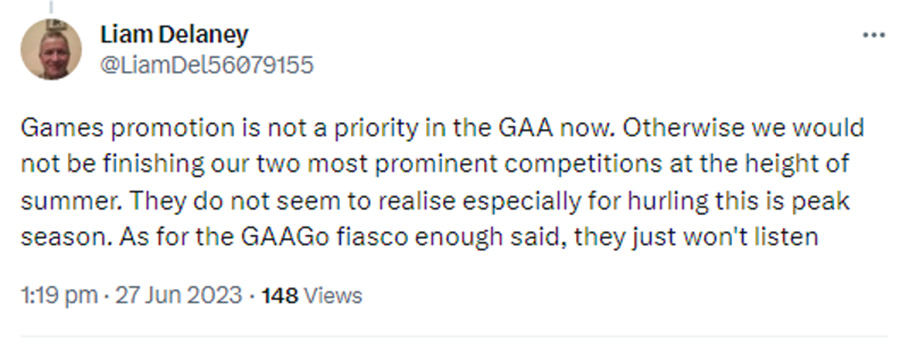
The telescoping of the inter-county championship into a few months was sold to members on the basis that finishing the whole thing before the end of July would free up more time for clubs.
Nothing to do, of course, with the happy coincidence that the GAA accountants and administrators now have more time in which to rent out Croke Park for other events, including other sports which will be potentially splashed all over the broadcast media at a time when the flagship inter county games are over and done with.
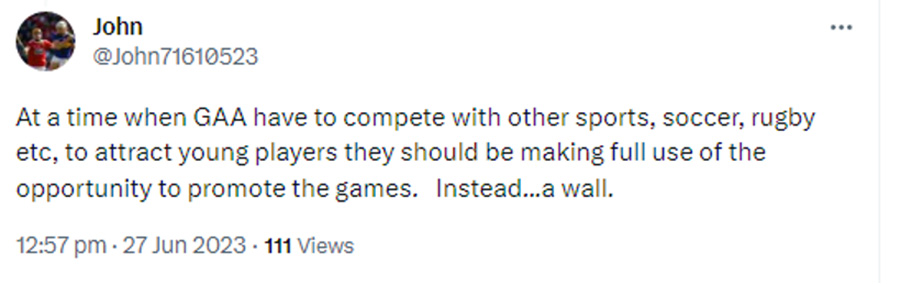
The final stages of the All Ireland championships have not only been the flagships of the GAA, but the main domestic sporting events for generations. Surrendering ground to rival sports makes no sense if the GAA hopes to retain that position.
The GAA might also stop allowing itself to be used as another vehicle for pushing an ideological agenda.
The GAA’s own publicity and the advertising of games by major sponsors portrays an idealised picture of a diversity that does not exist. No more, really, than advertising in general reflects social reality as opposed to an agenda driven aspiration.
The GAA centrally appears more anxious to placate people who either have no interest in Gaelic sports – or who openly dislike Gaelic sports and more particularly the fact that they are associated with the concept of Irish nationality – than they are with looking after its own members and supporters, like the elderly people in Kerry who will be thrown back on the wireless on Saturday to follow the fortunes of the county’s football team.
At least Raidió na Gaeltachta and Radio Kerry will not be interrupting proceedings to inform its listeners about dramatic transfer developments at “City” or “United.”