The footage of the raid on the home of a former British police officer, Julian Foulkes – who was being investigated for responding to a tweet and who was subsequently arrested and held in a cell for 8 hours – is at once completely bizarre and also, by now, wholly unsurprising.
The retired policeman, who is now 71, was “arrested and handcuffed in his own home by six police officer armed with batons and pepper spray”, the Daily Mail reports. He is now suing Kent Police, who have apologised and acknowledged that a caution should not have been issued to Mr Foulkes.
The Free Speech Union, who are supporting Mr Foulkes in taking legal action against the police authorities – says that “someone complained about Julian’s tweet to the Met, and Metropolitan Police Intelligence Command – a specialist unit set up to deal with terrorism and extremism – referred it to Kent Police, citing “concerns around online content”. The following day, six police officers turned up at his home, ransacked the premises, arrested him, detained him for eight hours and gave him a caution.”
Six officers? That’s a absurd number of police sent to deal with one retired former colleague. It would be laughable if the intent to intimidate wasn’t so obvious. Ransacked his home? The bloody cheek of them: as if he was an arch-criminal or a drug dealer. Then they put the pensioner in handcuffs and held him for interrogation for 8 hours. That’s just nasty, but then again, haven’t we learned that all the #bekind and #StopHate initiatives are based on being horrible to ordinary human beings, in the cause of ruthlessly supressing dissent, even of the mildest kind.
The footage from the Kent Police body-cams shows one agent murmuring “Very Brexity things,” while looking through Mr Foulkes’ bookshelves. They also described a book on Britain joining the Common Market as “a little odd”. A tome by Douglas Murray – obviously highly suspect – is examined.
It’s like some ridiculous over-the-top parody with shaky, hand-held camera footage of ‘When tweet-policing goes mad’, but this actually happened and is now just another example of the deplorable state of free speech in Britain.
One could be forgiven for thinking that having ‘Brexity’ things indicated membership of a dangerous lunatic fringe, or an underground faction seeking to undermine social cohesion, instead of signalling support for a view expressed by a majority of Brits in a free and fair referendum.
But what’s sinister about the ‘Brexity’ comment is that it reveals the persistence of seething, petty, establishment anger at the extraordinary audacity of the proletariat in upsetting the EU project.
Brexit, you see, wasn’t like other instances of proles getting uppity: this couldn’t be sorted by throwing money at NGOs or dragging plebs in front of courts for protesting, this was a disruption of the established order on the magnitude of an earthquake.
Instead of accepting that democratic result, its evident that almost seven years later, the thinking that has filtered down to cops on the beat is that a view that is held by the majority of ordinary people must be treated as suspicious, to the point where a police officer – investigating a wholly legitimate tweet – is prompted to note ‘very Brexity things’ as something suspect.
In fact, I’d warrant that while much of the free speech disputes that capture the public’s attention might centre around gender issues or immigration, the establishment has never forgiven the ordinary British punter for Brexit.
It’s very much like the implication that MAGA supporters held unacceptable views or made invalid choices in 2016, even after those voters won the election. They weren’t just deplorables: their whole outlook was invalid, and therefore could not be tolerated.
Suppression of free speech is part and parcel of the intolerance of the tolerant liberals, and this especially applies to the self-serving, whiny, virtue-signalling establishment classes. Anyone who disagrees with them – especially if they are working-class or male or, God forbid, both – must be punished severely. That used to mean social death and cancellation and twitter mobs, but then, to the delight of said gated-community-dwellers with sensitive souls and vindictive hearts, hate speech laws happily meant that the might of the Old Bill could also be employed to shackle the plebs in irons for mean tweets and bad thoughts.
Commentator Andrew Neil said that the whole sorry episode showed that the British police forced had gone from being one of the most-admired forces in any democracy in the world to being one of the most-despised. He’s right, but in fairness to the police, its worth remembering that they are only following orders, lame as that excuse may be. For all the complaints about Keir Starmer, this particular incident occurred in 2023 – when the Tories were in power.
“Very soon you’re going to be arrested, taken into jail and kept for eight hours, if you’ve got three books by Douglas Murray and a Michael Portillo train journey DVD set,” Neil said. I might be in trouble myself, though Portillo is absent from my shelves and I’d disagree with Murray on much of his current rhetoric.
Neil said that the problem was with the leadership, and certainly the focus on diversity and hate speech would come down from the top in each of the territorial police forces, where the notion that tweets need such heavy policing caught hold.
Britain is now being portrayed, in speeches by global figures like JD Vance, and in news reporting around the world, as a country that is hostile to free speech and actively practises “thought policing” as evidenced by the repeated arrests of pro-life witnesses for ‘praying in their heads’.
The Telegraph listed other egregious examples from this year such as:
In March, officers from Hertfordshire Constabulary arrested and detained the parents of a nine-year-old girl after they had complained about her school in a WhatsApp group, before concluding that no further action was required.
Ian Austin, a former Labour MP, has also been investigated for calling Hamas “Islamist”, while Julie Bindel, the feminist writer, was visited by police after a transgender man reported her gender-critical tweets as an alleged “hate crime”.
In addition, the paper’s own Allison Pearson was visited by two police officers at her home, who told her she was being investigated over a tweet she had posted on X a year earlier. She is also suing that police force.
It seems that Kent Police came after Julian Foulkes partly on a misunderstanding – he was tweeting about anti-Semitism (suggesting that others might be just one step away from looking for Jewish arrivals to the country) but the complainant apparently believed he was saying that this was an action he would undertake – and so the police investigated him for being “anti-Jewish”. Surely, even a phone call would have sorted that out – not that it is the business of the police to monitor speech – but instead Mr Foulkes had to endure police officers rooting through his personal belongings and even searching his wife’s underwear drawer.
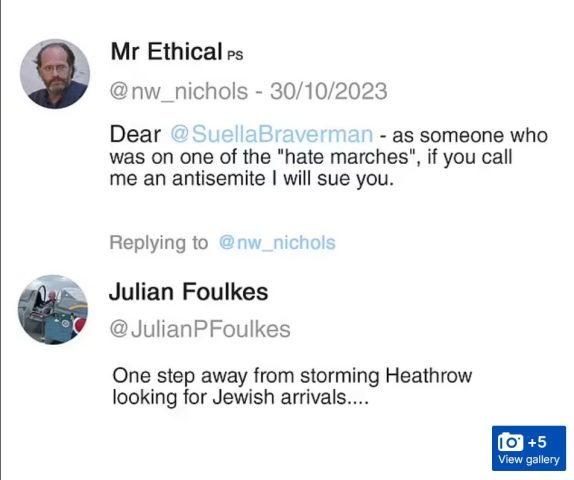
“Free speech is clearly under attack,” Mr Foulkes told The Telegraph. “Nobody is really safe… the public needs to see what’s happening, and be shocked.”
“It was just so wrong – and especially painful because I’d spent 10 years working with these people for no remuneration. I did it because I believed in it and enjoyed it. I left with a certificate from the chief constable, thanking me for my service. Now, all those memories feel trashed,” he said.
“I saw Starmer in the White House telling Trump we’ve had it [free speech] in the UK for a very long time, and I thought, ‘Yeah, right.’ We can see what’s really going on.
“I never saw anything like this when I was in the force. But this woke mind virus infecting everything has definitely infected the police.”
He is suing Kent Police because, the Free Speech Union says, “the emotional fallout has been devastating”.
Julian lost one of his daughters in a hit-and-run 15 years ago and his surviving daughter now lives in Australia. His greatest fear while he was being held in police custody was that a criminal record might prevent him from visiting her — which is why, despite having done nothing wrong, he felt compelled to accept a caution. “My life wouldn’t be worth living if I couldn’t see her,” he said.
The British courts, which last month found that biological sex determines what is a woman and a man, are likely to defend Mr Foulkes’s free speech. But he shouldn’t have had to endure the ordeal in the first instance.