Recently, the popular house price tracking social media page ‘CrazyHousePrices’, run by Ciarán Mulqueen, shared a Facebook message he received from a distressed tenant who had been outbid by a Chinese institutional buyer. “Outbid again by a Chinese cash buyer through the above property investment company,” the message read.
But what company is the messenger referring to?
Let me introduce you to Vanke. Vanke is a China-based real estate investment firm.
According to its website, the company has a hybrid purpose, acting as an intermediary for Chinese property buyers and investors in Ireland.
“Vanke Ireland (International) is the first Chinese licensed real estate agency in Ireland, a comprehensive real estate agency that assists clients in purchasing property in Ireland, as well as investment and property management,” it says.
Vanke lauds itself as “expert” in “sharing local knowledge with clients and prospective purchasers” including “transport links and schools, to the best local shops and restaurants” as “all of our agents live at the heart of the neighbourhoods we service and can provide insight and know how about the local intricacies of these markets.”
Like a lot of international property investors, Vanke views Ireland’s housing crisis not as a challenge, but as an opportunity – unlike tenants and those priced out of the market,
Under the section ‘Why Invest Property in Ireland’, Vanke lists several reasons for would-be investors.
The webpage has now been amended but until recently the Number 1 reason was: Ireland’s housing crisis’.
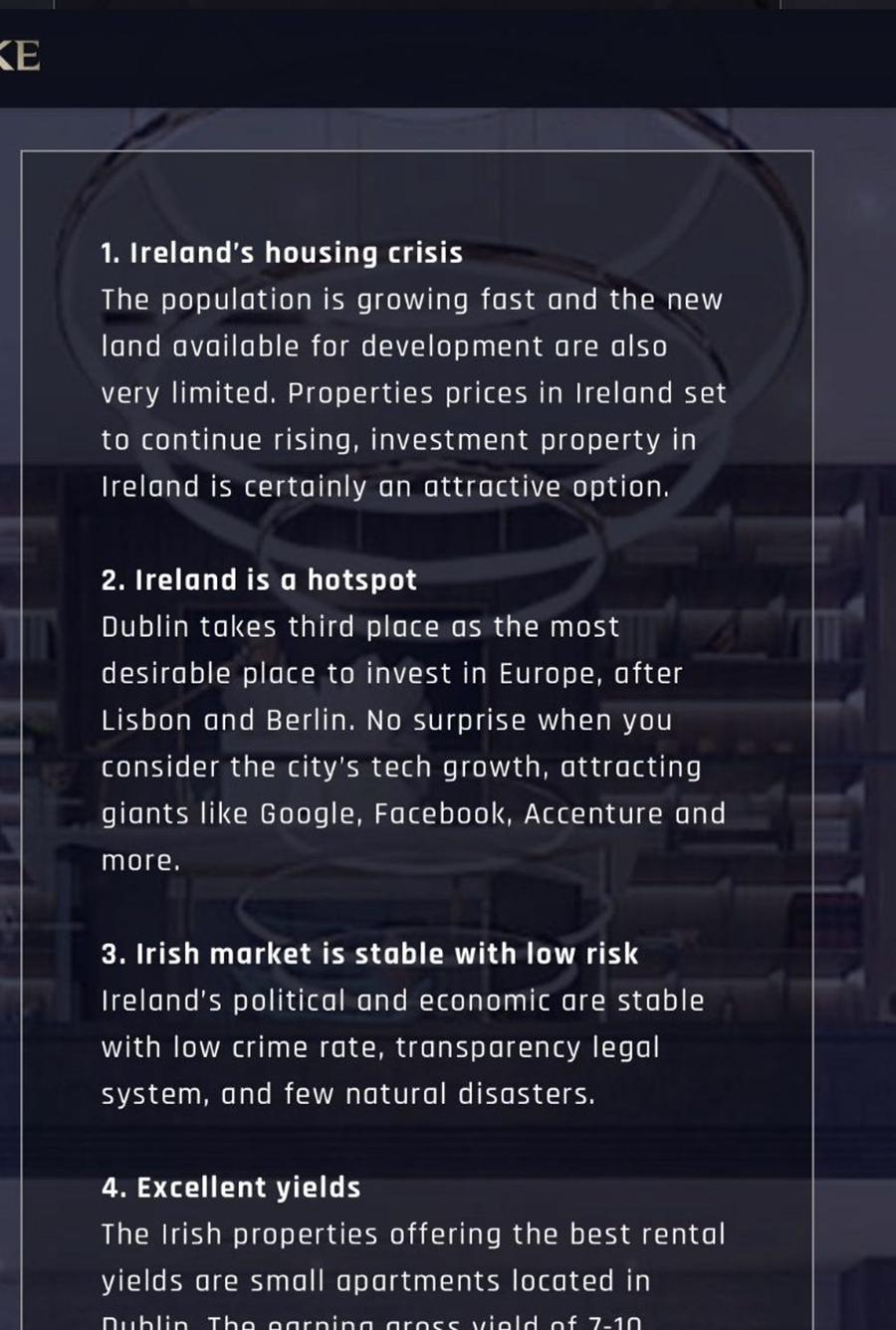
“The [Irish] population is growing fast and the new land available for development are also very limited. Property prices in Ireland are set to continue rising, investment property in Ireland is certainly an attractive option,” it read.
The firm also explains that small apartments in Ireland are “offering the best rental yields… earning gross yield of 7-10 per cent”.
But while a 160% increase in rents in the last ten years may be a negative for those struggling to afford sky high rents, for companies like Vanke it presents a profitable investment opportunity.
The situation for renters in Ireland is stark: The average Irish tenant spends a third of their income on rent exceeding €2,000 per month. Indeed, the full scale of rental affordability is masked by the massive sums of subsidies the government pumps into the market each year via the Housing Assistance Payment (HAP) and the Rental Accommodation Scheme (RAS) at up to €1b per annum.
While it may have the effect of reducing rents for some tenants, ultimately these subsidies distort the market as many of these tenants should be in social housing as opposed to being stuck in the private rental sector. This sector has grown massively since the crash from 80,000 rentals in 2005 to over 300,000 in 2016 at a cost of almost €10bn in taxpayers’ money since 2011 if you include all the various schemes including HAP, RAS, long term leasing, rent supplement etc.
Following the crash, many so-called ‘accidental landlords’, who purchased multiple properties during the boom, were asked to step in and provide social housing, and are now being subsidised, as I said, to the tune of €1b per annum, instead of using that money to directly build social or affordable housing as advised by the ESRI, NTMA and other international and domestic organs. This explains why overall rents have skyrocketed since their implementation in 2014 in the case of HAP, when rents were half what they are today.
These massive subsidies to private landlords and an influx of foreign high net-worth cash buyers and investment funds price ordinary people out of the housing market and inflate property values. If these subsidies were taken away, the one in five households in receipt of such schemes would be paying nearly 40% of their income on rent, with nearly half paying more than 40%.
This dire situation, however, is music to the ears of companies like Vanke.
Speaking before assembled guests in Dáil Éireann last year, I addressed Vanke’s profiting off of Ireland’s housing crisis: “While my generation is struggling to pay rents, working day in and day out to stay in a property we’ll never own, these funds are bragging about how beneficial it is for their balance sheets.”
But how did a Chinese investment company end up in Ireland?
VANKE’S HISTORY
Vanke was established in 1984 in the coastal province of Guangdong in south China by the entrepreneur Wang Shi. Having initially been a subsidiary of a state-owned enterprise, like most companies in China, Wang eventually oversaw its gradual privatisation and eventual initial public offering (IPO). In time, Vanke became the largest real estate developer in China.
In 2015, the much smaller Baoneng company, led by Yao Zhenhua, which specialised in real estate, and later life insurance and wealth management, attempted a hostile takeover of Vanke via high leverage amounting to ¥45b of borrowed money. Eventually, Baoneng became the largest shareholder of Vanke via a leveraged buyout having used its insurance subsidiaries to raise funds from members of the public promising short term returns, and through other asset management plans to acquire the cash.
Worried about this hostile takeover, Vanke began suspending shares and turned to another major real estate investor that has been in the news lately, known as Evergrande, to aggressively acquire shares in an attempt to challenge Baoneng’s dominance.
In time, Chinese regulators began to clamp down on attempts by Baoneng to acquire funds from the public by guaranteeing high returns and using the proceeds to engage in risky transactions. As such, Zhenhua was banned from the insurance industry for 10 years and suspended from selling high-yielding investment products.
The fallout from the saga provided an impetus on the part of Chinese President Xi Jinping to clamp down on speculators’ involvement in the housing market with the rallying cry that “houses are for living, not for speculation.”
The crackdown was rationalised on national security grounds as well as to alleviate the growing concerns of the ordinary Chinese public priced out of the residential housing market amid rife financial speculation and allegations of public officials accepting bribes for planning permissions, reminiscent of the property shenanigans during the Celtic Tiger era in Ireland.
The measures intended to avoid any systemic shock to the financial system, as real estate property accounts for over 20% of GDP, included the establishment of the Financial Stability and Development Committee, the equivalent to Ireland’s Fiscal Advisory Council or the UK’s Office for Budgetary Responsibility, to manage financial risk and coordinate the activities of the various regulators.
Banks were forced to impose regulations on their exposure to so-called shadow banking, which involves credit intermediation outside the well regulated banking system, and the insurance industry, which was instrumental in the takeover of Vanke, was mandated to ensure their products were used solely for insurance and not financial speculation. In 2018, the banking and insurance regulatory agencies were amalgamated into a unified regulator.
Amidst the regulatory crackdown, Vanke saw an opportunity, with foreign investment in Irish property largely deregulated with virtually zero constraints on foreign property purchase.
The company set up shop in the Republic in 2016 led by Tony Yu to sell properties to high-net-worth Chinese individuals. It is currently owned by Guangqian Yu.
Several of these properties have even appeared on the property listings website Daft.ie ranging from €200,000-€700,000.
On Vanke’s Facebook page, the firm advertises several properties including a 4 bedroom detached house in St James, Cross Avenue, Blackrock, Co. Dublin for €22.4m.
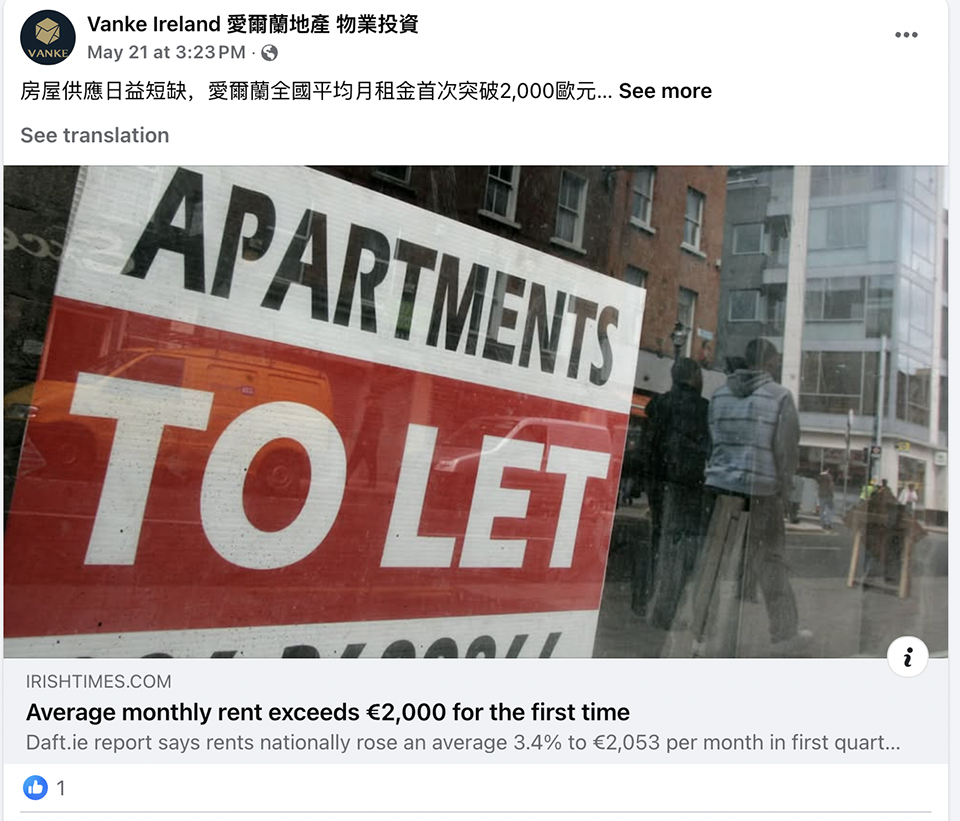
The page also recently posted an article from RTE which reported an increase in average nationwide rents above €2,000: “Growing shortage of housing supplies, national average monthly rent topped 歐2,000 for the first time in Ireland,” the post mentioned.
Other properties sold by Vanke include a penthouse apartment in Moland House on Talbot Street for €469,000 but sold for €700,000 – over €230,000 above the asking price; a property on Parnell Street for €230,000; an apartment in Trinity Plaza for €330,000; and a unit in Gandon House on the Customs House Square sold for €610,000 having been purchased previously in 2018 for €585,000.
Given the problems facing the property market, why is this foreign investment fund swooping in on the Irish property?
CHINESE ASSET MANAGEMENT
For its part, the Irish State has made a concerted effort to inform Chinese asset managers about tax dodging asset management structures.
In May 2017, former minister for housing and then minister of state for financial services Eoghan Murphy provided a foreword to an Irish Funds Industry Association document for the Asset Management Association of China (AMAC) explaining how the State is a hub for inward investment via asset management.
“The path of Irish economic development bears many similarities to that of China,” he began.
“Ireland’s proven capabilities across international banking, insurance, aviation financing, fintech and payments and asset management and fund services industries have been a constant source of growth and pride,” he added.
The document also outlines the QIAIF structure, mentioning that: “The Qualifying Investor AIF is an Irish regulated investment fund operating within the AIFMD framework suitable for well-informed and professional investors. As the QIAIF is not subject to any investment or borrowing restrictions, it can be used for the widest range of investment purposes.”
According to Mason Hayes and Curran, QIAIFs are an investment fund that allows for the pooling of assets, and are not subject to limiting investment restrictions, and the range of eligible assets that a QIAIF may acquire is not restricted meaning they can be established as hedge funds, real estate funds, private equity funds, master-feeder funds, etc.
According to William Fry, a property fund that establishes itself as a QIAIF is exempt from any borrowing restrictions which allows unlimited investment in real estate of any kind including residential and commercial.
The Irish Funds advises non-EU applicants to apply through the Irish Central Bank: “Non-EU applicant investment managers must complete an online application through the Central Bank of Ireland’s portal.”
Next to that information contains details of the Loan Origination QIAIF. These funds can be set up in 24 hours, and avoid taxes on income gains and withholding taxes made to foreign investors. According to the document: “For institutional investors, the low interest rate environment is making it difficult for investors to get yield, and this has resulted in an increasing number of institutional investors allocating capital to the private credit asset class.” How many Chinese companies have availed of this scheme is unclear but one US company that did Kennedy Wilson Real Estate Europe earned €26m in rent from its Irish assets and paid zero in tax in 2016. According to the Revenue Commissioners, Irish property held by these types of funds worth €8bn yielding €700m were taxed at only 1.3% or €9m.
Jeff Yao, a partner at Chinese law firm AllBright, has mentioned that Ireland is considered in the top three attractive markets for asset management: “Whilst overseas asset management institutions are heading for China, China’s asset management industry is also actively looking for foreign markets.
“As long-standing desirable fund domiciles, Luxembourg, Ireland and the United Kingdom are taken as examples… to give Chinese asset management companies some insights.”
Since the publication of this document and the establishment of the now halted Immigrant Investor Programme (IIP) in 2012, which allowed investors outside Europe as well as their immediate families to obtain visas for up to five years if they invested €1m in Irish property or businesses, Ireland has become a major location for Chinese investment.
CHINESE PROPERTY BUYERS
One group who have invested heavily in Irish property are The Collen Investment group of companies based in Hong Kong. The group held over €50m in Irish properties at the end of 2023. In a report for the Irish Times it mentions that it is run by a Dublin-resident named Yong (Jack) Wu with one of his companies, D1 Collection Ltd, seeing the value of its property portfolio jump from €6.4m to over €20m in 2023; another group company Collen Investment Ltd held assets worth €8m in 2023.
A former general manager for the group described managing over €100 million worth of residential, commercial and mixed-use properties on their LinkedIn.
In another piece for the Irish Times, it explores some of the transactions Vanke has engaged in for their clients including purchasing residential properties and, for the average client, two other investment properties to rent out, with the south inner city, Grand Canal Dock and Ballsbridge areas the most popular destinations.
The Irish Times, quoting a partner for DNG Estate Agents, mentioned that high net worth Chinese buyers are regularly purchasing property throughout Dublin: “They are there to buy, and you would see a lot of it,” Brian Dempsey said.
One tenant spoke of the heartache of desperately trying to search for two properties in Kilmacud Road in Dublin in which the asking price was €995,000 but agreed a sale at €1.4m, with the other on sale for €995,000 but again sold at a much higher price: “I think they [Chinese buyers] were live-streaming rather than recording… It can be frustrating, when people are live-streaming at a showing.
“You feel it is inflating property values.”
Indeed, the level of foreign purchase outside of Dublin is even more heightened, with the estates agency Savills reporting that ‘transactions totalling €190.6 million were conducted in 2023 for country homes – properties outside the main cities and the M50 corridor – valued at more than €1 million’ with the majority cash buyers outside of Ireland.’ While not specifying the nationality of the purchasers, this fits the description of previous property transactions involving Chinese investors.
Another Chinese real estate company that has invested in Irish property is the Siec Group. Set up in 2016, the company specialises mainly in social and affordable housing. The group, founded by Chinese businessman Tie Jun Hui, recently purchased land in Limerick which has planning for 384 homes worth €100m for a fee of €4.5m. Overall, Siec Group has developed over 400 units of social housing with its total residential portfolio valued at €79.6m. On its website, the group boasts of introducing “183 international investors to Ireland who have contributed 111 million euro towards housing development.” In a series of deleted posts for investors on its website, translated by Certified Translation Services, the group describes the Irish as a “warm and peaceful people” as well as “highly inclusive” who “live in harmony with all kinds of animals on this land and enjoy each other’s fun”.
From an investment perspective, Ireland is described as “the first choice for setting up overseas companies” and “a tax haven in Europe” with no “extreme refugee and Muslim issues.”
But while high net worth Chinese individuals purchasing property in Ireland prices other prospective buyers out of the market, ultimately Chinese investment in social and affordable housing may not be such a bad development.
Indeed, given the speed at which the Chinese build housing including an 11-storey apartment block in less than 30 hours in the city of Changsha in Hunan Province, perhaps Chinese know-how could be utilised for future developments similar to German efforts to construct housing in the 1990s or energy facilities most notably the Ardnacrusha Hydro Power scheme in the 1920s.
THE IMMIGRANT INVESTOR PROGRAMME (IIP)
What all these Chinese firms have in common is a keen interest in the aforementioned disbanded IIP programme. Many of the companies advertise the scheme on their website by outlining the criteria, which, as mentioned, includes investing a large sum of money in social housing projects to acquire a visa.
In February 2023, the Department of Justice shut down the scheme due to the outsized involvement of Chinese applicants. In a secret memo delivered to the cabinet, the Justice Department mentioned that many of the applicants had no relationship with Ireland and were likely using the “golden visa” for money laundering and tax evasion purposes. Indeed, applications exploded during the period 2021-2022 from 258 applications to more than 1,200, with 90% emanating from China.
For their part, property developers encouraged IIP applicants to invest in social and affordable housing including developer Richard Barrett’s Bartra Capital.
Bartra Capital enabled the entry of more than 200 Chinese families into Ireland with investors paying €1m to various social housing schemes including a similar sum for a Chinese charitable donation to Tallaght Hospital.
Indeed, Bartra attempted to lower the threshold for IIP status from a €1m donation to €500,000 in line with other European Union (EU) Member States.
As Matt Treacy previously highlighted Bartra was involved in plans to redevelop the O’Devaney Gardens estate: “A previous deal made between Dublin City Council Irish developer Bernard McNamara was set to develop the site as 100% public, mixed-income housing, but that fell through after the last economic crash.
“Now the Council has struck an 11th hour agreement with Bartra which will instead divide the site between social, affordable, and private housing. It is not clear whether Chinese funding is involved.”
PULLING BACK INVESTMENT?
But while Ireland may be a hotspot for Chinese investment, growing geopolitical trading tension has elicited a negative reaction from Chinese firms who have invested in U.S private equity.
According to the Financial Times, Chinese state-backed funds are cutting off new investment in the $4.7t US private equity industry including the sovereign wealth fund China Investment Corporation (CIC), which used to hold an over 10% stake in the U.S. private equity giant Blackstone.
The FT notes that indirect investment via private equity has allowed the Chinese State to circumvent Western sanctions against direct investment of companies.
Currently, Irish-China trading ties are huge, with bilateral trade up by close to 10% year-on-year in 2024 totalling over €20b. At one point, Ireland was the only EU Member State to have a trade surplus with the country.
Recent calls to encourage further Chinese investment into Ireland, more recently by David McWilliams who suggested Beijing help in building a metro, to ameliorate domestic planning bottlenecks could see Ireland follow the path of Italy in embracing the belt and road initiative (BRI), which it has since pulled out of, through the backdoor.
But given Ireland’s reliance on the United States for Foreign Direct Investment (FDI) inputs, how Dublin balances trading ties between Beijing and Washington will determine whether or not such investment outlined will continue or be explored in the future.
Calls to limit foreign ownership of property, including by this writer, could provide a regulatory roadblock to such investment. Indeed, given Beijing’s attempts to implement similar constraints on foreign investment in its country such a move should be considered not as a hostile act towards China but an acknowledgement of the merit of the policy.
But with Irish property values rising and house prices becoming historically unaffordable, limited Chinese investment in the housing market would, hopefully, help to provide a much needed property correction.