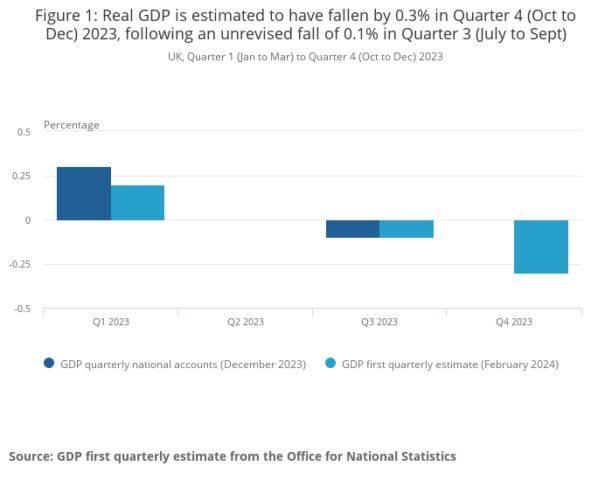
The UK has entered recession after new figures show that the country’s GDP fell 0.3% in the last quarter of 2023 after weaker retail sales in the run-up to Christmas because of the cost-of-living crisis. The news will come as a blow to the government who had promised to boost the economy.
The Office for National Statistics (ONS) said GDP fell by a larger than expected 0.3% in the three months to end of December 2023, which followed a drop of 0.1% of falling national output in the third quarter of last year.
A recession is defined as two consecutive three-month periods where the economy contracts rather than grows.
“In output terms in Quarter 4 2023, there were falls in all three main sectors in the latest quarter with declines of 0.2% in services, 1.0% in production, and 1.3% in construction output,” ONS said.
Sales in the Christmas period did not reach expected levels, the ONS said, with a fall in retail trade – and in personal services such as beauty and hairdressing.
ONS said they now estimated that services output decreased for three consecutive quarters, with a fall of 0.2% in the latest quarter.
The largest contributor to the fall in total services was a 0.6% fall in the wholesale and retail trade; repair of motor vehicles and motorcycles sub-sector. This was largely because of a 1.3% fall in wholesale trade, except of motor vehicles and motorcycles and a 0.9% fall in retail trade, except of motor vehicles and motorcycles, the statistics office said.
Their December 2023 bulletin showed that the month recorded the largest monthly decrease in retail sales since January 2021, when coronavirus (COVID-19) restrictions were in place.
Education also contributed negatively to the fall in services in Quarter 4 2023, with a decline of 0.8% partially attributed to a drop in school attendance, the office added, estimating that other service activities decreased by 2.4%.
“This is the third consecutive quarterly fall and the largest quarterly decline in this sub-sector since Quarter 1 (Jan to Mar) 2021,” they said.
“The fall in Quarter 4 2023 was mainly driven by a 3.4% fall in other personal services, where we have seen particular weakness in hairdressing and other beauty treatment over the Christmas period compared with usual.”
“The largest positive contribution to services growth was from administrative and support service activities, which increased by 0.6%, driven by growth of 6.9% in rental and leasing activities.”
Reuters correspondent, Andy Bruce, said that the ONS numbers showed that GDP per person had dropped every quarter in 2023 – and hadn’t grown in almost two years.
GDP per capita provides a basic measure of the value of output per person, which is an indirect indicator of per capita income.
Two quarters of contraction of real GDP will get headlines, but maybe this is the real story 👇
💥 GDP per person dropped every quarter of 2023. It hasn't grown since Q1 2022
💥 That's 7 quarters – longest unbroken run without per capita GDP growth since records began in 1955 pic.twitter.com/bknjT5TlMy— Andy Bruce (@BruceReuters) February 15, 2024
The figures will come as difficult news to Conservative Prime Minister Rishi Sunak, who had made a promise to grow the economy one of his five priorities.
It comes as some pollsters predict a landslide for opposition party, Labour, in the national election later this year.
However, UK Chancellor Jeremy Hunt said the recession was largely caused by high inflation and spiking interest rates, and that he believed the recession would be shallow as the economy was now turning a corner.