Debra Ireland, the charity which supports those living with epidermolysis bullosa (EB) has asked the government to invest in care for the rare and incurable skin condition for the second year in a row.
Last year, the charity failed to secure dedicated funding in the government’s €11 billion budget, and has reiterated calls for help – saying that for the cost of two coffees per person living with EB in Ireland per day, a real difference can be made in the lives of those with the genetic condition.
The condition, which is also known as ‘Butterfly skin’, occurs when there is an absence of the proteins needed to bind different layers of the skin together. This creates excruciating blistering and tearing with the slightest touch or movement. The most serious cases of EB require bandaging every 24 hours to prevent infection.
The charity, which works with people impacted by EB and their families nationally, is committed to raising awareness around the sometimes unheard of condition, which causes the skin to become extremely fragile. Debra Ireland is the largest funder here of EB research, and drives research into treatments and cures for the various types of EB.
Alejandra Livschitz, Head of Communication at Debra Ireland, told Gript that funding is crucial, with the organisation relying on donations to provide crucial supports to the roughly 300 people living with EB in Ireland. Funding from the government would go towards mental health support, home nursing care and outreach care for those with EB in Ireland.
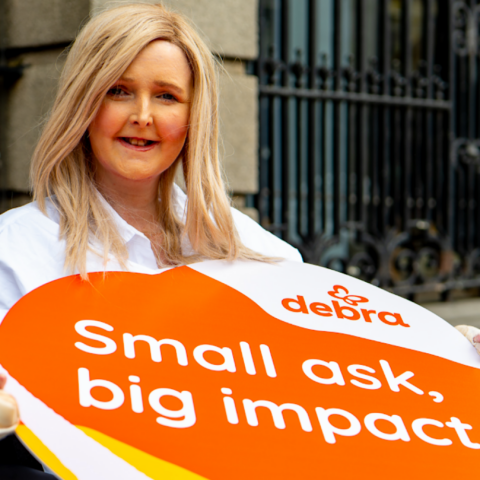
She explained that Debra are asking for just €810,000 to be allocated in Budget 2024 to support those with the extremely painful condition. Debra’s ‘Small ask, Big impact’ Pre-Budget Submission makes four requests of the government, including a care coordinator with the HSE to connect Ireland’s EB community to key supports.
People with epidermolysis bullosa (EB) shouldn't have to fight for basic care.
For the second year in a row, we're asking Government for €810,000 in #Budget2024 – just 0.003% of the €23 billion health budget – less than the cost of 2 coffees a day per person with EB.
Join… pic.twitter.com/CcfFSBhokV
— Debra – The Butterfly Skin Charity (@debraireland) June 28, 2023
Ms Livschitz told Gript that the group is seeking a tiny percentage of the current €23 billion health budget. Highlighting the mental and physical trauma, and lifelong pain associated with the condition, she said that those with the condition can go under the government’s radar.
The rarity of the condition should not, however, detract from the severity of EB or the urgent need for better supports, Ms Livschitz says.
“In terms of what we are asking the government for – when you put it into the context of the entire budget – it is not a big amount. It equates to just €7.50 per day for each person living with EB in Ireland. That’s all we’re asking for,” she said.
‘VERY MINIMAL SUPPORT FROM THE GOVERNMENT’
“When calculated, the €810,000 we are requesting this year, after not securing any dedicated funding in last year’s budget, is 0.003% of the total health budget. This funding, however, is hugely important for people with the condition, and will really help to build a better quality of life for those we support.
“We get some support from the government but most of our income comes from donors and supporters. We understand there are many important priorities in health, but people with rare diseases such as EB cannot be forgotten about. It’s really difficult to comprehend the lack of funding for EB because it really is a small ask.'”
She said that not only is the disease rare, but it is often overlooked when it comes to medical research, which has resulted in a need for research to be done. Debra is currently funding EB research projects in Ireland in the hope that it can move the needle forward for a potential new combination of treatments for the chronic condition.
Even though a one size-fits-all cure would not be possible with each form of the condition being incredibly complex and specific, Debra believes life with the condition can be improved for sufferers through finding a specific combination of new treatments.
“That’s what we are advocating for,” she says. “This will hopefully lead to a better quality of life for the hundreds of people in Ireland with EB.”
Ms Livschitz said people living with EB shouldn’t have to fight for basic care in this country.
“There are not enough supports in place for people with EB, and not enough awareness of the condition. it could happen that someone may go to a doctor’s appointment, but the doctor may not know how to diagnose EB, or they’ve never heard of EB.”
“Any chronic condition has such a huge impact on somebody’s mental wellbeing and emotions, so this is hugely important.”
Financial need is there as well, for people living with EB and their carers, because medical supplies are expensive and carers are often not able to work, which has a knock-on effect on families.
Debra is committed to shining a spotlight on the condition and increasing awareness, so that EB, which a person is born with, can be diagnosed quickly.
Over half a million people have EB worldwide, and it is estimated that one in 18,000 babies born in Ireland are affected by EB.
Ms Livschitz said it is important to remember that there is “no one-size-fits-all” treatment or approach for EB, which takes four forms: EB simplex, junctional EB, Dystrophic EB, and Kindler EB.
EB simplex (EBS) is the most common form of EB both in Ireland and worldwide, according to Debra. Those born with this form of the condition are missing a protein within the upper layer of the skin, the epidermis, which would usually help bind the skin together. Approximately 70% of people with EB have EBS.
Junctional EB (JEB) is a rare moderate-severe form of EB affecting the basement membrane, the structure that keeps the epidermis (outer) and dermis layers together, meaning the skin breaks apart easily causing blistering.
Dystrophic EB (DEB) can be less to more severe depending on the subtype. It affects the lower layer of the skin – the dermis, which is where the blistering occurs – while Kindler EB (KEB), previously known as Kindler Syndrome, is a rare form of EB. Blistering can occur in all layers of the skin or internal organs but tends to affect the extremities.
‘THAT’S NOT OK, THAT’S NOT GOOD ENOUGH’
“No EB journey is the same,” she says. “What we are doing through our budget campaign is asking the government to prioritise what we have identified from the lived experience of those with EB.
Claudia Scanlon, Aoife Murdock and Emma Fogarty all live with EB.
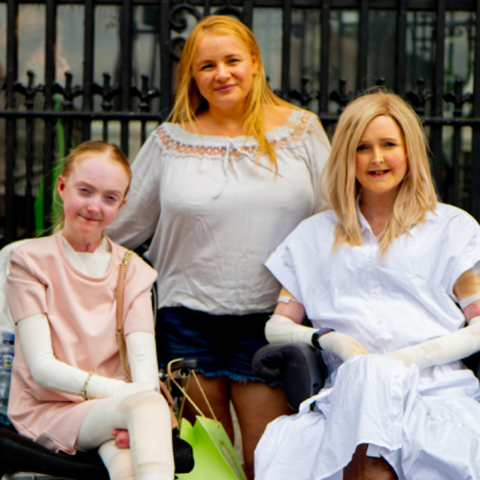
Earlier this summer, the three women attended the launch of Debra’s Pre-Budget Submission outside the Dail:
Wonderful to meet with @hoeyannie at the launch of our pre-budget submission to discuss the needs of people living with epidermolysis bullosa (EB).
A huge thank you to @labour @ivanabacik for your ongoing support.
▶ https://t.co/73Usy1B3SZ #Budget2024 #SmallAskBigImpact pic.twitter.com/6MXdND3YrW— Debra – The Butterfly Skin Charity (@debraireland) June 28, 2023
Emma, from Abbeyleix, speaking at the campaign launch in June, said that her mum was doing her dressings up until she was 28.
“That’s not ok, that’s not good enough,” Emma said, adding:
“It’s cruel on me and my mother. There were days when I was screaming in pain, and she felt she was causing it. She wasn’t causing the pain; EB was.”
For people with the most severe forms of EB, up to 80 per cent of the body can be covered in open wounds, which have to be bandaged at all times in order to prevent infection. Bandages must be changed every 24 to 36 hours for those people, and specialised care is needed at all times.
Another young female with EB simplex is 12-year-old Sophia, who’s passion in life is sport – especially football. Sophia, who has EB simplex, suffers from burning, stinging and blistering after playing the sport she loves.
“I have a skin condition called EB simplex. My feet burn, sting and blister after playing. They feel like they’re on fire. This is extremely painful and makes me sad,” Sophia said
The continued support Sophia receives from the charity has helped her to access the resources she needs.
Sophia (12) loves playing sport, especially football, but her skin suffers from painful blisters. Her journey with football hasn’t been easy.
“I have a skin condition called EB simplex. My feet burn, sting and blister after playing. They feel like they’re on fire. This is… pic.twitter.com/mUQy4FsCMf
— Debra – The Butterfly Skin Charity (@debraireland) July 20, 2023
The organisation is seeking a meeting with the government to discuss their requests and, thanks to the charity’s supporters across the country, pressure is building. So far over 1,800 messages have been sent to the Minister for Health asking that EB be prioritised in next month’s Budget.
Debra is continuing to encourage people to support their campaign on Twitter and Facebook.