As a bit of a history anorak I would like to share something with you that I never knew until recently.
Most with even a passing interest in history or even a Netflix subscription will have heard of the Salem Witch Trials. They took place in 1692 and 1693. In all, 20 people were executed and that was the end of the Protestant witch hysteria in the English colony of Massachusetts.
None of the Salem victims were Irish but I was intrigued to discover that a “witch” burned in Boston in 1688 had not only been Irish but had a personal story that goes far beyond the Protestant religious element to the hysteria that gripped the New England colonies for a time.
Her name was Ann Glover and, despite her surname, she was not only an Irish Catholic but an Irish-speaking Catholic – which was both the reason for her having been in Boston in the first place and, it would seem, the main contributory factor in her killing by the cousins of the folk who had stolen our land and transported our people as slaves.
I found a reference to her in an essay, ‘An Ghaeilge i Meiriceá’ written by the late Proinsias Mac Aonghusa in which he refers to trial reports that claimed that while Ann Glover could still understand English that she could only speak Irish and that she required an interpreter. According to another report her fate was sealed when the court demanded that she recite The Lord’s Prayer and could only do so in a mixture of Irish and Latin.
A contemporary apologist for her trial and execution, Cotton Mather, described her as “a scandalous old Irishwoman, very poor, a Roman Catholic and obstinate in idolatry.” It is believed that her devotion to the saints, and perhaps to Mary, may have been adduced as evidence of contact with Satanic demons. It was all the same to the Puritans.
She apparently died refusing to confess and telling her murderers that killing her would not make the sick children she was accused of cursing any better.
Her surname would not suggest a Gaelic origin but there might be several explanations for that. She might have been “married” to an English settler in Barbados where it is believed by some she was first transported. Or she may merely have been given the name of the trade she was set to, making gloves, a common practice among lower ranks for centuries.
What is clear is that she came to be in Boston in the same hands as those who were stealing and murdering in the land from which she had been taken.
I have looked previously at the spurious claims to connect the Irish people as a whole with the slavers of English descent who had stolen land in Ireland prior to expanding their civilising influence to the Americas. What we also need to be reminded of is that it was the same class with its roots in the Cromwellian conquest in particular which had also sent Irish people abroad as slaves.
To even mention this was “racist” during the height of the George Floyd/Black Lives Matter cult when certain people – including some whose own background make them far more likely to have a connection to the vile trade in African slaves – were intent for their own purposes in having us responsible for the legacy of slavery. Lots of Pollyanna fools were, and are, only too happy to oblige, of course.
Obviously, in that context, pointing out that Irish people had been slaves in the Americas was not helpful to the project. But they had been. The only weak counter to that has been the claim that some of the numbers cited in “memes” are not accurate. It is interesting that some of the same people who jumped on those inaccuracies went to great lengths to conceal the real personality and criminal record of the chap who they had adopted as an icon.
They also claimed that the Irish in the Americas were not slaves but “indentured servants”, as though thousands of Irish people – in a country that had just been devastated by a colonial war of expropriation and ethnic and religious cleansing to make way for the same sort of people who were doing the same from Jamaica to Connecticut – were on the 17th century equivalent of the “Year in Oz” or the J1 visa to work and kick football in Chicago.
Liam Kennedy, who already in his 2016 book Unhappy the Land had sought to show how just about everything about our history was no more than whinging, was not slow to jump on the BLM-inspired bandwagon. It was timely as another swift kick to the ribs of backward Catholic nationalism attempting to revive its sorry corpse on the back of the “slavery myth.” This chap is a professor in the UCD Clinton foundation institute.
It is suggested Ann Glover ended up as a servant to an English Protestant settler family, the Goodwins, in the English colony in Massachusetts, having come there from Barbados. She had clearly not gone to Barbados voluntarily, nor did the tens of thousands of other “indentured servants.” They were there because they were forced to go to the Caribbean, to provide cheap labour for the English settlers.
It is remarkable indeed that even “left wing historians” who have no difficulty in accepting that the English navy in the late 18th century largely consisted of people who had been forced into service by Press Gangs – more than 60,000 and largely made up of Irishmen, some victims of the Terror of the 1790s, at the time of the Battle of Trafalgar – mock the very idea that the same class might have forced Irish people into indentured slavery. Forced, as in abducted them, just as sailors were abducted to fight for Nelson.
That programme of forced labour of Irish people overseas has been documented as having begun in the second decade of the 17th century and lasted for at least most of the rest of the century. There is evidence of Irish “servants” in Bermuda around 1612; of a 1625 proclamation recommending the transportation of Irish “rebels”; of Irish servants in Guiana in the 1620s, in Antigua and Montserrat in the 1630s – and that the majority of the population of some of the sugar islands were Irish servants.
A commonly agreed figure for the population of the English colonies in America in 1700 is 260,000. It is believed that between half and two thirds of those were indentured servants. A large proportion if not a majority of those involuntary settlers may well have been Irish too. Like Ann Glover.
One of the “memes” seized upon by Liam Hogan and others to “debunk the slavery myth” is that 300,000 Irish people were sent to the Americas. Any of the serious referenced material I have seen cite figures of between 50 to 60,000 with an upper estimate of somewhat over 100,000. Hogan himself admits somewhere that it is impossible to know the actual number. Whatever his intent, others with ulterior motives just cite it as disproof of the very fact of forced transportation on a large scale.
Sometimes it is best – as we did when previously examining the ideology and demographic projects of the settlers from Cambrensis to Spenser to Petty – to read what they themselves knew and thought at the time all of these things were happening to our people. They were more honest than their latter day Irish apologists, for sure.
So I will leave you with what one London publication in 1742 had to say about the transportation of the indentured servants to the Caribbean, which was that it
“was a measure beneficial to Ireland, which was thus relieved of a population that might trouble the planters; it was a benefit to the people removed, which might thus be made English and Christians … a great benefit to the West India sugar planters, who desired men and boys for their bondsmen, and the women and Irish girls… To solace them.”
Perhaps that is how Ann Glover became Glover rather than the name by which she had been christened?
Southies in Boston remember even if we mostly do not.
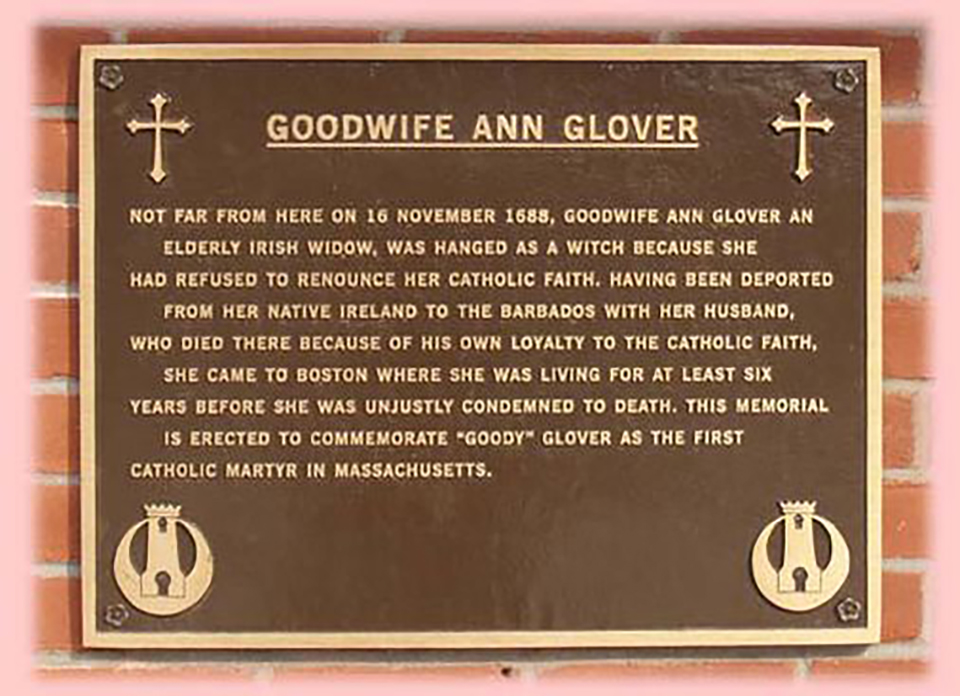
A photo of the Goodwife Ann Glover plaque in North End, Boston, Massachusetts. Photo: Jess Olsen, Wikimedia.