The Countess has been highlighting the safeguarding issues arising from gender ideology and its widespread adoption in Irish society for four years. Schools and Safeguarding Working Group lead, Judith Murphy, a retired social worker, gives a deeper insight into why gender identity theory is such a major concern for safeguarding.
I have worked as a Social Worker in Chid Protection for 19 years. Over the years, I followed the introduction of gender-identity – theory with alarm. My main concern is the increasing exposure of children and young people to this theory through online content, schools, policies, and legislation.
State bodies have adopted gender-identity-theory as fact*. LGBT support and awareness organisations and policies increased significantly, mainly around the “T” (Trans).
Many state bodies have adopted gender-identity theory as fact, including the Department of Education and the Department of Children.*
The drastic changes in legislation and government policies were made at the behest of transgender lobby groups, including TENI (Transgender Equality Network Ireland) and BelongTo. These groups are put forward as the experts on the needs of trans-identifying people, including trans-identifying children.
BeLongTo and other LGBTQ+ organisations train teachers and youth workers on how to support trans-identifying and LGB children and young people. This training promotes the affirmative model, which relies on social transition and medicalisation as a solution to a temporary crisis of identity.
Young people are coming into contact with ‘trans content’ through many channels, including SPHE classes in school. The Junior Cycle SPHE curriculum defines gender identity as ‘a person’s felt internal and individual experience of gender, which may or may not correspond with the sex registered at birth’. This shows that the NCCA promotes the doctrine of gender-identity-theory, that everybody is born with an innate gender identity. SPHE and CSPE schoolbooks contain these statements as fact.
GENDER IDENTITY TAUGHT IN SCHOOLS
The existence of a gender identity, separate from the sex observed and registered at birth, is unverifiable, unfalsifiable, and unknowable. That this theory or belief is taught in Irish schools as fact has become a very controversial issue.
Many parents are not aware that their children are taught this, others might agree or disagree that everyone has a gender identity. The views of teachers, principals and social workers also varies greatly on this subject.
This situation is causing some confusion, tension, and conflict for teachers, parents, and children. We have already seen conflict around this issue.
When adults create a situation that puts children at the centre of a conflict between them, it is the adults’ first duty to the children to find a solution to this conflict, because this is in the children’s best interest.
If I was asked for a solution, I would recommend that the Department of Education and schools be transparent about the content of SPHE lesson plans and respect parents’ wishes. I suggest that parents should be offered the same training and guidance as teachers, so that they can make informed choices for their children.
Parents are their children’s primary carers and educators. Schools do not have the right to teach children a novel belief as fact without parents’ expressed consent, nor do they have the right to keep incidents or issues regarding their children from them, as they are acting in loco parentis. This would be an undermining of parents’ rights. Some schools/teachers have inappropriately adopted the role of co-parents.
LIE TO PARENTS?
In this context it is very concerning that the Irish LGBTQ+ Youth Support Service BelongTo advises teachers and youth workers in their training manual ‘not to out children to their parents/guardians’ and that they should, if directly asked about a child ‘s sexuality/gender by a parent, lie and say, ‘I don’t know’
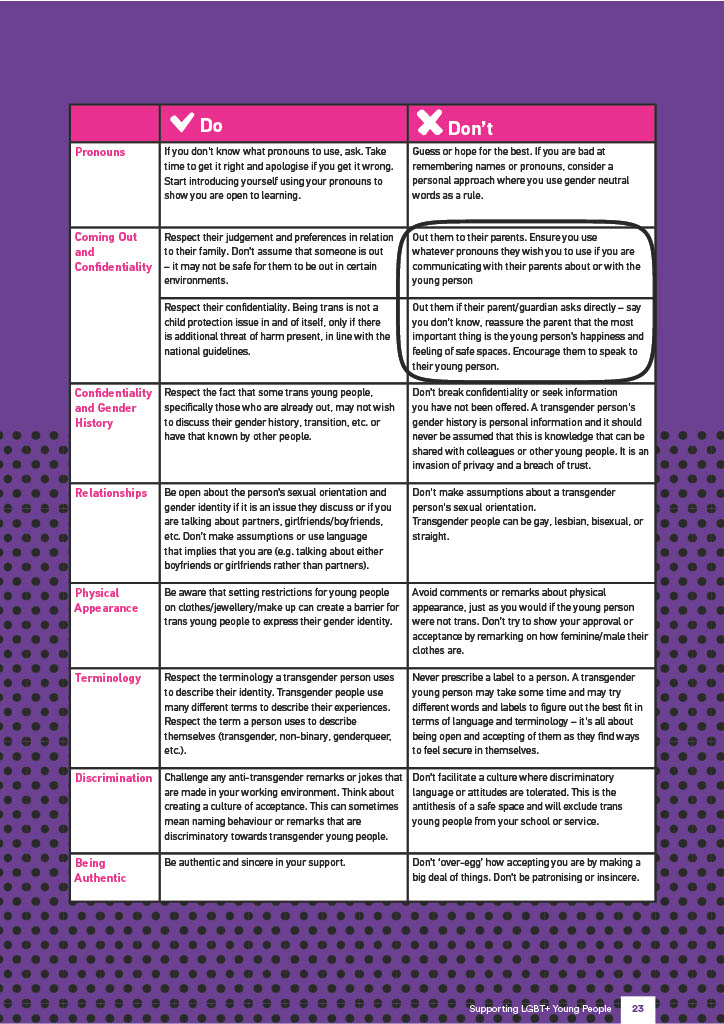
The rationale for this advice is ‘being transgender is not a child-safeguarding concern’. It appears that BelongTo confuses the role of teachers with that of a professional therapist, who with consent of parents, agrees that in a therapeutic relationship the therapist will keep confidentiality, with the caveat that if the child discloses something that indicates a child safeguarding concern, the parents
(unless they are the source of the protection concerns) and Child Protection Services need to be informed.
A teacher is not a therapist and is obliged to inform parents of any significant issue or incident regarding the child. BelongTo’s concern is that a child might be harmed by parents’ refusal to affirm a child’s trans identity relies on the lie — that the risk of suicide is elevated among people who are not affirmed in their gender identity.
Teachers with concerns about a child’s safety have a professional obligation to follow the Children First guidelines and report this child protection concern to the local Social Work Department.
If a teacher follows BelongTo’s guidance, he or she is violating parental rights, and undermining basic safeguarding principles, including:
- A trusted adult should never keep a secret with a child,
- Do not undermine the authority of parents,
- Do not collude with the child against the parents, and
- Do not interfere in the parent–child relationship
Social workers who learn of anything that impacts the child must inform the parents, even if the child asks them not to.
The only exception to this rule is when there are concrete indications that the child would be at risk of harm if parents were told. In that case, the social worker needs to have this signed off by their line manager. BelongTo’s advice to teachers is clearly in breach of these safeguarding principles.
It is irresponsible to suggest that it is acceptable and safe for teachers to decide to keep something as fundamental from the parents as a child declaring a trans identity, and deeply concerning that this is sanctioned by the Department of Education and Skills.
There are reports of schools socially transitioning children without parents’ consent and knowledge in other jurisdictions. If this were to occur in Ireland, it would be a major breach of parental rights.
SOCIAL TRANSITIONING NOT A NEUTRAL ACT
Social transitioning is a profound psychosocial intervention, it is not a neutral act. A teacher does not know the impact this has on the child.
It is common for children to feel uncomfortable in their growing bodies and feel they might not be a real boy or a real girl. Most of them develop into adulthood, reconciled with their gender. When adults confirm a child’s idea that they are a different gender than their sex, they diminish this child’s ability to change their mind, because if a trusted adult says it, it must be true. Even if the child changes his or her mind, it would be extremely difficult to admit, when the adults had believed them supported them, and helped them to transition.
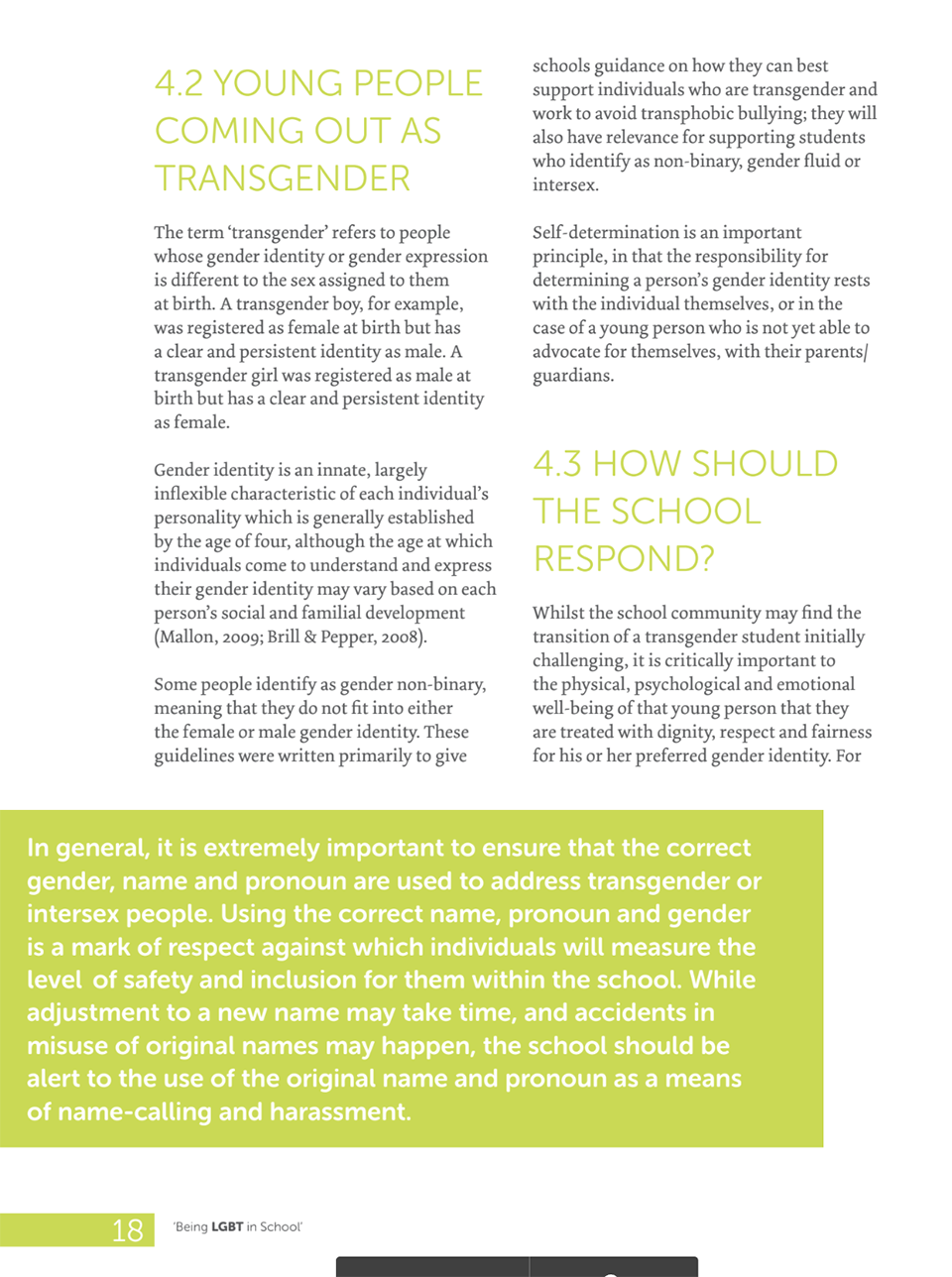
BelongTo, TENI and other LGBT organisations advise schools to affirm a child’s claim to be ‘trans’ and to use their preferred name and pronouns, with the support of the Department of Education, as outlined in the Being LGBT in School.
To socially transition in school places a child/young person on the first rung of the ladder to seeking medical treatment in the future, which puts a huge medical burden on that child. The child and the family have to deal with the consequences, – not the teacher. The rest of the class are also affected by the affirmation of a child in their school. The teacher does not know how the other children might be affected by this intervention. They have to accept that their classmate has changed gender, whether they are okay with this or not. Their needs are not considered, and their boundaries are being breached.
Socially transitioning a child or young person in school would also be breaching safeguarding principles, such as that a trusted adult should not cross children’s boundaries.
Should a school socially transition a child or young person without parents’ knowledge and consent, it would violate parents’ rights and interfere unduly in the family’s life.
This would also breach an important safeguarding rule that an adult should not keep a secret with a child from parents nor ask children to keep a secret.
CHILDREN WITH ADITIONAL NEEDS
Most children, but especially children with learning disabilities, or children on the autistic spectrum cannot grasp what terms like trans, gender-identity, and non-binary mean, and often think they can really change sex.
Children who are struggling with mental health or identity issues might be easily persuaded that their difficulties would be resolved if they became a different person. The Cass Review’s final report, the independent review of the NHS Tavistock Clinic’s Gender Identity Disorder Service, confirmed this.
The Cass report found that a high percentage of children who were referred to the clinic had
- a diagnosis of autism
- mental health diagnoses
- experienced trauma
- been children in care
- multiple diagnoses
As a social worker, I am aware that it takes all of childhood and adolescence to develop an identity.
Children with negative and traumatic life experiences often find it extremely difficult to develop a positive identity. They often feel they are unlovable. The promise to be able to escape from who they are can be very tempting. The accounts of some detranistioners, -young people who had transitioned, regretted it later and reverted to identifying as their birth sex, – confirm these concerns are valid.
Many say that they feel betrayed by the adults who allowed them to make a decision, when they were too young to comprehend the long-term consequences and impact on their health. They were misdiagnosed and harmed by affirming care.
It is my considered view that interfering with the process of identity development puts children at risk of not developing to their full potential and of being physically and emotionally harmed.
Gender-identity-theory does not take the process of childhood development into account, especially the process of identity formation, the lack of children’s ability to make decisions that have long-term consequences, and children’s cognitive ability to grasp complex, abstract concepts. Vulnerable children are being influenced unduly and are trusted to make decisions they are not equipped to make.
SAFEGUARDING
A central child safeguarding principle is that trusted adults need to guide children and not allow children to take on responsibilities they do not have the capacity to take on. This not taken into account in the sphere of gender identity.
Gender-identity- ideology demands that we ignore this basic safeguarding principal, among others, and immediately affirm a child as soon as they declare a gender identity different from their biological sex.
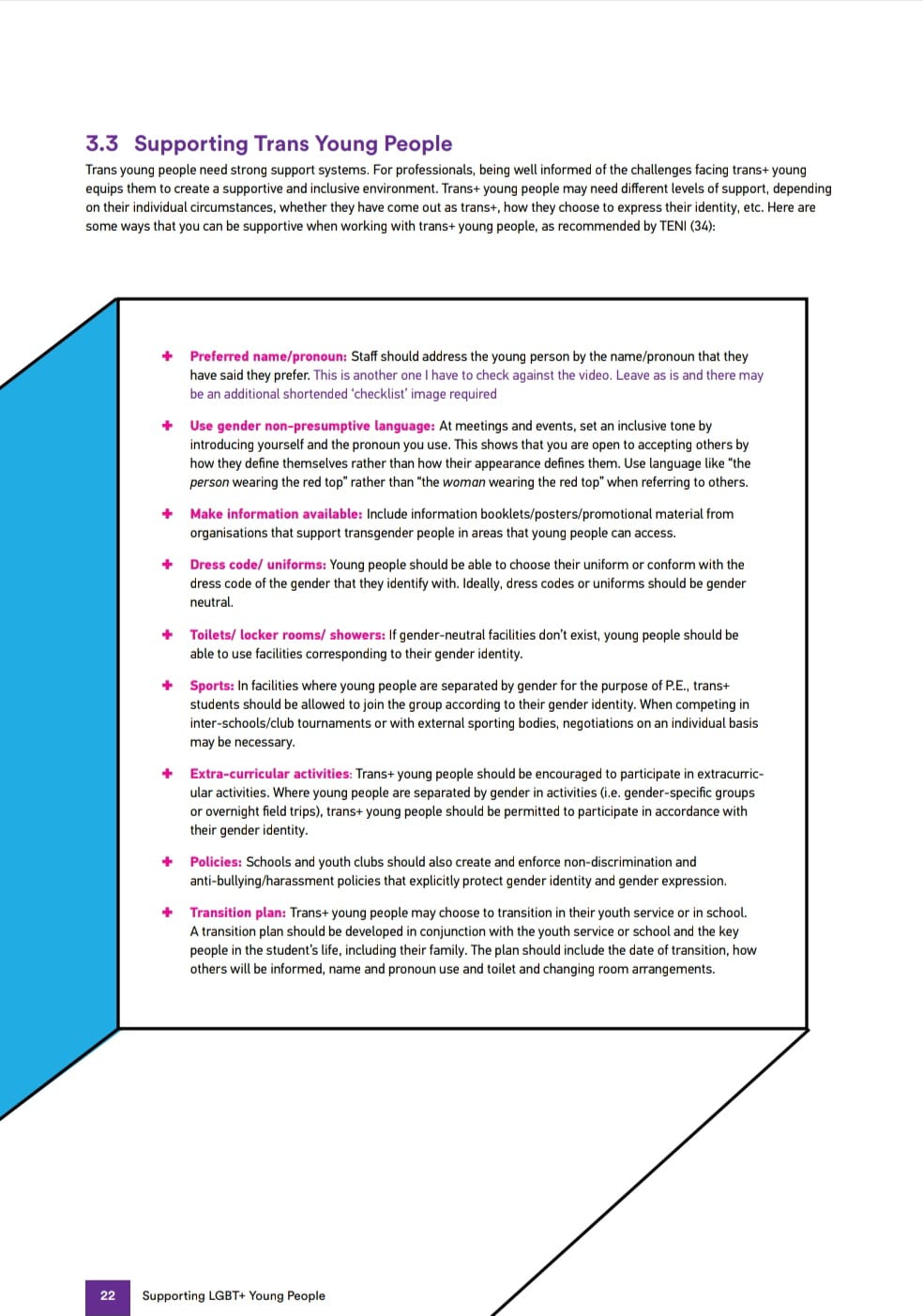
BelongTo’s guidance for schools and youth organisations is that trans or non-binary studends should use the single sex facilities and engage in single sex activities according to their gender identity is of concern. This means that boys are to be admitted into girls’ sports and spaces, although there is no legal obligation for schools and youth organisations to do so.
Worryingly, BelongTo’s advice is already being followed in some Irish school, youth and sport clubs, and is causing child safeguarding concerns. Boys – and potentially men- who identify as the opposite sex in girls’ intimate spaces and sports teams, puts girls at risk of sexual and physical assault and undermines girls’ dignity.
There are valid reasons for insisting on single-sex spaces. Both sexes value their privacy. In particular, girls require separate spaces from boys because boys are stronger and more aggressive than girls.
The Gender Recognition Act 2015 and government policies treat trans-identified adults as persons of their preferred gender with the right to enter single-sex spaces of their preferred gender. This compromises the safety and boundaries of girls. The presence of a biological male adult in girls’ spaces is also clearly problematic.
Girls need to be protected from men and boys because some pose a risk to them. Trans-identified men and boys pose a risk to girls for exactly that reason. They are men and boys.
To be known as a sex offender has severe consequences, but this deterrent is not strong enough to stop abusers from offending. There is no evidence that this would be different for males who identify as girls or women. In fact, studies show, and the website transcrime uk documents, that convictions of trans-identifying offenders and their behaviour patterns match those of the offender’s biological sex.
The Stay Safe programme, taught in Irish schools, teaches children to run away and tell a trusted adult when somebody makes them feel uncomfortable. This message is undermined when girls are told to ignore the fact that a male in their single sex spaces makes them feel fear and embarrassment. Girls no longer have the power to keep themselves safe.
SOCIAL MEDIA
Children spend considerable time on the internet, where they are exposed to content about being trans and non-binary from peers, but also from adults. Some advice young people to have no contact with their parents if they won’t agree to affirm their gender-identity. The best-known of these adults, queer influencers is Jeffrey Marsh, a man who identifies as non-binary.
He tells children that their parents do not understand them and do them harm if they don’t affirm them, but that he will be there for them because he loves them unconditionally. This is the most irresponsible behaviour by an adult.
He has videos on many platforms, including TikTok with hundreds of thousands of followers.
Parents are the most ardent protectors of their children. To undermine parents and pit them against their children is damaging, and irresponsible.
If I, in the capacity of a social worker in the statutory child protection agency, had come across an adult in a child’s life who told a child that sex did not matter, who had allowed biological males into girls’ intimate spaces and sports, undermined the parents’ authority, had not informed parents about an important matter regarding their child, and/or had socially transitioned a child without parents’ consent and knowledge, I would have considered this person an unsafe adult around children. This assessment would have been widely regarded as well founded and reasonable. It would not have been controversial.
Because gender-identity theory is not based on observable reality and because it teaches children that biology is irrelevant and should be ignored, it is putting children at risk of emotional and physical harm.
This is why I have come to the conclusion that gender-identity doctrine is not compatible with child safeguarding.
======================================
*
- Department of Education: Being LGBT in School Document: https://assets.gov.ie/24762/729f5d8906184a6a8c4be0c5e2a349dd.pdf
- Department of Children, Equality, Disability, Integration, and Youth: Final Report of the Implementation of the LGBT National Youth Strategy 2018 to 2021 Document: https://www.gov.ie/pdf/?file=https://assets.gov.ie/297288/5a49b786-bcb4-4459-ac06-a152a744d19d.pdf#page=null
- Tusla, Child and Family Agency: Healthy Sexuality and Relationship, The education and Support Needs of Children and Young People in Care Document: https://www.tusla.ie/uploads/content/HSRD_Toolkit.pdf
- HSE, Health Service Executive: LGBT+ Sexual Identity and Orientation Document:
- https://www2.hse.ie/mental-health/life-situations-events/sexuality/sexual-identity-orientation/
The Countess has been highlighting the safeguarding issues arising from gender ideology and its widespread adoption in Irish society for four years. Our Schools and Safeguarding Working Group lead, Judith Murphy, a retired social worker, gives a deeper insight into why gender identity theory is such a major concern for safeguarding.