A proposed new 293 MW gas powered electricity generation plant in Dublin has been given the go ahead despite having being previously denied permission, and despite prior objections by environmental campaigners such as Friends of the Earth Ireland and Fingal One Future, who object to the use of fossil fuels.
When Fingal CC rejected the plans in Feb 2022, a spokesperson for Fingal One Future greeted the decision saying “Fingal County Council’s decision not to allow a new fossil fuel plant to go ahead shows its commitment to sustainable development.”
However, this statement shows a lack of understanding of renewable energy and how to generate reliable and sustainable energy. Understanding this issue also reveals why renewables are more expensive than fossil fuels energy. This can be summed up with two words; intermittency, and dispatchable.
Intermittency could more aptly be called weather dependent or unreliable, and dispatchable could more aptly be called “planable”, because dispatchable means you can switch it on when needed because it is powered by a fuel that can be stored and used when required.
The proposed Fingal plant is dispatchable.
What most people don’t know is that if you have intermittent energy sources you have to also have dispatchable backup or else you will experience power blackouts when the weather isn’t cooperating. This is a hidden cost of renewable because these backup power plants are not free.
The Fingal plant will cost €150 million and is effectively a backup generator to provide electricity when renewables can’t produce. It is estimated that it will run for an average of 46 hours a year.
Yes that is right: the plant will be used so little that it will be running for less than an hour a week, on average! It is a large outlay of money for such little usage.
The cost of electricity comes in two forms. There is a fixed cost and a running, or operating cost. The running costs include the fuel that is burned, lubricants, maintenance, management and wages. Some of these are fixed (wages, maintenance, etc) and depend upon the plants capacity; and some are semi-fixed (fuel, shift wages etc) and depend upon the amount of energy units produced.
On top of these operating costs, there is a capital investment cost of the plant (€150 million in this case) and this, over the lifetime of the plant is added as a fixed cost to each KWh of output.
If we look at the capital expenditure per KWh of this plant and assume that it has a life of 20 years (the standard approach is to assume depreciation of between 10 and 20 years) we find that there is a capital expenditure alone of 55.6c/KWh. That is just the cost of the depreciation of the plant. It does not include the running costs and generating costs. This cost will be added to the wholesale price that the regulator pays for electricity. The wholesale price for electricity in Ireland in April 2024 was 8.85c/KWh, so the cost of the electricity in the Fingal plant seems exorbitant.
So why would it be built? We can return to that question later.
People ask, and it’s not an unreasonable question: “if renewables are cheaper, why don’t we have more of that energy?”
After all, renewables such as solar and wind, just like any other form of energy generation have initial building costs, but after that, barring maintenance costs, it’s basically free energy forever – or at least for the lifespan of the equipment, which depending on the technology could last between 20 and 30 years.
(What to do with those wind turbine blades when they wear out, or those Solar panels when they reach the end of their productive life is a question that most enthusiasts for this technology seem slow to answer. That’s a separate question.)
So why is the build-out of renewable taking so long?
One assumption is that the fossil fuels industry is hampering the build out of renewables and is lobbying to keep the public dependent on fossil fuels. That is an assumption that many people in the environmental activist scene, such as our friends in Fingal One Future, seem to readily accept.
But this assumptions has a huge logical flaw. That renewable energy is being blocked by a conniving fossil fuel industry defies the clear reality that there is massive political and public consensus that “clean energy” would be preferable, even if there is a significant cost to the switchover. There is a will to implement a “green transition” the only real question is, “is there a way.”
As we have written here previously, a stable economy, or indeed a stable society, has to have reliable energy as a minimum. The public knows this in a tangential way, because whenever there is a blackout nothing works. We are used to the lights turning on when we flick the switch, when we don’t have this basic consistency we get very annoyed.
That’s only speaking of the disruption and inconvenience of unreliable supply to household consumers. Imagine how disruptive it would get if critical services, industry, and infrastructure were prey to blackouts. This is not a matter of a minor annoyance; the consequences of an unreliable base-load could mean death and massive irrevocable costs to society, and to industry and the economy.
Base-load supply is what in power management terms implies a steady consistent supply of power. Power is measured in watts (a Megawatt being 1 million watts) and it is the ability to do work.
Power is dynamic and it must be used as it is produced. If you don’t use it, you lose it. So for the power grid managers, they have to manage this balancing trick of producing just as much power as is needed at any particular time.
We call this dispatchable power, and as the name implies it is power, or electricity, production that can be planned by the second as it is required. We are using the term power and electricity interchangeably here.
There is a way around the dilemma of power only being available instantaneously. Power can be stored. We can think of the Lugnacoille reservoir as a big battery because, by pumping water up a hill to a reservoir, it turns electricity into potential energy. Whether it is stored in batteries or by converting electricity to fuel such as “Green Hydrogen” there is a cost to the storage of energy. Converting between energy types is a ‘lossy’ process and this is why we hear so much hopeful talk of green hydrogen while seeing so little results from the technology. This paper tells us that for every watt of electricity put into green hydrogen only 0.4 watts of work can be done with it. That’s a hugely ‘lossy’ system, as 60% of the generated electricity is lost in the process.
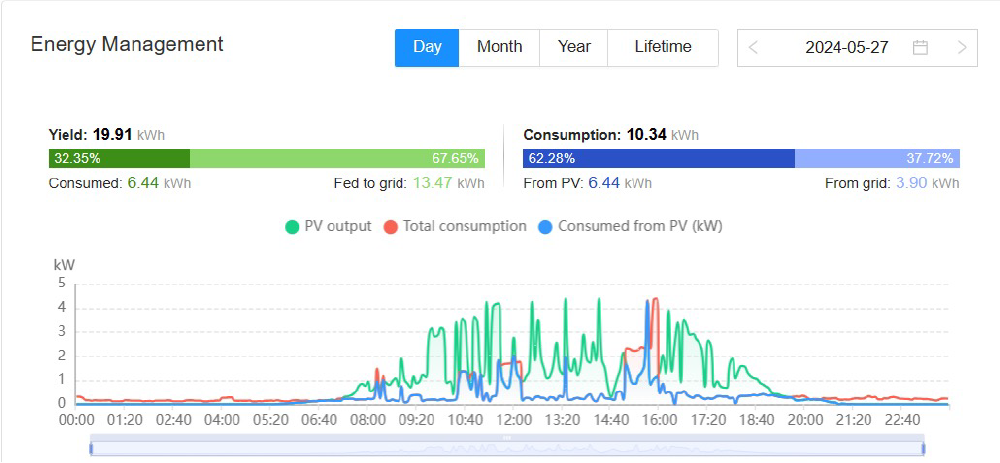
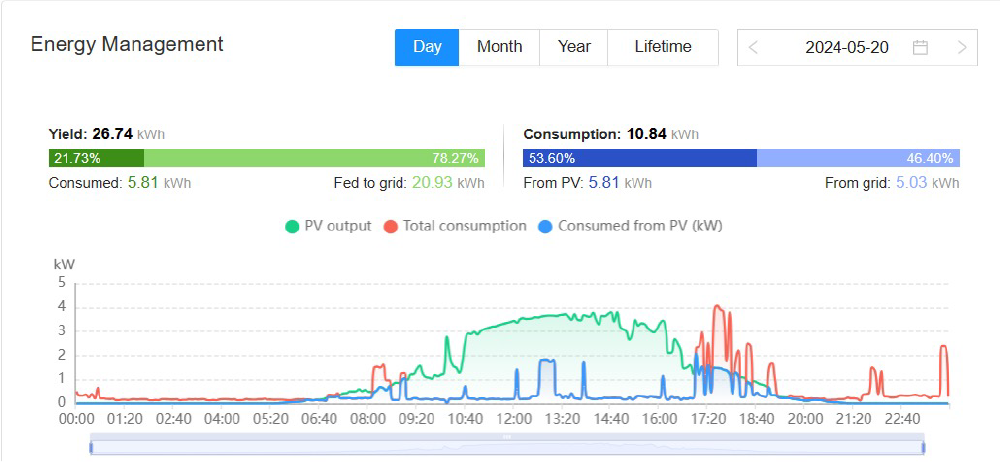
These daily snaps of a household solar panel system illustrate the problem with intermittency.
The first graph shows the power generation and consumption on a typical overcast day. This is a summer day with good visibility but high cloud cover. It is a 4.4 KW system
The green line is the instantaneous power output of the panels. The blue line is the power consumed by the household directly from the panels. The red line is the power consumed by the household from the grid.
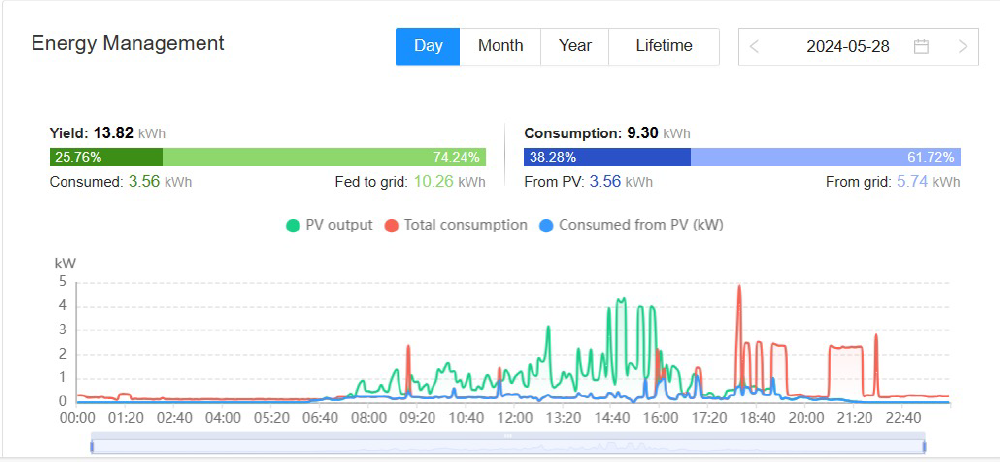
As can be seen the panels produced more power than was used by the household. However, the household cannot store the power so when there is no demand in the house, the excess power is fed to the grid. Overall the household consumed 9.3 KWh and produced 13.82 KWh, but it only used 3.56 KWh of the energy prouced by the panels. Most of the power it used was in a few heavy demand periods where the panels were producing no electricity.
This second graph shows a day with sunny spells which was generally overcast. As can be seen the panels oputput swings between 1KW and 4KW depending on whether there is direct sunshine (clouds or no clouds).
This day was sunny nearly all day and the panels were nearly at full capacity all day producing 26.74 KWh of electricity
The monthly graph shows that daily yields vary between 8 KWh and 26 KWh. This is the biggest issue with weather dependent electricity and the higher the mix of renewable in a grid the more planners and managers have to deal with this unreliability with strategic methods such as backup generation and high capacity storage.
A system of massive battery storage to account for this intermittency is not a feasible option.
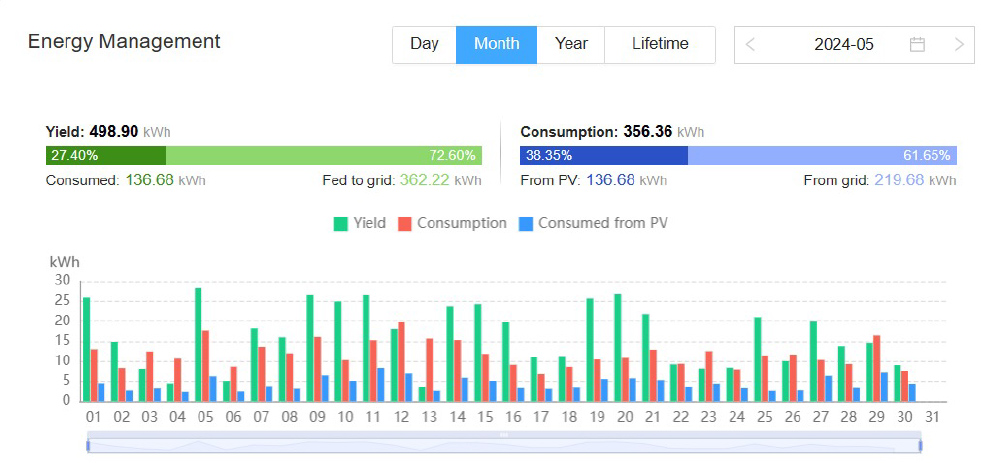
If we focus on May 23, a rainy day, we can see that the output was consistently low and peaked at 2 KW. The yield for that day was less than a third of the maximum yield that month. This is the intermittency problem we talked about.
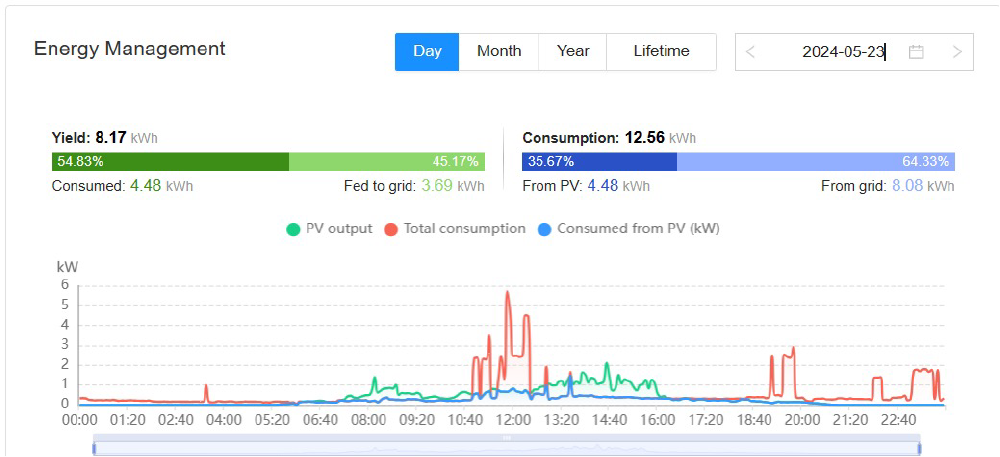
As above, so below! What happens at this household is the same as what happens over the grid. This household can export their excess energy to the grid, and import when their supply does not match their demand, and this solves their intermittency problem. In effect this household has offloaded their intermittency problem to the grid and its users. Any costs that that incurs are paid by the rest of the grids users. But how does the grid solve this problem if the grid is supplied by massive solar farms and wind turbines? Experience has shown that when the wind does not blow and the grid is heavily reliant on wind generation, the price of electricity can shoot up.
One way is to invest massively in storage, and in back-up plants like the proposed one in Fingal. Interconnectors between Ireland and other energy markets can help also, but this involves both transmission losses and massive infrastructure investments that have to be built replaced and maintained.
Do we know what this costs? Fortunately, we can examine the experience of Germany who have ploughed this furrow for a long time, so we can guess with the benefit of hindsight what the benefits and pitfalls of this policy are.
As we have now written here many times – here and here for example- that the German renewable policy has been something of a disaster for the German public and German industry.
Despite all the ambitious projections, in reality, Germany has not had success decarbonising. Comparing Germany’s emissions with nuclear heavy France revealed a shocking result:
A new study by the Organization of Economic Cooperation and Development (OECD) shows how Germany, between 2006 and 2017, increased the cost of electricity for households by 50%.
In 2018, German carbon emissions declined modestly, but only because of unusually warm weather and — ironically — higher nuclear output (4.9%) which grew more than renewables did (3.1%).
Promoters of renewable energy subsidies claimed in 2015 that the cost of electricity would peak in 2023, but the new OECD report concludes that electricity prices will increase as long as Germany keeps deploying solar and wind — in other words, indefinitely.
French electricity costs are just 59% of German electricity prices. As such, according to the prevailing economic wisdom, French electricity should be far more carbon intensive than German’s. And yet the opposite is the case. France produces one-tenth the carbon pollution from electricity.
Why? Because France generates 72% of its electricity from nuclear, and just 6% from solar and wind.
Germany’s claim to be a world leader in clean energy seems a cosmic joke On top of this German energy costs have risen at twice the rate as they have in low emissions France (France relies heavily on Nuclear, Germany is shutting down nuclear) and since 2007 have been consistently around 40% higher than the European average.
Consumers concerned about the environment might ask ‘but isn’t it worth it to achieve net zero?’ Well more and more people who have campaigned in the renewables sector, and understand the challenges, are changing their minds on this.
This former green energy executive, Brian Gitt, a twenty year veteran of clean tech says that, for the sake of humanity and the environment, we need to use more energy not less; and he says we should be focusing on natural gas and nuclear.
Returning then to why the Fingal plant, with its extraordinarily exorbitant cost of electricity, is being built. Zero carbon is a bit of a white buffalo and the further you get to realizing it, the more expensive electricity gets.
The 2030 climate target is to reduce CO2 emissions by 51% (with 2018 as a baseline number). The biggest contributor to emissions is energy production, and so the drive for emissions-free energy. As the renewables proportion of the energy supply increases, the cost of energy rises in a nonlinear manner. This is because of all the problems with weather dependent intermittency. It’s wonderful on a windy or sunny day, but incapable of meeting requirements when the conditions are not right. And so backup has to be built into the system no matter how costly.
It’s an iron fast rule. As the green proportion of the energy grid increases, the cost of the system and consequently, electricity, increases. If you want green energy, you have to pay more. How much more?
Well today, according to researcher Michael Shellenberger, Germany pays 41% more than the European average. This is after a decade of pursuing pro-scarcity policies and massive spending on renewable.
It’s not that surprising; if you make the generation of electricity more costly and also increase scarcity, the costs go up. No amount of waffle about a “just transition” can change that.