This week’s issue of The Economist, the world’s most respected news magazine, features the iconic Rosie-the-Riveter under the headline “Meet America’s Most Dynamic Political Movement”.
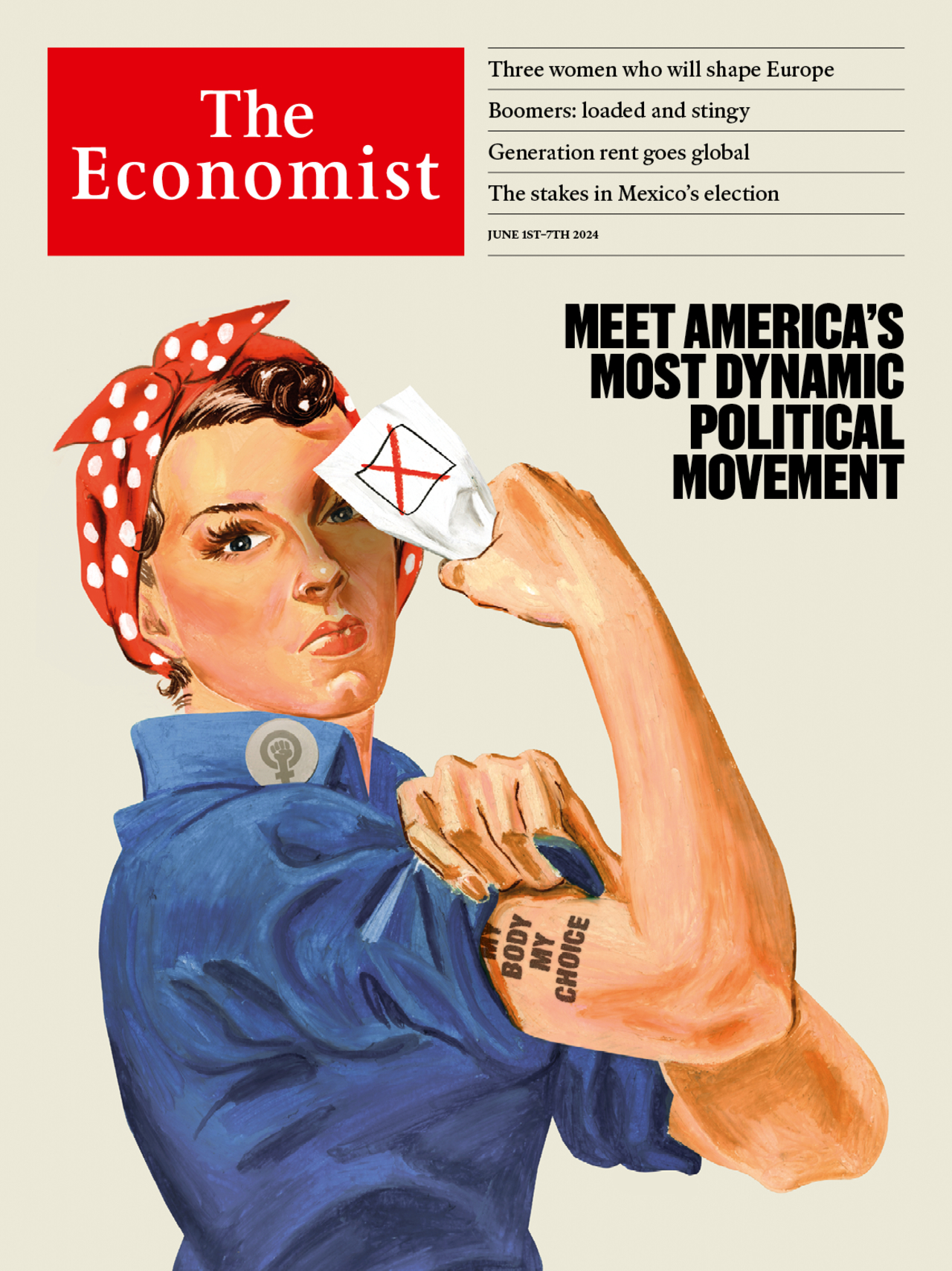
Intriguing. What’s old Rosie up to now, 80 years after D-Day?
It turns out that The Economist is touting abortion activism — not just as the most dynamic, but as the noblest, bravest, most altruistic, most democratic movement in the US in 2024. Its leader (editorial) describes it as: “a revolt of millions of Americans who think government has little business inserting itself into private decisions … [a] movement [that] will restore or fortify the freedom to choose.”
Mercator never has and never will support abortion. But it has been debated for half a century and there are arguments on both sides. In such a controversial issue, the business of the mainstream media is to report on both and to assess them in its editorial columns.
What The Economist has done is to step over the red line separating opinion from propaganda. At least on the topic of abortion, it has become more like China’s Global Times or Russia’s RT News.
The difference between the two lies in acknowledging the possibility, however remote, that the other guys might be right. And this The Economist does not do. A classic definition of “propaganda” notes that “to maximize effect, [the propagandist] may omit or distort pertinent facts or simply lie, and they may try to divert the attention of the reactors (the people they are trying to sway) from everything but their own propaganda.”
In its cover story, The Economist ignores completely the possibility that there is another side to the story. Those heroic women with clipboards collecting signatures for abortion amendments are foot soldiers battling mysterious aliens. We learn nothing about how many of these malignant beings exist (at least half of America), or why they oppose abortion (human rights), or whether they are women (half are), or whether they are the privileged elite (the poorer and less educated they are, the more likely they are to be pro-life). They have been cancelled
The magazine’s lack of curiosity is scandalous.
Propaganda differs from opinion in at least four ways:
- Propaganda always begs the question. In other words, it assumes that its conclusion is correct before commencing the argument. In this case, The Economist assumes that abortion is not merely morally neutral, but bold and virtuous.
- Propaganda always ignores the central issue. In this case it is the ethical status of abortion, which is killing a baby. Assume, for the sake of argument, that it may be necessary for some women. But it is pure propaganda to treat the three-syllable word “abortion” as if it were as innocuous as “bananas” or “cheeseburger”.
- Propaganda is always selective. Rather than confront opposing ideas, it ignores them. G.K. Chesterton captured this strategy well as long ago as 1909: “[News] may be so selected as to give a totally false picture of the place or topic under dispute. Selection is the fine art of falsity. Tennyson put it very feebly and inadequately when he said that the blackest of lies is the lie that is half a truth. The blackest of lies is the lie that is entirely a truth. Once give me the right to pick out anything and I shall not need to invent anything.”
- Propaganda always idealises supporters as heroic. Just have a look at Russian advertisements recruiting men for its “special military operation” in Ukraine. In The Economist’s feature, not only is Rosie the Riveter flexing her biceps defiantly against a 2024 enemy every bit as evil as the Nazis, but it portrays abortion activists as brave, generous supporters of grassroots democracy.
- Propaganda always assumes that its ideology is self-evidently true. In this case, The Economist, as Mercator has often pointed out, esteems autonomy as the highest of moral values. Even within this bleak and solipsistic framework, this ignores the fact that a foetus (or baby) has competing interests.
A newspaper or magazine loses credibility if its journalists fail to ask obvious questions. In this case The Economist praises “America’s Most Dynamic Political Movement” for organising an army of grassroots volunteers to canvass for abortion rights legislation. These are people:
giving up their weekends and evenings to try to persuade their neighbours of an idea they hold deeply. It is participatory and local, the kind of thing that de Tocqueville raved about after visiting the country back in 1831. It is how democracy in America is supposed to work.
Who could deny that many supporters of abortion rights are passionate? But are all these door-knockers genuine volunteers? Planned Parenthood is spending millions to promote pro-abortion politics this year.
A jobs website in North Carolina, for instance, is recruiting for PP:
We are currently hiring campaign staff to canvass door-to-door on behalf of Planned Parenthood Votes! South Atlantic to rally the vote for candidates who will protect our right to make our own decisions and keep the government out of our health care … All positions run through November 5th with possibilities for continued work afterwards. Shifts run between 1:00 PM – 7:00 PM with the possibility to work part-time or full-time.
Get paid well! Canvass positions start at $20/hour base pay. Leadership positions earn up to $21.50/hour. In addition, we offer overtime pay, paid training, sick pay, and bonuses.
Most dynamic political movement? Or best paid political movement? We deserve to know. Isn’t it the job of The Economist to ask challenging questions like this?
By publishing mawkish propaganda about abortion, The Economist is prostituting its stellar journalism. If it’s prepared to bend its ethical standards on the issue of abortion, whom will it be shilling for next? Ukraine? Russia? Hamas? Israel? Big Tech? Big Pharma?
Michael Cook is editor of Mercator. His article has been published with permission.