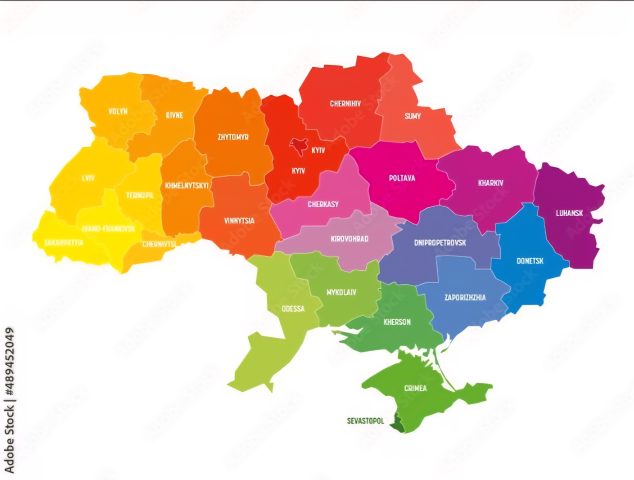
On Wednesday, the Swiss Federal Council decided that from November 1 it will no longer accept Ukrainian refugees from seven of the western Oblast administrative regions. They are Volyn, Rivne, Lviv, Ternopil, Zakarpattia, Ivano-Frankivsk and Chernivtsi.
Those who are already under Temporary Protection will not be removed but Ukrainians who are in Switzerland and who are from one of the seven Oblasts but have not yet been granted a protection order can be sent back after the end of this month.
This follows a motion from Esther Friedli of the Swiss Peoples Party (SVP), passed by the Federal Parliament, that “a distinction be made between regions of Ukraine to which return is considered reasonable or unreasonable when granting temporary protection.”
The decision means that in future only refugees who arrive in Switzerland with proof that their home is in one of the Russian occupied oblasts to the east, or in a combat zone, will be allowed to apply for protection.
Switzerland has just under 69,000 Ukrainian refugees according to the latest official figures from the Secretariat for Migration and the numbers have fallen steadily from a peak of 76,000 in late 2022. The population of Switzerland is 9 million so the number of Ukrainian and other refugees is much smaller than in Ireland and many other EU states.
However, not only is the absolute number of Ukrainians in Ireland much higher than in Switzerland but the per capita figure here at 2.2% is three times that of Switzerland.
Swiss autonomy from EU Directives has not assisted with its overall refugee problem and there are over 200,000 refugees in the country with an estimated 30,000 undocumented arrivals.
Although not reported in Ireland – as far as I can tell – on September 16, the European Council also approved a proposal to facilitate the removal of Ukrainians “once conditions improve.” However, there was no timescale attached nor no reference to what some believe are refugees from safe parts of western Ukraine.
There has been no proposal by the EU or by any EU member state to take a similar approach to Switzerland. While the numbers were falling moderately since 2024, from a peak of around 4.3 million, according to Eurostat there was a slight increase in numbers of new arrivals of just under 31,000 between July and August this year and the figure is currently estimated at 4.37 million.
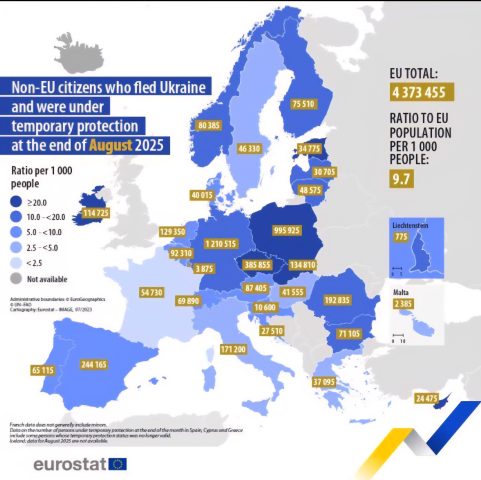
While the numbers arriving into the Irish state have slowed – with another 5,300 new arrivals this year to the end of August – the total numbers under Temporary Protection was estimated to be 114,725. Of that number 34,000 are estimated to have left the country based on the CSO estimate of how many of the PPS numbers issued to Ukrainians since 2022 are still ‘active.”
As with all other official estimates regarding migration and its correlation with PPS issues that remains an estimate. What we do know is that Ukrainians continue to arrive in significant numbers and that the per capita intake in Ireland has been the fifth highest in the EU.
Czechia, Poland, Estonia and Slovakia have been the biggest recipients, followed by the Irish state with 21.5 for every 1,000 of the population. That compares to an overall EU average of 9.7 per 1,000.