An Independent Senator has described the government’s policy on migration as “reckless” and “madness” after a new report showed that the “severity” of Ireland’s housing crisis was “on a different level” with almost 4 people being added to the population for every home built. Most of the recent sharp population increase has come from immigration.
The report from Savills Ireland analysed the scale of the housing crises in an international context, and found that Ireland is an outlier in the severity of its’ housing supply challenge.
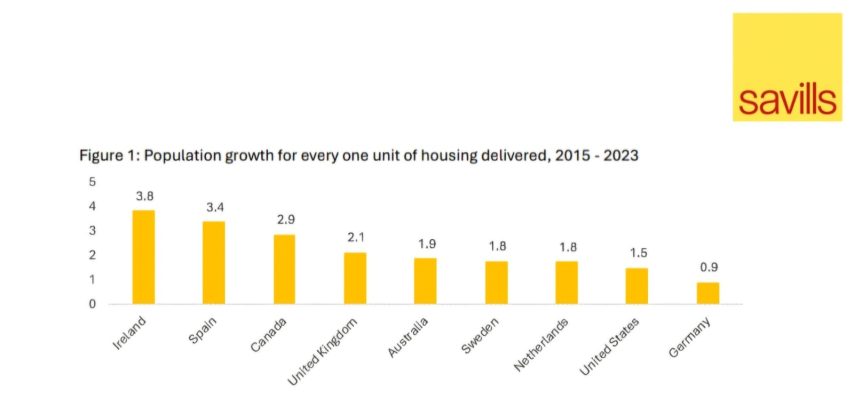
“Looking at population growth in comparison to housing delivery between 2015 and 2023, the analysis shows that 3.8 people were added to the population for every one new unit of housing delivered, a ratio of nearly four to one,” the analysis reported.
It said that ration was “by far the worst among the countries analysed”, being 14% higher than the next worse country, Spain, which saw 3.4 new people per one new unit delivered followed by Canada with a ratio of 2.9.
“Ireland’s ratio was 80% worse than that of the United Kingdom (2.1 ratio) and double that of Australia (1.9 ratio). It was also significantly worse than the United States (1.5) and Germany, the latter of which had a ratio of less than one person (0.9) for every one new housing unit delivered,” the report said.
“Thus, while housing shortages are a common narrative across advanced western economies, Ireland does stand out alone in its severity.”
House price growth and rental price growth far exceed income growth, it also found, while the supply challenge compounds for every year that market demand is not met.
Independent Senator Sharon Keogan said that the ratio was being driven by the continued arrival of migrants to the country, accusing the government of “reckless” behaviour in relation to migration.
“What do you expect? 130 rocked up to IPAS on Monday 12th alone and I don’t have a figure for Ukrainians who landed at Citywest Convention Centre, Cork or Limerick. This is reckless behavior by our government. #MigrationMadness When will the Irish Citizens stand up to this?” she posted on X.
What do you expect? 130 rocked up to IPAS on Monday 12th alone and I don't have a figure for Ukrainians who landed at Citywest Convention Centre, Cork or Limerick.
— Senator Sharon Keogan (@SenatorKeogan) August 15, 2024
This is reckless behavior by our government. #MigrationMadness
When will the Irish Citizens stand up to this? https://t.co/UdP7KtK1gC
The Central Statistics Office estimated the population increased from 5,184,000 in April 2022 to 5,281,600 in April last year – growth of 97,600 people, with just 19,000 of that increase due to natural growth (births less deaths), while net migration accounted for an additional 77,600 people.
“While it is true that many countries across the world are facing housing shortages, it is important to recognise that the severity of Ireland’s is on a different level to others,” said John Ring, director of research at Savills. “Ireland has unique drivers – a delayed natural population boom, high migration due to strong economic growth, and structural legacy issues resulting from the Celtic Tiger crash – that explain why Ireland has the unenviable position having the worst supply-to-population growth [ratio] of the countries analysed.
“At present, we are running to stay still and a more aggressive approach to promoting new housing supply is warranted compared to our peers.”
John Ring said that while progress on housing “has undeniably been made”, the scale of the housing crisis remained large.
“It is evident that the market requires significantly more stock across the country to meet demand for both sale and rental properties nationwide. The speed of development is also important – the problem compounds for every year that market demand is not met. The government must be proactive about developing partnerships and working hand in hand with the private sector to advance the quantity and speed of development. The expected revision of current housing targets over the coming months is welcomed. New targets should be reasonable but also ambitious and challenging, which recognise the seriousness of Ireland’s housing crisis as outlined in this analysis,” she said.