It was only the other day, a colleague of mine – not from Ireland – remarked that she could smell marijuana everywhere she went in Dublin. She is right. Like many other issues, social nuisances if you like, smoking marijuana is virtually ignored by all.
Smokers feel no reason to refrain, even in public spaces. They may be a little cagey about lighting up but ultimately know that the only people who may tell them stop are the Gardai. And there are not many Gardai around.
The social opprobrium that goes with smoking is practically invisible. It isn’t gone away, but such is the public – polite – discourse about the drug that anyone who holds reservations is likely to have more to be wary about than actual smokers of getting a dressing down. Public censure is likely to fall harder on the fuddy-duddies that are not comfortable with the ubiquity and general acceptance of marijuana in everyday life.
This is why Alex Berenson’s 2019 book, Tell Your Children: The Truth About Marijuana, Mental Illness and Violence is so important. It gives voice to those concerns. It gives substance to concerns that were previously considered self-evident truths before being undermined by the marijuana legalisation lobby.
People who felt they were right to be worried about weed can have the evidence to back-up those niggly feelings. I was the same. I am the same. I understand why people like to smoke. For the majority, it feels good. And aside from lethargy, possible sloth, there is little downside to the high. ‘Hungry, happy, sleepy’ is what we are told.
But the myths that have been pedalled about weed are that it has no downside at all. For anyone. And if there is a downside, it is only minor. That is what I thought as well, although I had seem some correlation between mental illness and smoking in a very small data-set of contacts. But those were only anecdotes. And the plural of anecdote is not data. There was no way to assume causation.
What Berenson does is a social good. His aim is altruistic. It is exactly what he says on the book. He wants you to tell your children, to spread the word, that marijuana is not benign. He sold 40,000 books in the first year of its release and his deep dive into the evidence has yielded some fruit in the United States as the push for legalisation of marijuana has slowed although it has not paused nor gone into reverse.
In Ireland, this book deserves to be read. It needs to be read. There is increasing laxity towards marijuana by society, by the government and by the police. Before making up your mind on marijuana read the book. If you choose not to, then you risk remaining ignorant, by commission, of the dangers that accompany the drug. If you read it and decide the pros outweigh the cons, then so be it. That is on your conscience.
If you choose not to believe what Berenson is saying, then it is on you to dig deeper and find evidence to refute Berenson, that tell you marijuana is benign; that it is not to be discouraged by social sanction or criminalisation; that the pros of getting high outweigh the mental health risks, the lives that are likely to be lost as well as the other social ills that Berenson determines that come with marijuana use.
If you cannot prove him wrong, to yourself before anyone else, then continued ambivalence towards the weed is a selfish and dangerous choice. That is what Berenson’s book is telling us. He came to Ireland in 2019 and spoke at the Royal College of Surgeons and told us the same thing. It seems to have made little impact and all the stories supporting decriminalisation and legalisation of weed continue to circulate.
On the one hand, there are the apparent benefits of medicinal marijuana. Berenson largely refutes this claim, outlining that it is not marijuana that is medicinal but one of the chemicals in marijuana, cannabidiol, otherwise known as CBD. The CBD is not what give the high. It is another ingredient called THC (delta-9-tetrahydrocannabiol). And most cannabis consumed today has little or no CBD and is loaded with THC. ‘So, whatever good CBD may do is irrelevant’.
The book has a bit more on the science but that is the basic thrust in relation to ‘medicinal’ marijuana. We have been fed a myth by marijuana advocates seeking to build a legal industry in any jurisdiction possible, supported by well meaning weed users who like the idea of the grass being legal.
The other benefit touted are that marijuana reduces crime by chilling people out. This is refuted. The final benefit, that marijuana can reduce opiate dependency is not as clear but assumed trends are also rejected as more and better data becomes available.
Then there is the benign argument. Marijuana is fine. It may not have all the benefits, but there is no downside. This is where Berenson’s book really hits home, when the stories of real lives torn apart by the effects of marijuana are combined with bringing together a growing body of data that shows, quite clearly, and in Berenson’s mind, beyond any shadow of doubt, that marijuana causes mental illness, primarily psychosis, and that marijuana has a causative effect on violence.
Citing 30 years of evidence examined by the National Academy of Medicine in 2017, he quotes “The association between cannabis use and development of a psychotic disorder is supported by data synthesised in several good quality systematic reviews … the magnitude of this association is moderate to large and appears to be dose dependent” – the more you use, the greater the psychotic effects.
The data since then has grown in study after study. Emphatically, he declares that marijuana causes paranoia and psychosis. The numbers are not small. Translated into a population the size of Ireland this means the mental health of thousands of people. With a growing emphasis on youth mental health, the lives of thousands of young people in Ireland are at risk from marijuana. And evidence also says that legalisation of the drug only makes this worse.
The second aspect is equally backed up by the science. Marijuana causes violence and it does this directly but also, and most frighteningly, through its impact on psychosis. Not everyone gets aggressive. Real-life encounters with smokers tells you that many users relax, ‘but some become paranoid, and some have full-blown psychotic episodes’.
‘Marijuana causes paranoia and psychosis.’
‘Paranoia and pyschosis cause violence.’
He has plenty of anecdotes in the book to give life to the data. The data itself is telling. In one third of child deaths from abuse or neglect in Texas in 2017, authorities found the perpetrator was using cannabis at the time of the child’s death. One anecdote: The nineteen residents at a Japanese nursing home stabbed to death in July 2016 by a 26 year old man who had been hospitalised less than five months earlier for cannabis psychosis. 26 other residents were wounded … the man told investigators he wanted to legalise marijuana and believed drug gangs were targeting him, so head no choice but to ‘complete his mission.
Berenson’s book is a good read. It is well written, it moves fast. It is engaging. But most importantly, it is important. The casual assumptions around marijuana have taken hold. There are very few people willing to get animated about the drug as society has been fed a well-funded myth that it is harmless and recreational. That is has no victims. That is less harmful than alcohol. That it is medicine. And if it is medicine, it can’t be harmful.
Berenson says none of this is true and the cost of accepting these myths is very, very high.
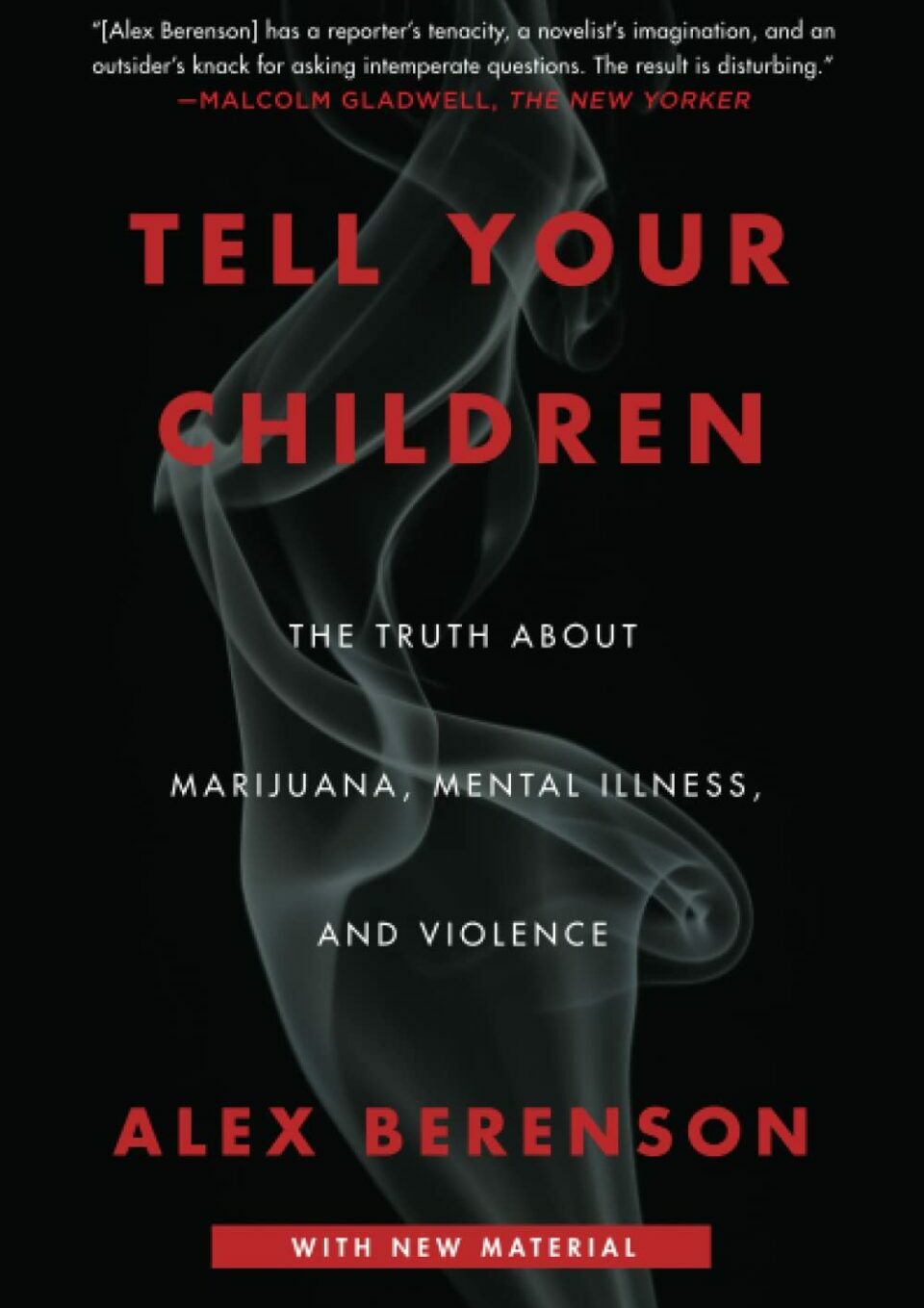
Tell Your Children: The Truth About Marijuana, Mental Illness and Violence
- Author : Alex Berenson
- Publisher : Free Press (January 8, 2019)
- Language : English
- Hardcover : 272 pages
- ISBN-10 : 1982103663
- ISBN-13 : 978-1982103668
- Item Weight : 12.8 ounces
- Dimensions : 5.5 x 0.9 x 8.38 inches
Dualta Rougneen