The fight against Helen McEntee’s controversial hate speech legislation has been brought to the Minister’s constituency where it was criticised as being “flawed beyond redemption.
A public meeting on the issue, hosted by Free Speech Ireland, took place last Thursday in Kells. The attendees were addressed by Senator Sharon Keogan and featured speakers from a variety of concern groups about the social impact of the legislation.
The legislation in question, the Criminal Justice (Incitement to Violence or Hatred and Hate Offenses) Bill 2022, also known as the Hate Speech Bill, passed through the Dáil earlier this year and has been debated twice in the Seanad.
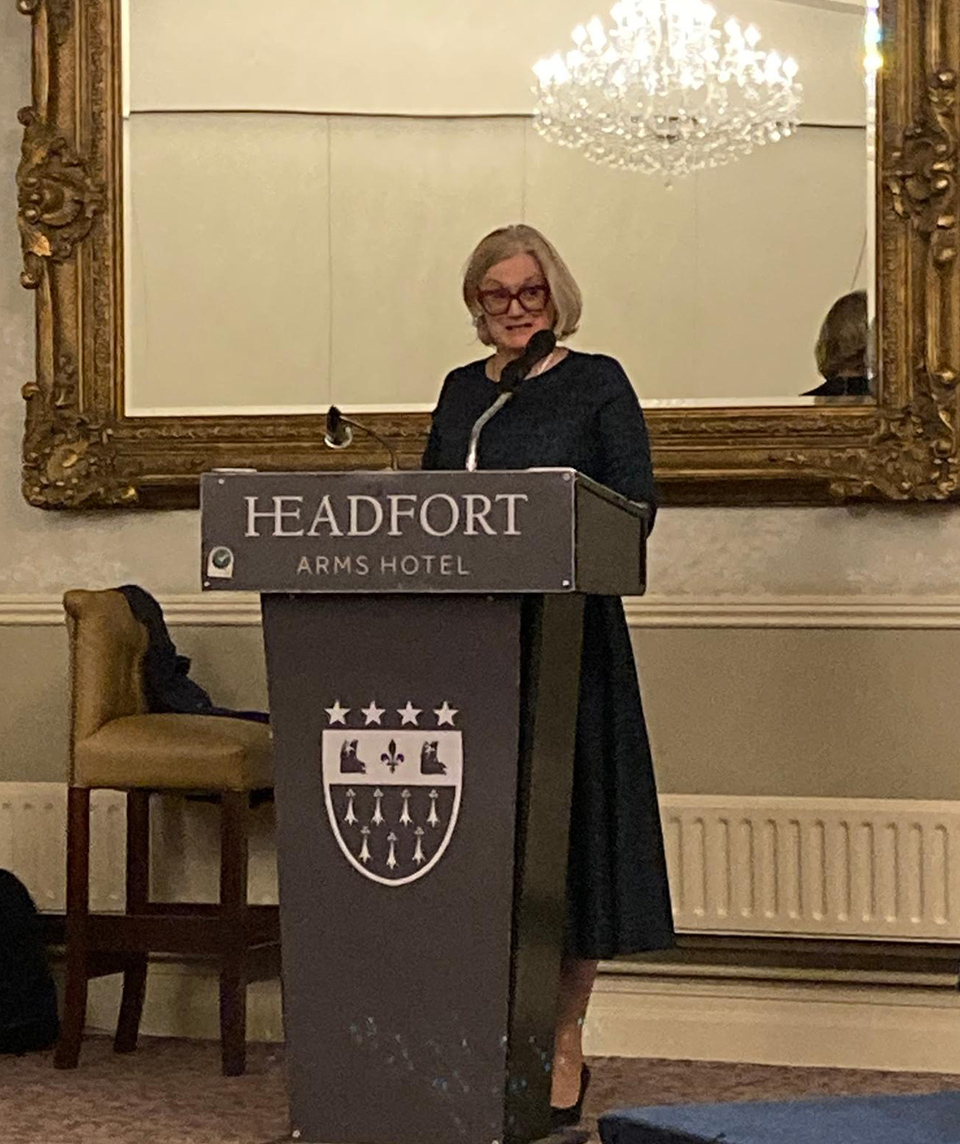
Senator Sharon Keogan remains a staunch opponent of the Bill
Senator Keogan described the Bill as being “flawed beyond redemption”. She added “the very premise of this Bill is that some people are worthy of protection and others are not“. Section 3 of the Bill specifically outlines the protection of certain personal characteristics as protected characteristics, insulating these groups from certain types of speech. These characteristics include race, religion, sex characteristics, gender and sexual orientation to name a few.
“Go woke or go broke appears to be strategy of Fianna Fáil and Fine Gael”
Senator Keogan referenced the Finnish politician who was prosecuted for hate speech for quoting the Bible as a warning to the public about the consequences of such laws in Ireland.
She condemned attempts to bring in this law as the product of an ideology seeking to create a “woke theocracy”.
Speaking on the nature of protests that are currently ongoing across the world, Senator Keogan references the 2015 French High Court case in which 12 pro- Palestinian protesters were prosecuted for wearing T-shirts that advocated for a boycott of Israel. She commented that similar consequences could occur here, should the law pass.
The public heard from UCD philosophy Professor Emeritus Gerard Casey on the legal and constitutional shallowness of the proposed legislation, as well as a spokesman for advocacy group Not All Gays (NAG), on the potential weaponisation of hate speech legislation by the trans lobby.
The NAG spokesperson was critical of Belong To and TENI, and acknowledged that Belong To specifically had been hostile to members of support groups when certain subjects were raised, such as gender transition regret. He also added that lesbians in Norway have been maligned for not wanting to have relations with biological males.
“Hate crime would be thought crime” opined Professor Casey, the newly appointed President of Free Speech Ireland, as he described how the key terms of the legislative push were shaky and that the criminalisation of public opinion should not be the domain of the government.
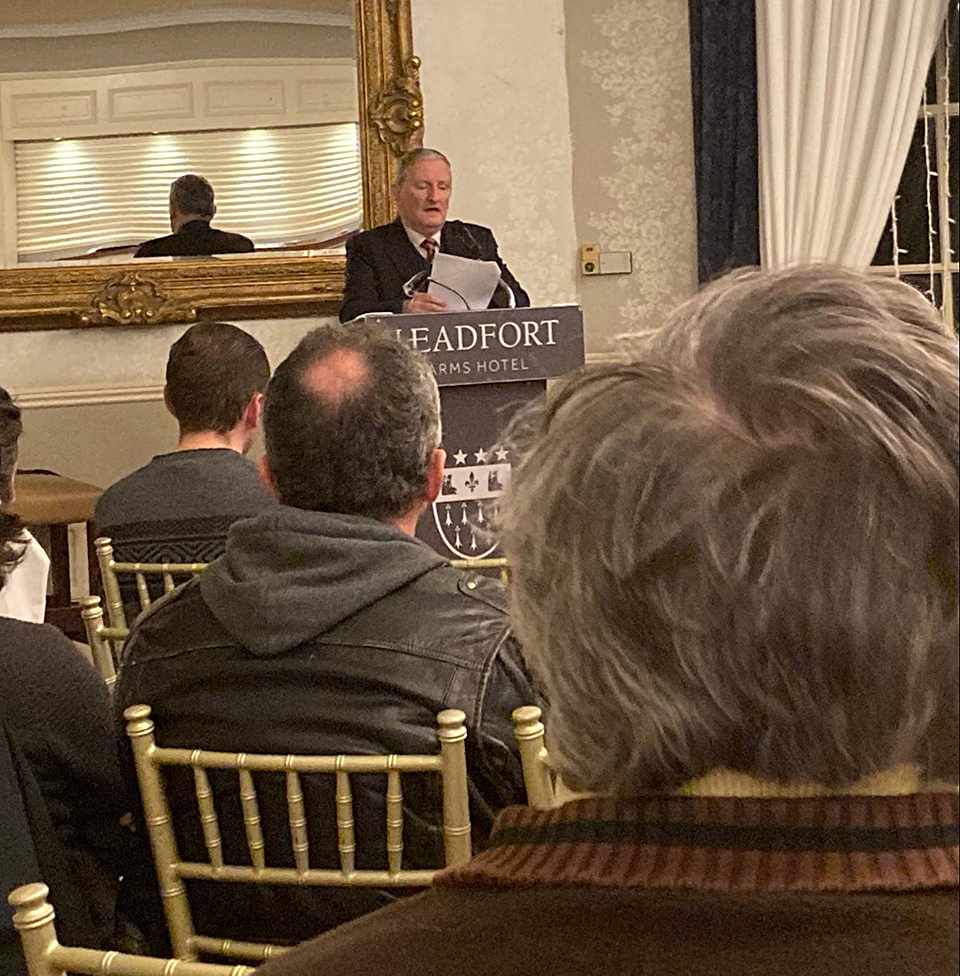
Professor Gerard Casey, President of Free Speech Ireland
_ _ _ _ _ _ _ _ _ _ _ _ _ _ _
Professor Casey referenced a book called The New Puritans by Andrew Doyle in his speech and thoroughly recommends it for people concerned about this issue. He added that the book outlines well how this issue is part of a broader ideology seeking to limit liberty of the masses.
He added “you would look in vain for anything that might count as a definition” of hate, in the Hate Speech Bill. The lack of a definition of hate is one of the primary criticisms of this Bill in its current form.
Professor Casey continued “You need to define the key terms…this isn’t a peripheral term this is part of what the legislation is about.”
In reference to other countries, Professor Casey adds “people have been had up for doing things like reading the Bible“. He also adds a reference to a case in Spain where a bishop was prosecuted for his speech for doing so some years back. He emphasized that the point of this law was to “check your thinking”.
“If you can’t say it, eventually you can’t think it,” Professor Casey said.
Section 15 of the Bill was also discussed by Professor Casey. This section allows a Garda to apply for a warrant at the District Court to allow them to enter by force, if necessary, and anything belonging to anyone found at that place can be seized. The warrant will compel the handover of passwords for electronic devices and the warrant will apply to all persons residing with the person to whom the warrant applies.
Con Óg Ó Laoghaire of Free Speech Ireland noted Minister McEntee makes the claim that “offensive speech won’t be criminalised”.
Mr Ó Laoighre added that “Politicians do this, they make it out that the scope of the legislation is just to cover… the more extreme cases.
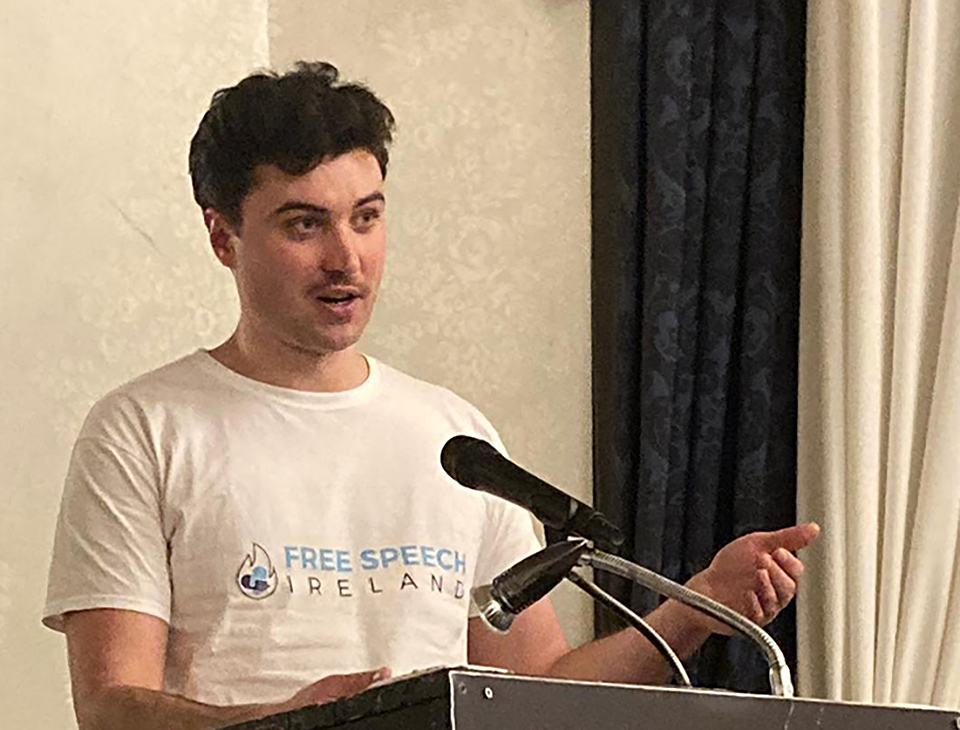
Con Óg Ó Laoghaire of Free Speech Ireland
_ _ _ _ _ _ _ _ _ _ _ _ _ _ _
He continued “What it comes down to… is it her remarks when the Irish Times are doing a write up on a conference she has attended, or is it the contents of the bill itself, that will stand up in a court? That is the question I would put to her if I had the chance.”
McEntee’s Public Claims
Gript’s Ben Scallan has questioned Minister for Justice Helen McEntee several times in press conferences on the Bill.
Irish Justice Minister Helen McEntee expects her controversial Hate Speech bill to be in force "by the end of the year", and says how confident she is that nobody in Ireland will ever be taken to court for "misgendering" under the law. Question by @Ben_Scallan. #gript pic.twitter.com/QEuNlpqjFE
— gript (@griptmedia) September 8, 2023
The meeting follows on from a successful conference against the prospective statute in September where hundreds gathered at the RDS.
The “Ireland Uncensored” event was the largest attended event on the issue to date and was co-sponsored by Gript and Free Speech Ireland.
There is growing unease in Irish politics over the introduction of UK-style hate speech laws with many warning of the impact this will have on social media users globally, a fact complicated by Ireland’s place as an important Big Tech hub.