It is interesting to compare and contrast the media coverage given to the clashes between Gardai and squatters in Prussia Street, Dublin, this week, with the media coverage doled out to anti-lockdown protestors in Dublin in march. Both events, it is fair to say, had some degree of hostilities between Gardai, and those taking part. But there are some differences, too.
The squat in Dublin was against the law. One cannot simply walk into another person’s property, without their permission, and claim it as his own. By contrast, public protest is not only legal, but a critical right in a democracy.
There can be no doubt that Ireland has a housing crisis. We have tens of thousands of homeless people, and almost as many housing charities. Some might argue that the purpose of a squat is to highlight an issue with the housing market – the number of vacant properties. As such, they would argue, it was a protest. But that is not right. A protest is targeted at people who make policy – in the case of the March event, the Government. This “squat” by contrast was targeted at a private property owner who is doing nothing illegal, whether people like that or not. Besides, squatters have always existed, and always provided some excuse for their actions. That does not make them any more legal.
What is interesting, however, is the difference in coverage and tone in the media. These squatters are redefined as “activists” in most media coverage, which immediately frames them as noble participants in a political cause. The violence is depicted as a “fracas” between Gardai and the squatters: Take this tweet from the Irish Times’ Jack Power, as an example:
Major fracas between gardaí and housing activists, as a number of men clear off a yard believed to be used as a squat on Prussia Street pic.twitter.com/04un9gNkLu
— Jack Power (@jackpowerIT) October 27, 2021
The National Broadcaster, RTE, didn’t even find time to mention any of the violence in its report. The only indication you get that there was any clash with Gardai is the phrase “no injuries were reported”.
Now take a look at how the Times (not the Irish Times, to be clear) covered the anti-lockdown protest in February:
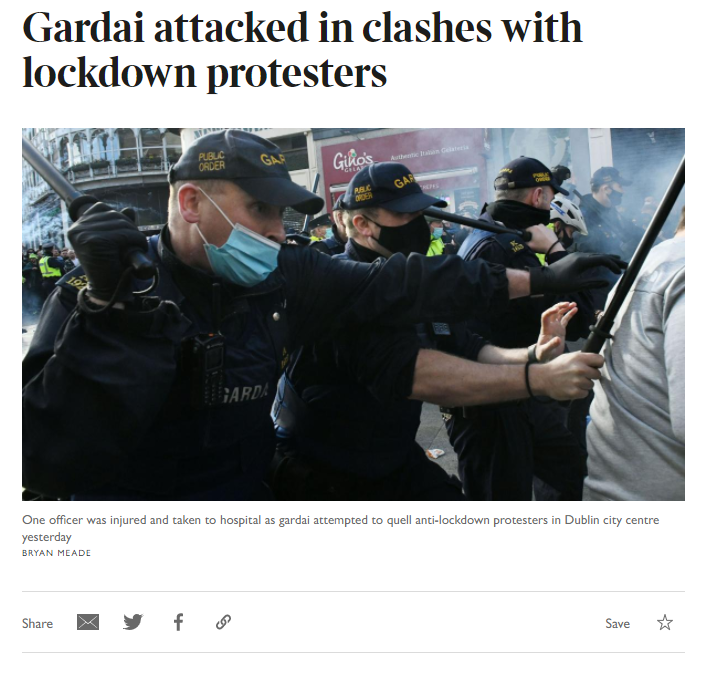
In neither instance did the Gardai instigate any violence. But the general tone of the coverage could not be more different: In one instance, Gardai were “attacked”. In the other, there was a “major fracas”. The truth is that in both cases, Gardai were attacked. The difference is that it was a small minority at the anti lockdown event, and a large majority of those at the squat.
In February, of course, the attack on the Gardai warranted a Prime Time special. A crisis, we were warned, was under way. The far right was rising, and out to take over the country. Disinformation was blamed. Yours truly was summoned onto Prime Time to answer for it.
In the case of the squat, there will be no such panic. There never is, with the hard left, who have always been held to a different, lesser, more sympathetic standard in Ireland.
The bottom line is this: Those people in Prussia street were breaking the law, and doing so blatantly. The Gardai were doing their jobs, and were attacked and interfered with in the course of doing so.
The only difference is, this time, there’s no panic over it. No outrage. In fact, media opinion generally is much more sympathetic to the protestors than it is to the Gardai.
It is, of course, impossible to expect the media to be perfectly consistent, all of the time. That would require them to be robots, not human beings. At the same time, though, you might expect the Irish media to at least try and be consistent. But if you do, you will be eternally disappointed.