Hold on now; I know you’re planning a party with friends, but before you reach for that alcoholic beverage, isn’t there someone you forgot to ask first? Namely, Micheál Martin? Where is your permission slip, boyo?
If you’ve tried to buy drink at all in the last few days, you probably will have noticed the absolute explosion in the price of alcoholic products – all due to an intentional government policy.
As reported in the Irish Independent:
“Minimum drink pricing: how cost of some supermarket alcohol is set to double tomorrow
“Some supermarket alcohol will more than double in price as new minimum pricing laws kick in from tomorrow. All alcohol will have a minimum price based on the number of grams of alcohol, with one gram costing at least 10c.
…
The legislation, introduced in May last year, aims to reduce consumption by heavy drinkers by making strong drink less affordable and therefore reduce alcohol-related harm.”
The Independent went on to list some examples of the mandatory price hikes.
For example, 24 cans of Budweiser at SuperValu a few days ago used to cost €18, Now, they cost €40.71. No, that’s not a typo – they increased in price by €22.71.
12 cans of Galahad Export in Aldi went from €8.79, to an eye watering €18.93. Additionally, Aldi’s Corley’s Gin went from €13.99 to €20.71.
Bear in mind, this is Aldi we’re talking about – they’re not exactly known for being price gougers and taking big profit margins. Their entire brand and business model is about getting prices as low as humanly possible.
I actually once bartered my entire weekly shop in Aldi for an amulet made of sea shells.
So I think it’s safe to assume that when you see a huge price increase from shops like Aldi, or Lidl, or Tesco, with one product jumping over €20 in a single day, you can smell the government’s grubby mits all over that situation.
Which is not to say it won’t help businesses, mind you. In fact, it actually hurts nobody but the consumer. Big business and the government do quite well in this arrangement.
Contrary to what many people are saying, this is actually not a tax – it’s just a mandatory price hike.
When you think of the Government putting up the price of alcohol you probably think of how they put up the price of cigarettes in the budget. In that case, they increase the excise duty, meaning that they get an extra 50 cent in tax for every packet of cigarettes sold. But that’s not actually what’s going on here.
This will mean that the price is being put up by law, but the supermarkets and off-licenses selling the drink get to keep 100% of the profits. These businesses will be making almost double what they are now, and nobody will be able to compete with them, by law.
The government benefits because increasing sales prices means more VAT is charged – so that’ll help send a few quid the way of the State’s exchequer.
Big business wins. The State wins. Rich people aren’t really affected. Poor people lose.
The Independent adds that “While the new system will not affect the price of premium alcohol, cheaper brand prices and promotional prices will rocket.”
So this policy appears to be directly targeted at those on lower incomes. Fancy premium alcohol will be left untouched. Because of course rich people never abuse alcohol, right?
Now, the motive here is clear. The government has already said they want to reduce alcohol abuse, and therefore need to make the products less affordable by design so people consume less of them.
And doesn’t that make sense? After all, alcohol can have a devastating effect on people’s health. Isn’t it necessary for a radical step to be taken to cut back in this area?
Well, there’s just one fatal flaw in this plan.
Alcohol consumption has already been plummeting for well over a decade.
According to the World Health Organisation, Irish people drank about 32% more alcohol in 2005 than they did in 2016 – a huge reduction in consumption.
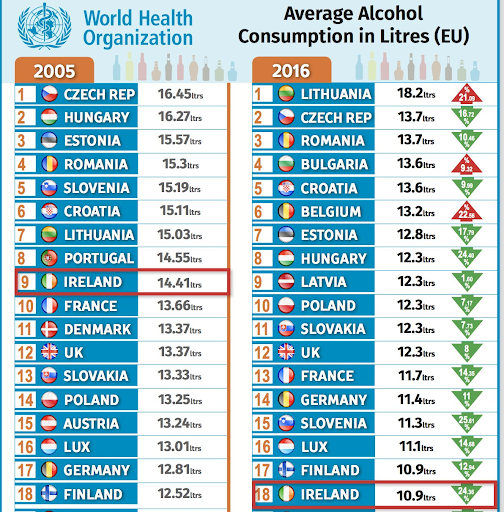
There goes the government, as usual, implementing an absolutely extreme and radical policy to solve a problem that was already solving itself before they arrived. This is unnecessary nanny statism and hectoring at its worst.
For the record, I don’t even drink alcohol myself – I’ve never touched a drop of the stuff in my life. I have no skin in the game personally. But you don’t have to like alcohol to dislike the government trying to install themselves as the moral arbiters of our lives.
It’s a bit like the HSE considering a ban on smoking, even though they weren’t elected by anyone, and have about as much authority to make such pronouncements as I do – i.e. none.
The #HSE is considering a total ban on the sale of tobacco in a bid to bring an end to cigarette smoking in Ireland.#smokingbanhttps://t.co/iiLcxdBDrD
— Irish Daily Mirror (@IrishMirror) December 31, 2021
It should also be noted that the people who a policy like the alcohol one would be aimed at in particular – namely severe alcoholics – are not going to be deterred by high prices. Alcoholism is an addiction, and addictions demand to be fed.
For people with severe alcohol dependency issues, if forced to choose between paying their rent one month or getting their fix, many would rather pay the higher price for the booze and take their chances with the landlord. This will very likely not have the desired effect of reducing alcohol abuse.
It will, however, increase the already skyrocketing cost of living and strain the finances of many ordinary people who simply want a few cans at the weekend.
Now I know what you’re thinking: “Where is the Opposition?” Surely, the “most effective opposition party in Irish history” will have something to say about this injustice?
And in fairness to them, Sinn Féin did raise objections to this policy. Specifically, they complained that it didn’t go far enough, and wanted it expanded.
As reported by Buzz.ie:
“Sinn Féin call for Health Minister to work towards an all-island roll out of minimum unit alcohol pricing.
Speaking on the letter to the Health Minister, the Donegal Sinn Féin TD, Mac Lochlainn said: “Sinn Féin supports implementing minimum unit pricing of alcohol products across the island. It has a positive role to play in addressing problem drinking and reducing health inequalities.”
“However at the time the legislation was passed, it was understood that this would be rolled out on an all-island basis.”
So Sinn Féin’s main objection to this move is that it hasn’t been rolled out universally across the entire island. They’re perfectly happy with it – they just wish it was being used in even more places. So much for being a party of the working classes.
Apart from anything, whether this policy is in effect in the Republic or the whole island, criminal gangs will simply form black markets and sell it anyway. Irish criminal gangs made more from alcohol sales than they did from all illegal drugs.
Both the government and the opposition are effectively begging for unsavoury characters to create unregulated speakeasies and profit from the absurd situation this policy has created.
If you put “Leaders with common sense” on your Christmas wishlist last year, it unfortunately seems like St. Nick may have dropped the ball.