There are several takeaways from the Report on Refugees and Integration published by the Joint Committee on Children, Equality, Disability, Integration and Youth on Tuesday.
The first is that there are clearly no differences among the members of the Committee – at least none that are reflected in the document or among any of its recommendations – along party lines. It might as well have been written by an advocacy NGO or indeed a far-left version of the “Far Right Observatory.”
Which is the second take; why were pro-immigration NGOs and a self-appointed “observatory” staffed by left activists the only “non-governmental” bodies invited to make submissions at Committee?
The third and most important one is that the report clearly does not reflect the widespread concerns over this issue among the public, other than a Singing Nun type secular prayer for “communities” that they might come to learn that “So much more can be achieved by coming together to make things better for everyone”.
Ironically, it begins by referring to the ongoing and indeed growing, emigration of young Irish people. The implication being, along with a frankly ludicrous reference to Irish people perhaps having to seek protection from some unspecified future danger (someone was reading a mediocre novel methinks…) is that “sure didn’t we all go to Amerikay” and sure why wouldn’t anyone who wants to, be allowed come?
What the foreword does not say, nor does the report, is that much of the current emigration of young educated Irish people is because they are finding it increasingly difficult, even if working and well qualified, to afford to live here. That reason is intimately connected to the level of demands imposed by huge numbers of migrants.
This ties in with the surreal claim on the part of all parties that they can somehow magically solve the housing crisis while at the same time artificially creating a much greater demand. One that they clearly are unable to meet, and none of them have given any plausible explanation of how it will be met, or how increasing future demand will be met. Back to Singing Nun territory.
There are 96 recommendations in the report, and they are overwhelmingly supportive of a further liberalisation of the immigration system. Indeed, many could be taken as advocating for the dismantling of any controls on entry, and of any restrictions on anyone who does manage to be admitted into the state and allowed to make an application for international protection.
Some of the motivation on the part of the participants from the NGOs themselves could not be spelt out more starkly.
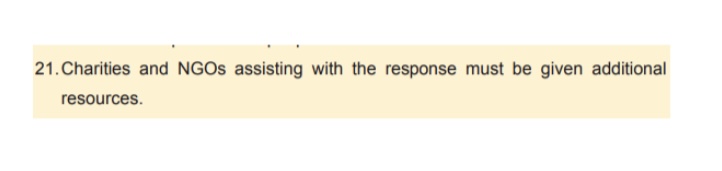
That is really the be all and end all of it. These are all people whose livelihood depends on mass immigration.
If they were charities who provide meaningful assistance to people in need, then you might give them a pass. They are not. All of their demands for provisions for their clients or prospective clients are made upon the state. That, of course, is ultimately on the taxpayer, and therefore at the expense of other public provisions, which of course is what lies at the heart of the genuine grievances expressed by communities from Rosslare Harbour to Dromahair.
The NGOs, meanwhile, are almost entirely dependent on taxpayers for their existence, even if some owe their initial prominence to the funding from billionaire foundations like Atlantic Philanthropies. A cynic might suggest that this strange amalgam of Far Left and Capital is motivated by elements of the latter regarding the former as useful idiots, facilitating a race to the bottom that has made fortunes for some.
One of the demands, which it seems the Committee with its formal government majority, were happy to sign off on was to propose to redefine or even abolish the category of “safe countries” which is meant to be, but clearly is not, a restriction on economic and welfare migrants abusing Ireland’s liberal asylum system.
We are told that “Members raised concerns” about aspects of the designation of safe countries including:
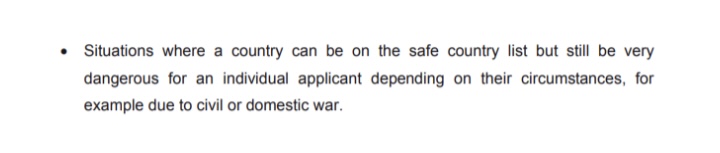
Seriously, if you look at the short designated list of safe countries it is quite clear that there are no civil or domestic wars in any of them. Nor are there any such wars in other obviously safe parts of the world which account for a huge proportion of those claiming asylum here. Are members of the committee incapable of researching such basic information? Especially when standing over proposals that may have major implications for the state and its citizens.
Do they also stand over the claim that one of the countries which is on that list and which is beloved of Sinn Féin and other left liberals here – South Africa that has been run by the Shinners comrades of the African National Congress for almost 30 years – is not safe?
Most pathetically of all, they question the designation on the basis that it might apply to people arriving in Ireland from “Countries that may be conservative, religious or otherwise unsafe for women or members of the LGBT+ community.”
Was this written by Ógra Shinn Féin?
Apart from the infantile belief, nay slander, that countries that are “conservative” or “religious” are automatically “unsafe” for women and gay people, how would they even begin to define that? The UK has a conservative government – or at least one that goes by the name – and most of its citizens identify with some religion or other.
It clearly is safe for any purposes of international protection. Yet, we have members of our national legislature who believe that Sue from Stourbridge might have a claim to asylum on the basis that Stourbridge had a thumping Tory majority in 2019, and possibly home to gangs of Church of England vicars, and perhaps even the odd Romanist, roaming about oppressing her.
Mockery aside, and really sometimes it is the only rational response, the real purpose of suggesting the abolition of the category of safe country of origin is revealed in the following:
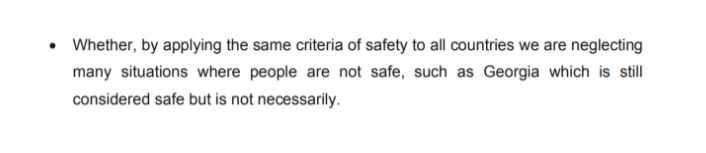
You see what they did there? Georgia is designated a “safe country of origin.” It is a safe country, there are no wars, civil or domestic (what the distinction is I am not sure) and the only ones claiming that there are or that it is not safe are bogus asylum seekers, NGOs, and now by all accounts a Committee of the Oireachtas. All being experts on Georgia above and beyond any Irish state, or EU or United Nations official, it would seem.
Anyway, that’s neither here nor there. It is important for the NGOs to dismantle the notion that anyone from an internationally safe country like Georgia might not be entitled to come here, because to impose restrictions would be to reduce the overall traffic of asylum seekers, and that would be bad for business.
Just like a public health campaign hits cigarette merchants, or more intensive policing and border controls reduces drug supply and abuse.
I apologise for interrogating the implausible attempt by people – some of who are clearly far from being motivated by universal feelings of goodwill for all humankind – to turn this crucial debate into an episode of Blue Peter and about being nice. And if you are not nice, they have a plan for that too:
