There was an interesting exchange in the Dáil last Thursday, May 12, during questions to the Minister for Education Norma Foley. The Sinn Féin spokesperson on Education, Donnchadh Ó Laoghaire wanted to know if Ukrainian children placed in Irish schools would be shown “flexibility” in relation to the costs of books and uniforms.
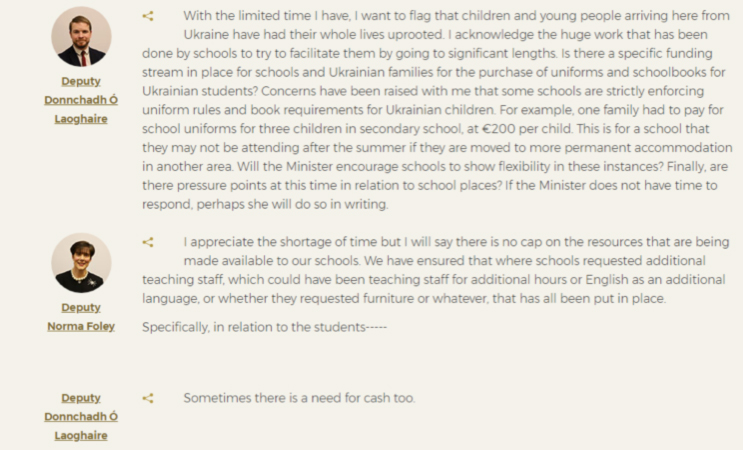
In normal circumstance, when a Minister is asked such a question about resources for schools or any other part of public provision, they will tend to claim that the problem is being exaggerated or that it is in the process of being solved. Rarely will a minister, as Minister Foley did, respond by stating that “there is no cap on the resources that are being made available to our schools” and actually mean what she says.
Fair enough, you may cry. This is not a normal situation and there needs to be an immediate response to those fleeing the war in Ukraine. It does, however, highlight – as we have also seen in relation to housing and medical cards and other areas – that the same state that has persistently cried poverty in regard to their inability to address issues like homelessness suddenly seems to have discovered the Magic Money Tree.
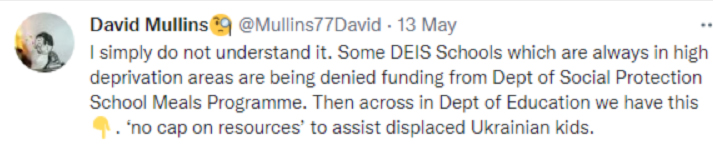
This is slowly starting to be remarked on, although not by the same people who usually portray themselves as Tribunes of the People when it comes to getting things off the state. The left has a totally schizophrenic mindset on these matters.
The Delivering Equality of Opportunity in Education (DEIS) programme is actually a good example of the very different response that the state now has to queries about the financing of the programmes that fall under DEIS.
Just the day before Minister Foley declared that there is “no cap on resources,” Heather Humphreys the Minister for Social Protection, gave a rather different response to a question from Green Party TD for Wicklow, Stephen Matthews.
Matthews had asked why the extra 310 schools being added to the DEIS programme in September will not be able to avail of the free meals programme. Humphreys informed him that the budget for this had been capped for the current year, and that: “Any provision to extend the programme to the newly added schools to the DEIS programme will need to be considered as part of the budgetary programme.”
If the “cap” fits, and so on.
No limit to resources for Ukrainian children, less so for Irish children, especially those who are poor.
In his rejoinder to Minister Foley’s declaration that there was no limit to the resources available for Ukrainian school children Ó Laoghaire responded that “sometimes there is a need for cash too.”
Which there is. The problem we have here is that on one hand we have a government that can suddenly come up with vast amounts of money when they have decided that it is the right thing to do; and on the other an opposition that believes that it is possible to increase public provision for the citizens while at the same time constantly advocating for the numbers of people entitled to that provision to be radically increased.
It is difficult to know which is the worst.