Despite what you may have read in the papers the new report from the Irish Penal Reform Trust, a report which was paid for by the Irish Human Rights and Equality Commission, does not show that foreign nationals and non-white offenders get longer jail sentences than Irish-born criminals.
We’ve got to mark down both the Irish Time and the Irish Examiner here for their coverage of this report, as both of them decided to put headlines on their pieces about their reports which were simply factually untrue. The Irish Examiner headlined their article with, “Foreign nationals get one-third higher prison terms on average than Irish-born criminals,” whilst the Irish Times went with “Foreign nationals and non-whites get longer jail terms for sex and drug offences, study shows.”
Of all the mainstream media outlets who covered this report the Journal.ie had the best coverage, and they managed to headline the piece in a way which was neither factually incorrect nor even misleading.
We’ll go through exactly what is untrue about those headlines shortly, but first let’s look at what the report actually tried to do, or rather what the part of the study that dealt with figures tried to do.
The report looked at data from the Irish Prison Service on the different sentences that Irish prisoners are serving, and then tried to analyse that data to see if foreigners and non-white prisoners had been given different sentences than white, Irish-born prisoners. They grouped the offences prisoners had been sentenced for into 13 categories, and they worked out the average sentence for Irish-born prisoners and foreign prisoners, and for white prisoners and non-white prisoners. It’s a pretty straightforward way of doing things, and one which is certainly defensible, although there are certainly issues with it.
The first problem that the report runs into, and this relates to the Irish Times headline, is that the report is ultimately unable to determine the average sentence given to prisoners of different ethnicities for the very simple reason that they didn’t have data on the ethnicity of 24.5% of the prisoners in their database, roughly 1,067 people out of a stated sample size of 4,356 – interestingly when we reviewed the number of cases considered based on nationality it appears that the sample size was actually 4,346.
As such a large percentage of the dataset cannot be grouped based on ethnicity the study cannot show that non-whites get longer, or shorter, sentences for sex and drug offences, or for any offence.
This ties into a second issue with the report and its analysis of the sentences given to non-white offenders – the low sample sizes. Since they’ve divided a relatively modestly sized sample, as Ireland doesn’t have that many prisoners and we only have ethnicity data on ~75% of them, into 13 smaller categories, in order to get the results per category, it means that each category has a very small number of non-white cases to consider. Across all 13 categories considered by the report only one, fraud, had more than 25 non-white cases associated with it.
The study, for instance, says the average white prisoner will receive a sentence of 49.2 months for sexual offences, compared to 81.2 months for a non-white prisoner. But there were 134 cases of sexual offences for whites, and only 9 for non-whites.
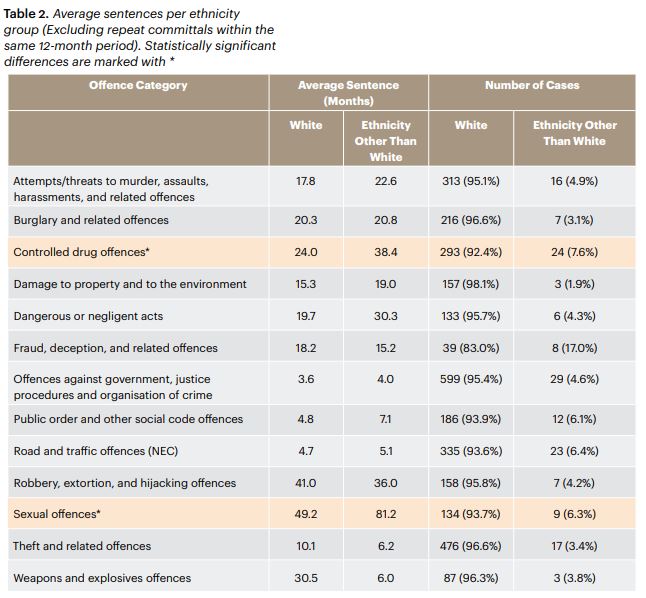
This gives rise to two issues, a) the numbers are so small an injection of an additional 1,067 people into their analysis could reverse every single result the report shows, and b) the numbers considered are so small that there’s a high risk that outliers could be throwing off the average.
As such it would be improper to claim that the study demonstrates anything solid about the sentences given to non-white offenders, as the Irish Times headline did.
This failure isn’t the fault of the research team, it’s a hard limitation of any research into this area that relies on the existing data.
In relation to the Irish Examiner’s claim that ‘Foreign nationals get one-third higher prison terms on average than Irish-born criminals,” that’s simply false – the research does not say that at any point. In the actual article itself Mick Clifford, the author, does make the point that the claimed increase in imprisonment only relates to certain crimes. Clifford also notes that the data used for the report is lacking.
When we move from white versus non-white to Irish nationals versus foreign national the report does become a bit more solid, and the sample sizes do increase. Of the 13 categories considered foreign nationals are said to receive longer average sentences than Irish nationals in four of the categories – controlled drug offences; public order and other social code offences; sexual offences; and theft and related offences.
It is worth noting here that neither the Examiner, the Irish Times, nor the Journal reported that, of the 13 categories of offence considered in the report, Irish nationals received longer sentences than foreign nationals in eight of those categories. Nor did they note that Irish nationals who were imprisoned for ‘dangerous or negligent acts,’ one of only three categories in which the report says it found statistically significant differences between the sentences given to Irish and foreign nationals, received sentences which were nearly double those given to foreign nationals.
This leads to the next problem with this report – we have no idea of the degree to which the crimes Irish and foreign nationals are being convicted of are comparable. The report looks at offences in very broad categories, but just because two people have been convicted of the same crime, let’s say assault, doesn’t mean that their crimes were of comparable severity – you can be convicted of assault for a relatively minor action, and you can be convicted of assault for something malicious, premeditated, and potentially very harmful indeed. Judicial discretion, the ability of a judge to amend your sentence, within the parameters of the law, based on the exact characteristics of a case, is a core part of Irish law.
As such, the study cannot show, in instances in which the average sentences differ, that the crimes being compared against each other are actually comparable or the differences in sentences are caused by the differences in ethnicity or nationality. It may be that Irish nationals commit worse crimes when they engage in ‘dangerous or negligent acts;” in the same way that it may be that foreign nationals imprisoned for ‘controlled drug offences’ engage in those crimes differently than Irish nationals.
Given judicial discretion, and the low numbers of non-white prisoners per category, the decision of the report to present only the average sentence, instead of showing us the mean, median, mode, and range, is not optimal, as it does not allow us to see the full array of sentences handed out to determine if extreme cases are pulling the average in either direction.
The report itself seems to acknowledge this, saying “foreign nationals may [emphasis added] receive longer sentences than Irish nationals for controlled drug offences and sexual offences.”