Newly published statistics show that arrivals of new persons claiming asylum here are on course to exceed previous records – and, if the trend continued, would exceed 18,000 people this year.
According to the latest statistics published by the International Protection Accommodation Services on Wednesday, 441 people made applications for asylum here in the week to March 3.
Some 3,144 people have arrived in the first 9 weeks alone – vastly exceeding the numbers for that period in other years, and up 50% on the number arriving in the first nine weeks of 2023.
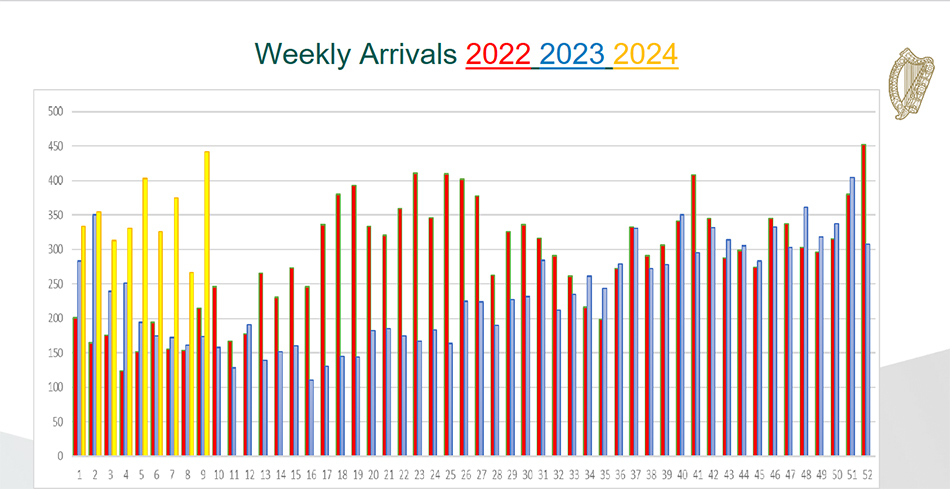
This means that there were an average of 349 arrivals each week in 2024 thus far – which, if averaged out over the entire year, would mean that the numbers arriving to claim asylum – to a system already bursting at the seams – would exceed 18,000 for 2024.
The total number who arrived in 2023 was 13,319, and that represented a massive increase on almost every other previous year in recent times – up 415% from 2021, and a 186% increase on 2019, the year before the Covid lockdown took effect
The total who have arrived claiming asylum in the first nine weeks of 2024 is 3,144 – a dramatic increase of almost 50% on that period in 2023 when 2,101 persons arrived.
Not only are numbers vastly exceeding those for other years, but the pattern has been that they climb in late Spring and early Summer. Exactly what sort of figures we might be facing over the next several months is anyone’s guess.
The trend may change, it may not, but if it continues, as noted above, the numbers would be unprecedented.
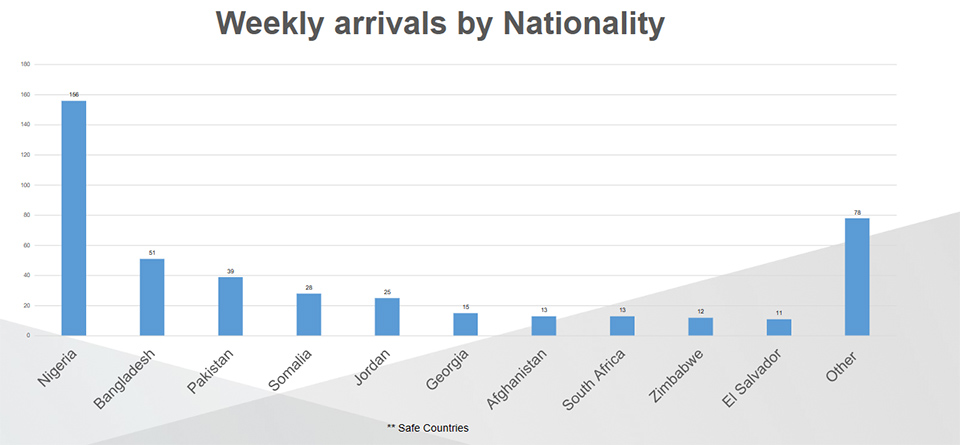
It is also apparent that while the Government’s stated objective of curbing the numbers coming here to claim asylum from Georgia and Algeria has been mostly successful, that gap in the market has not only been compensated for but exceeded by those arriving from elsewhere, and in particular from Nigeria.
Nigerians now make up the biggest proportion of any national grouping accommodated in the 269 IPAS and emergency accommodation centres as well as in the National Reception Centre, Citywest and three tented accommodation sites. New centres are opening every week and there will be an increased demand for them if the current influx continues to be unchecked.
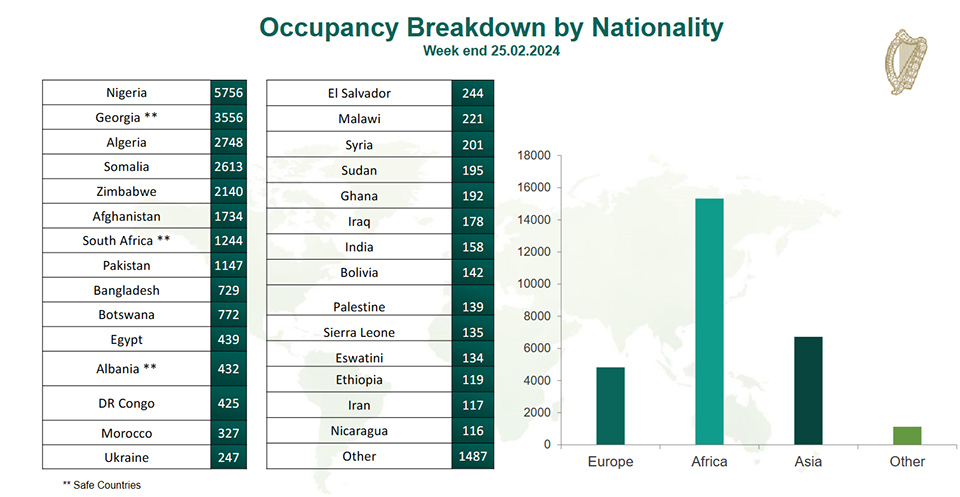
The only reason that so many Nigerians are arriving to claim asylum here is because there is already a large resident community, many of whom have been allowed to remain in Ireland despite a very high rejection rate of applications for asylum from Nigerians on first instance or on appeal.
Many of those who remain go on to claim Irish citizenship and as we reported yesterday EU statistics show that Ireland granted the fourth highest number of citizenships to persons formerly of Nigerian citizenship in 2022.
Given that there is no internationally recognised war or human rights crisis that would justify such a large number of people claiming asylum from Nigeria – and that is reflected in the international statistics for applications – it must be accepted that the main driver is economic. Many would also seem to come to Ireland having previously resided in other countries, in particular the United Kingdom.
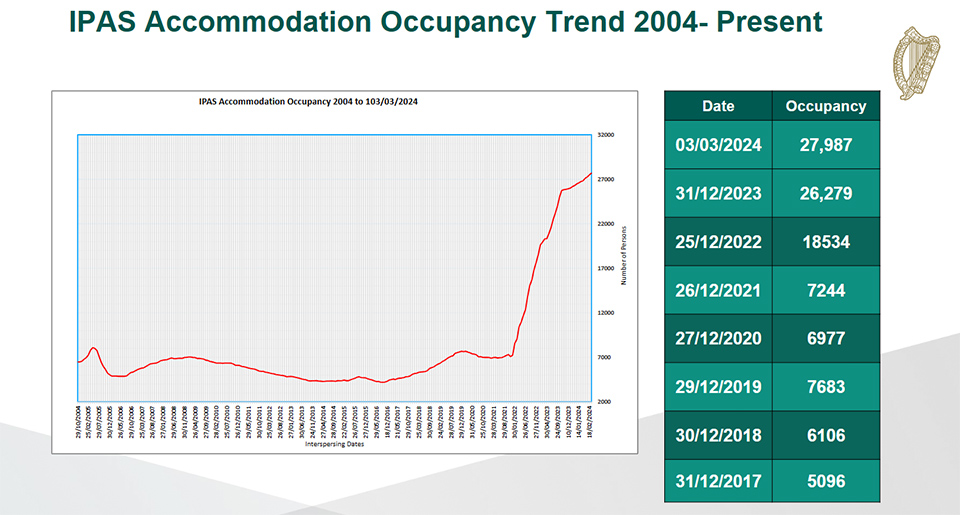
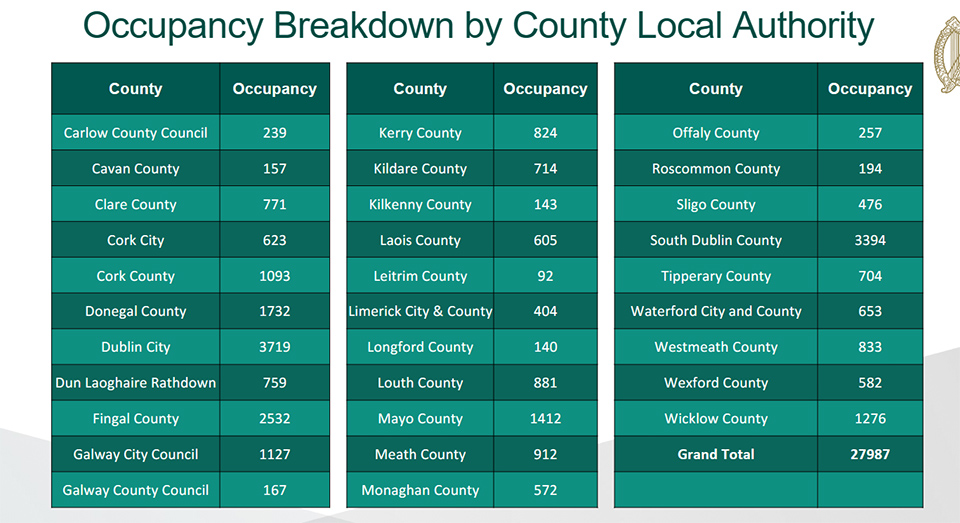
The figures for occupation rates across the 26 counties suggest that there is little existing capacity to absorb so many new arrivals. This has led to a renewed push by the state to contract private businesses, and in particular hotels, to take in International Protection applicants. With the inevitable consequence that this leads to local unease and almost invariably now sustained protests.
It is hardly a scenario that the current government would wish for, especially if as seems likely the number of daily and weekly arrivals continues to increase steadily in the weeks and months leading to the European and local elections that are scheduled to take place in June.
The dramatic and sudden reduction in the numbers coming here from Algeria and Georgia prove that it is indeed in the capability of the state to pretty much cut off access to the state when it has the will to do so.
If they can do so in those cases, despite having assured us for years that this was either impossible or would be unconscionable, then surely they can apply the same restrictions on other economic migrants who chose opportunist asylum seeking ahead of legitimately applying for work through the permits system.