The national curriculum body (NCCA) has removed a section from its document advising SPHE teachers which said that school students should be told that what they discussed in the class was not to be shared with anyone.
The NCCA document – What makes a safe SPHE classroom? – previously stated on page 3, under the heading of ‘Child protection’, that “what is said in the group/class stays in the group, and this goes for the teacher too.”
The statement had led to expressions of concern from parents and teachers who said that it amounted to a “kind of non-disclosure agreement for schoolchildren” which put teachers in a position where they were asked to be in “breach of safeguarding norms”.
The document outlines that in “SPHE/RSE, children and young people are learning important, and sometimes challenging things about themselves and others,” adding that from the outset, it is important to be clear about boundaries and ground rules for how the class will work together, in addition to child protection.
It also states that “establishing ground rules (also called a class contract/agreement) may make it easier” for students to safely participate in the SPHE class.
The document then went on to state that “Confidentiality within the context of the SPHE classroom needs to be discussed fully with students and the discussion might include the following”: with the following bullet pointed instruction –
- “what is said in the group/class stays in the group, and this goes for the teacher too.”
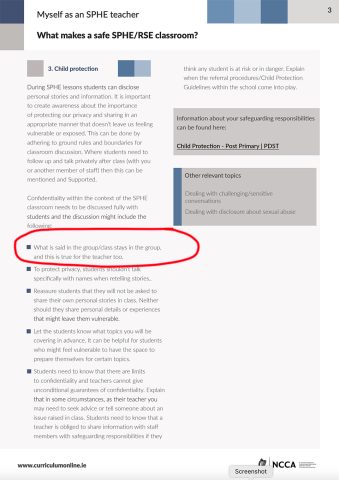
In a viral video which revealed what had been presented to SPHE teachers on a DCU course, Mary Creedon who had taught SPHE for over 16 years, said that she felt a direction to teachers to create ‘class contracts” where school students were told not to discuss what had happened in the lesson outside the classroom was a “serious safeguarding issue.”
“Why the secrecy,” she said. “Why would we tell children not to discuss this with anyone – and clearly that includes their parents. This is contrary to all we have learned about child safeguarding, especially given the content of these lessons. Parents need to wake up and realise what is going on.”
Laoise de Brún of campaign group The Countess said that the instruction amounted to “a kind of non-disclosure agreement for schoolchildren.”
“Parents deserve to know who signed off on this idea? The Minister for Education Norma Foley must be brought before a committee to explain this breach of safeguarding norms, of the Education Act 1997, of the Children First Act and of the robust Constitutional rights enjoyed by every Irish parent,” she said.
“The lack of accountability of this government is chilling. Spending our tax money on bike shelters and hospitals if it was water, and indoctrinate our children into gender ideology and queer theory in the classroom against the express will of parents who made their views crystal clear in NCCA consultation. Like ‘Hate speech’ the wrong answer came back and was simply ignored. Parents are seething, and rightly so. The vast chasm between these vacuous ideologues and the values of everyone else deepens and widens everyday and yet they plough ahead cheer led by a craven media,” she said.
The instruction specifying that what is said in the class stays in the class has now been removed from the NCCA document online.
Alan Whelan of the Catholic Secondary Schools Parents Association (CSSPA) said that his organisation had written to Oide, the new support service for teachers and school leaders, funded by the Department of Education, which has instructed SPHE teachers in in-service days regarding the new SPHE curriculum, with concerns about the class contracts.
“As president of the CSSPA, I have been made aware of safeguarding concerns in respect of instructions reportedly given to school faculty by an OIDE presenter,” he wrote. “The OIDE Presenter reportedly advised faculty of the importance of the teacher developing a class contract with the students to ensure that issues discussed during SPHE would remain confidential and not be discussed by the students elsewhere.”
He said the CSSPA “believes that discouraging children from speaking to their parents about matters relating to sex and relationships, whether discussed in the classroom during SPHE or otherwise: (a) creates an ethos of secrecy, which offends all child safeguarding principles, (b) potentially creates mistrust between parents and their children, (c) could ultimately make the children more vulnerable to predatory behaviour due to a lack of openness with their parents; and (d) offends Article 42 of the Irish Constitution which acknowledges parents as the primary and natural moral, intellectual, physical and social educator of their children.”
A reply to Mr Whelan from Oide seen by Gript said that, in relation to the idea of a class contract, “The Oide PP SPHE Team share the guidance provided in the NCCA’s document ‘What makes a safe SPHE classroom?’ which advises:
Establishing ground rules (also called a class contract/agreement) may make it easier for these students to safely participate. Ground rules make explicit the roles, rights and responsibilities of all involved in the learning relationship. They also ensure respect for people’s privacy and establish appropriate boundaries for what should and should not be raised in classroom discussions.
“The professional learning provided to the faculty of the school, on which you have based your concerns, is aligned with the guidance provided by the NCCA and is quality assured by a number of stakeholders in education, including the Inspectorate and the Teacher Education Section (TES) of the Department of Education,” the Oide reply stated.
Addressing other concerns raised by Mr Whelan, Oide also said that the Oide SPHE Team had also based its instructions regarding “heteronormative language” and “personal pronouns” on NCCA’s documents for schools:
Heteronormative Language:
The Oide PP SPHE Team share the guidance provided in the NCCA’s document ‘What makes an inclusive SPHE classroom?’ which advises:
Use affirming and gender-inclusive language. Avoid heteronormative language and assumptions, such as referring to romantic relationships only in terms of boy/girl relationships and binary-based language that doesn’t take into account the diversity of ways that people can express gender and sexuality.
Personal Pronouns:
The Oide PP SPHE Team share the guidance provided in the NCCA’s document ‘What makes an inclusive SPHE classroom?’ which advises:
When you greet your students for the first time, announce your name and pronouns (e.g. “My name is Ms Murphy and my pronouns are ‘she/her’). This signals that you are aware and respectful of the fact that not everyone will use the pronouns that people expect or the name and pronouns that are on official records.
The NCCA told Gript in response to queries that some commentary about SPHE “refer to confidentiality within the SPHE classroom and suggest that students are discouraged from talking to their parents about their learning in SPHE. This is absolutely not the case”.
“The role of parents as partners in all aspects of their child’s education is strongly supported in SPHE. SPHE learning is a shared responsibility that does not begin or end in the classroom. It is most effective when there is a partnership approach between the school and home. This involves regular communication that builds mutual understanding about the role and value of SPHE in young people’s education,” the Curriculum body said.
“In recent queries and commentary about SPHE, the bullet in question was isolated from its context as one of five bullets presented within a broader section on Child Protection, and was misconstrued,” they added.
However, Laoise de Brún said that this amounted to “plausible deniability”, adding that “the NCCA would rather remove a bullet point that expressly stated “what is said in class stays in class” and pretend it was never there in the first place rather than face up to the massive breach of safeguarding this guideline would create in classrooms across Ireland”.
“As with mixed-sex toilets in schools, we at The Countess have learned the hard way that the Department of Education is so captured that the only concessions made are done to avoid a public furore. It is a cynical exercise only. They want the story to die down and to go away. The Minister will no doubt continue to say precisely nothing in response to parents’ concerns waiting for the story to fade,” she said, calling for a full review of the SPHE curriculum.
Alan Whelan said that to when the CSSPA had written to Oide with safeguarding concerns in respect of class contracts they felt their concerns were dismissed. “They seemed to say secrecy contracts are alright because NCCA says so,” he said. “The Department of Education, NCCA, OIDE and other agencies are beginning to to see the seriousness of their neglect of parental consent for their SPHE curriculum.”
The revised SPHE curriculum continues to be the subject of controversy, with revised some of the new schoolbooks featuring, amongst other things, an 8 page lesson on masturbation for 13-year olds, an “anti-Irish” depiction of a GAA-loving, traditional music playing family as narrow-minded bigots, and repeated presentations of gender ideology as fact.