A report from the European Council on Foreign Relations (ECFR) on the likely outcome of the June elections to the European Parliament is being relatively widely quoted today.
The reason for this is that they foresee a “sharp right turn” for the EU’s parliament and they are not happy about what that might mean. .
All grist to the mill, of course, for a liberal media that is obsessed with any potential challenge to their current hegemony, not least in Ireland where that hegemony – shared on almost every key issue by Fine Gael, Fianna Fáil, Sinn Féin, the Greens, Labour, Social Democrats and even by the communist far left when it comes to abortion and other “social issues” – is only challenged by a small number of members of the Oireachtas.
The European Council of Foreign Affairs sounds very official which lends a certain gravitas to its pronouncements. It ought not to. The reality is that the ECFR is little more than a left liberal NGO.
It was founded in 2007 with start-up funding from the George Soros Open Society foundation, and has also been funded by the Sigrid Rausing foundation and the giant Italian based UniCredit bank.
The Irish taxpayer, through the Department of Foreign Affairs, partly funds this left liberal NGO. Why? Do we not have enough of our own? And among the corporations who chip in to ensure that the European Council on Foreign Affairs is not forced into unseemly begging are Amazon, Apple, Google, Nokia and Ericsson.
The ECFR was founded by Mark Leonard who is the son of former Labour MP Dick Leonard, a prominent figure on the pro-European Gaitskillite wing of the party. Mark Leonard sometimes writes for The Guardian where he was wont to advise Labour on how best to combat those arguing for greater autonomy from the EU.
He was also among the bright young things once selected as a Young Global Leader by the World Economic Forum, whose badge has illuminated the lapels of many a Irish liberal politician from Leo to Mary Lou.
The Council is dominated by personalities and perspectives of the European liberal left. Among its founding members were former Finnish Social Democratic President Ahtisaari who played a role in the taming of the Irish republican movement.
Anyway, all that is just to let you know where their discomfort regarding the right may originate. The report itself, while clearly designed as a “wake up call” and to provoke some unspecified “action” by member states to preserve the left/centre right liberal majority, does contain an interesting overview garnered from an analysis of election tracking polls.
Their basic thesis is that the right, including the three main factions of the European Peoples’ Party (EPP), the European Conservatives and Reformists (ECR), (whose event last November in Kilkenny the NGO far-left in Ireland attempted to disrupt), and National Identity (ID) will have a majority in the Parliament after June.
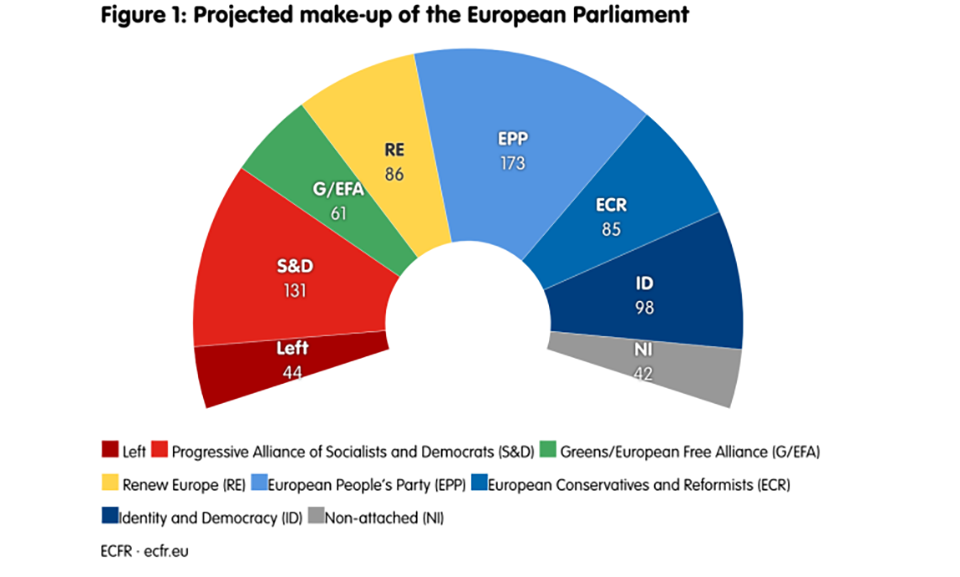
That is based on polling which is by and large confirmed by polls collated by Politico but the ECFR claim of a “sharp right turn” is somewhat exaggerated when one considers the makeup of the European People’s Party. The Irish section of the EPP is Fine Gael. It would take some serious leap of the imagination to consider Fine Gael to be on the right on any main issue other than the old definition of being a pro-corporate business party.
The same applies to many of the other constituent parties. Parties such as the German, Dutch and Danish Christian Democrats have been similarly to the “left” on issues such as migration. There are some interesting exceptions, such as some of the central and eastern European parties, and some surprising emergences such as Donald Tusk’s Civic Platform in Poland which threatens to disrupt the consensus in immigration.
Regarding their projected outcome, the ECFR says that: “on civil liberties and justice and home affairs, this could have major implications for EU migration and asylum policies, where there is likely to be a majority in the European Parliament that supports very restrictive immigration policies and will seek to push the commission to reform the EU’s asylum policy framework to allow more discretion for member states and to limit any sharing of refugee allocations.”
The depiction of the EPP in general, however, suggests that the report is little more than clever campaigning by a left liberal NGO “think tank” in the hope of shoring up the falling support for the liberal left as represented in the European Parliament.
Excluding the EPP, the polls suggest that the likely combined radical right and nationalist bloc, centred on the ECR and ID along with non-affiliated MEPs is unlikely to get more than 200 of the 705 seats. The only hope for a radical shift therefore is if elements of the EPP are pushed into a position more reflective of public attitudes on illegal immigration and migration in general.
This remains a first world problem from an Irish perspective, and one of the more optimistic notes (for them) sounded by the ECFR is of gains for the Left in Ireland. Which presumably is based on a forecast increase in the number of seats held by the now tamed and EU Commission-agenda-compliant Sinn Féin.
A party that was once in favour of Ireland leaving the EU until the Core Group decided, without any vote at an Ard Fheis, to abandon that along with most other “core values,” is not even considered to be nationalist by some of its tamers.
According to the ECFR report, there will be no gains for the “sharp right” in Ireland even if that includes Fine Gael, which is projected to do badly. Which means that any potential change in the current almost uniformly liberal composition of the Irish group will depend on new parties and candidates from outside of the establishment making a breakthrough.
Polling figures on migration and indeed the support levels for “independents and others” – as high as 16% and 17% in recent months up from 10% in January 2023 – might provide some potential for such a development but it has certainly not crystalised as of yet around any specific groups or potential candidates.