I have a vague memory, sometime from the early 1990s, of my mother running the Dublin Women’s Mini Marathon. It was, as I recall, part of an initiative to raise money for my primary school, on whose board of management my mother served as the parent’s association representative. Either that, or it was a collective motivational effort on behalf of the local “keep fit” organisation she attended at the time. One or the other, anyway.
The point being, it will not I hope embarrass my mother to say, she got a medal. Not for finishing first or second, but one of those medals they give out to participants as a commemoration of the day: That she had trained for and completed the ten kilometre distance.
It’s a mini marathon, but it’s no joke. In my experience, anybody who runs a “10k” whether as part of the mini marathon or just on their own accord, likes to talk about it. I myself have never managed much more than the one hundred metres, being as I am built for short bursts of activity rather than consistent exertion. (This is where there would be an editor’s note expressing skepticism, had I not the privilege of being the editor myself).
In any case, it is worth remembering why the women’s mini marathon came into existence. History tells us that it was an initiative, begun in 1983, to get more women into running and fitness. In that cause it was spectacularly successful, in its heyday. It has raised eye-watering amounts of money for charity, and provided women in Ireland with an achievement to tick off the list of “life goals” for more than four decades.
Yesterday, it was announced that it is no longer the women’s mini marathon. Blokes can now enter it too, so long as they “identify” as women. Senator Sharon Keogan was amongst the great number of women less than impressed, taking particular aim at the event’s sponsor, the VHI:
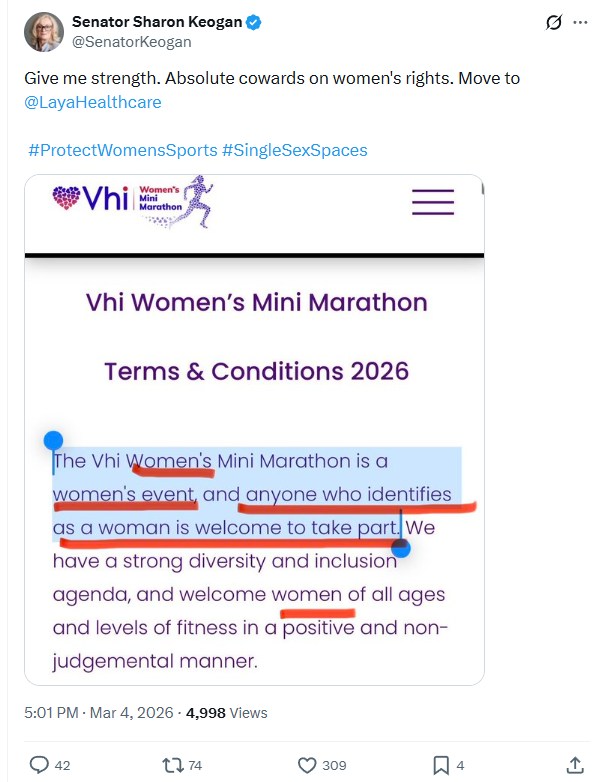
It should be noted at this juncture that the women’s mini marathon is not just a fun event: There are actual winners, which include some of Ireland’s premier female athletes in Catriona McKiernan and Sonia O’Sullivan. Last year, the winning participant, an Irish professional runner called Grace Richardson, completed the 10,000 meter course in a time of thirty four minutes and seventeen seconds.
By contrast, at the Olympic Games last year, the last placed – yes last placed – finisher in the men’s 10,000 meters finished the race in a time of twenty-nine minutes and twelve seconds, and did so during the much hotter and more oppressive conditions of Paris in August, as opposed to Dublin in April. Had that Japanese athlete competed in the Dublin Women’s Mini Marathon, he would have finished a minimum of five minutes and five seconds ahead of the field.
It is very likely, in other words, that a reasonably well trained biological male who identifies as a female will finish miles ahead of the majority of the field. This may not happen this year or next, but we can reasonably foresee a situation where the women’s mini marathon will be won outright by a biological male.
For some reason, in this bizarre feminist society of ours, that’s one of the few outrages against women that cannot be spoken about openly. We can assume, for example, that there would be grave political disquiet were UCD to appoint a male head of the department of women’s studies. Or if the Taoiseach of the day did not appoint the mandated number of women to cabinet.
But this nonsense of course does not affect important people like academics or politicians in high powered jobs. It instead affects the ordinary women of Ireland, who have – in the week of holy International Women’s Day – had an event that was previously just for them be made one in which they must compete against men. In the name of equality.
This is nuts. Senator Keogan knows it is nuts, and so do the vast majority of Irish people. It simply remains the case that not enough of us feel confident enough to stand up and say so in public.
That, I’m afraid, must change. And it will take women, rather than blokes like me, to change it.