A well known right wing and nationalist activist, Stephen Kerr, was arrested last week, over accusations that he threatened to kill an Irish Independent journalist. The accusation against him is so ludicrous on its face that it should raise very serious questions for An Garda Síochána.
Ireland’s police force has a long-standing policy of not commenting on the details of ongoing operations and investigations. This is a policy that is operationally defensible – though it puts the Gardai notably at odds with police forces elsewhere in the world, such as in the United States or Australia. However, the policy means that the Garda standard for deciding to investigate and make an arrest in a case is essentially a “black box” from which no information can be extracted officially.
In this case, the decision to make an arrest looks very strange indeed. Let’s start with the context.
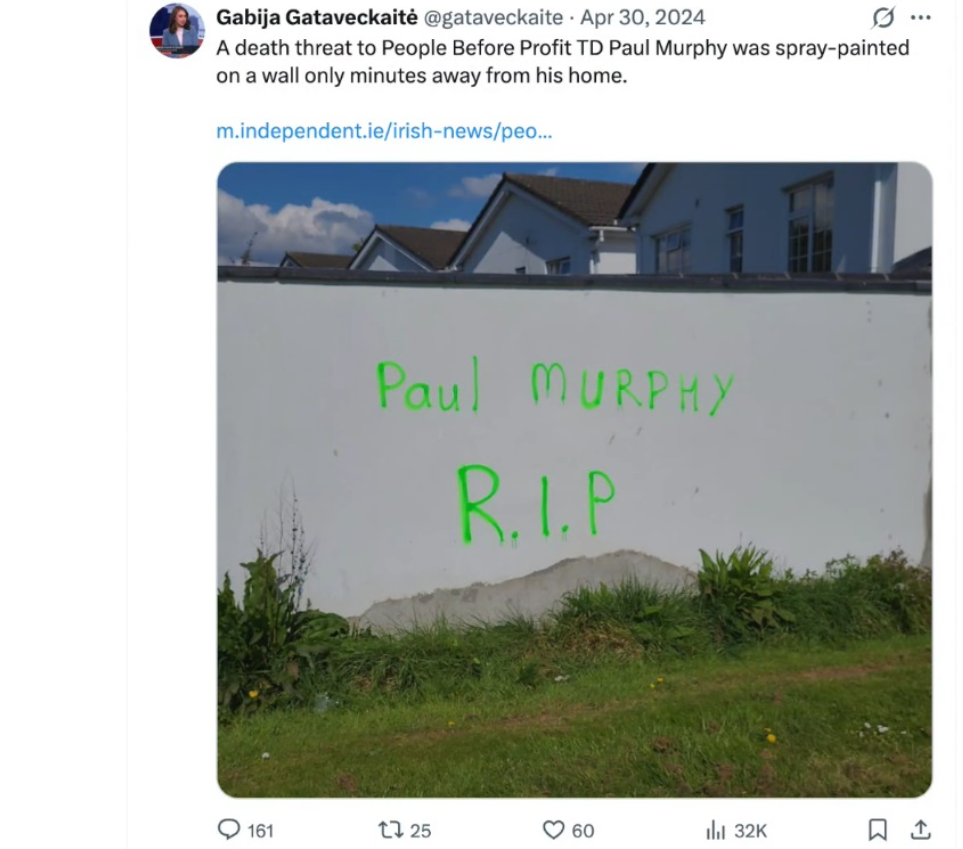
In 2024, almost two years ago, then Irish Independent (and now BBC) journalist Gabija Gataveckaite (a fine reporter who is utterly blameless in this matter and who has done nothing wrong), sent the following tweet reporting on a Garda investigation into an alleged death threat made against People before Profit TD Paul Murphy:
Kerr, replying directly to the journalist, wrote the following:
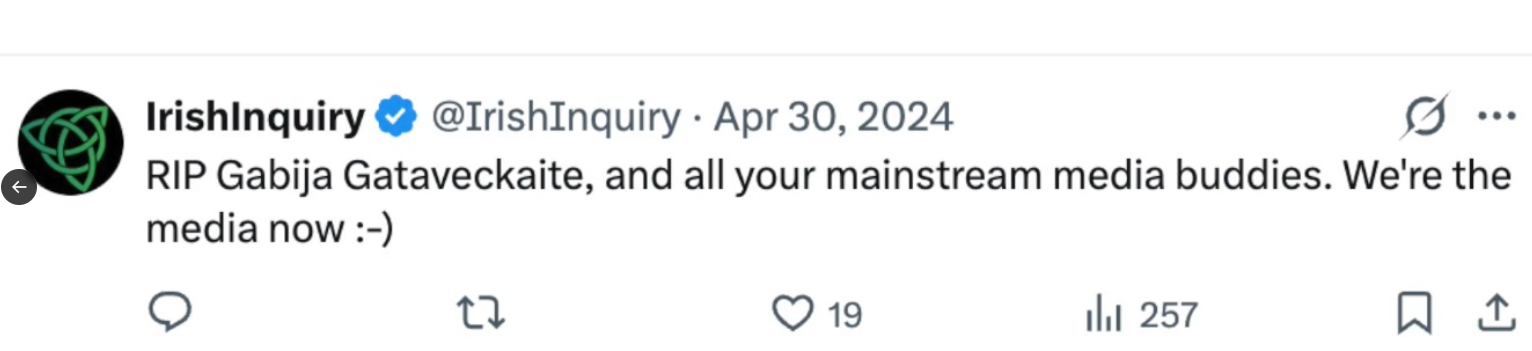
Two years later, three Gardai show up at his door, having travelled from Dublin to make an arrest on the basis that his tweet may have constituted a “death threat” to Ms. Gataveckaite. Kerr for his part denies any intent to threaten the journalist and describes the tweet as a “joke”.
This reporter asked the Gardai for a statement on the arrest, yesterday. A statement has yet to be received.
In any case, even were one to come in, as it presumably will hours after my deadline, Garda statements routinely provide no insight into the Gardai’s reasons for making an arrest in a case. One might say that they are duty bound to investigate every complaint made to them – this is true – but the force is certainly not duty bound to make an arrest on foot of every complaint. The fact of an arrest suggests that somewhere within the Garda hierarchy, the plain facts set out above were examined, and a conclusion was arrived at that Mr. Kerr had acted criminally in sending his tweet. That conclusion is objectively deeply concerning.
We’ll start, as we should, with the strongest possible case against Kerr, in order to give the cops the benefit of the doubt. That case is that he took language that he knew that the Gardai were investigating as a possible death threat (“RIP Paul Murphy”) and deployed that exact same language in his own tweet (“RIP Gabija Gataveckaite”). This arguably suggests that he knew before he wrote his tweet that the language he was using was considered threatening by the Gardai. Which arguably suggests a degree of precognition and recognition that what he was doing was potentially threatening in the eyes of the state’s police force. In the unlikely event this ends up in court, the state will point to this fact as “mens rea” – the guilty mind – which is a necessary element in most criminal cases where a conviction is sought.
But that’s where the case against him ends. The exculpatory evidence, by contrast, is significant.
Most importantly, there’s the fact that in a free society, one is not obligated to agree with An Garda Siochána’s definition of what is, and is not, threatening. Kerr’s tweet is clearly satirical on several levels, and is designed to present disagreement with the Gardai’s priorities. This is evidenced by several factors:
First, we can say it was not a death threat because of the final clause: “We’re the mainstream media now”. This suggests replacement, not elimination.
Second, while a smiley face at the end of a tweet does not automatically denude it of any threat, that emoji has been internet-shorthand for a friendly joke for almost thirty years.
Third, because “RIP” has been used as a form of internet slang for years in similar context: For example if a person wrote, on foot of yesterday’s first half Old Firm humiliation (later rescued by a dodgy penalty), “RIP Glasgow Celtic FC”, one would not take it as a threat to murder that team’s players, but as an expression of the club’s institutional death.
Fourth, and this is important: Even if you think Kerr’s tweet was worthy of investigation, escalating this to a level of making an arrest is extraordinary. Kerr (who unlike the Gardai, replied to my request for information) tells me that initial contact was made with him a year ago, with investigating Gardai looking for a conversation, though declining to provide him with details on which of his tweets was being investigated. That request was followed up one month ago by telephone, again looking for a conversation but declining to provide information on which tweet they wanted a conversation about. There were no further follow ups, and no further conversations.
Instead, they barreled over to Mayo, two years after the incident, to make an arrest.
Let’s discuss, by the way, that timeframe: What kind of a police force takes a death threat seriously enough to make an arrest, but only two years later? This is not, I remind you, a matter of the force having had to go to great lengths to identify the suspect: Kerr’s identity is open and not a secret.
All of this should lead a thinking citizen to ask some obvious questions about the Gardai’s motives and consistency. For example, in the aftermath of the Dublin Riots of 2023, a Limerick Fianna Fáil councillor – Abul Kalam Azad Talukder – expressed a desire to see the rioters “shot in the head”. He later apologised for those comments, saying that he mis-spoke. The record shows no arrest of Cllr Talukder.
Kerr, by contrast, is a very vocal critic of state policy on migration and various other matters. Here he is being arrested for an alleged threat, two years after he made it, over a tweet that a child would be fairly able to interpret as a joke, albeit a dumb one. Is there a rational explanation for why one man would be arrested, and the other not?
If it looks like politically motivated policing, and it feels like politically motivated policing, then the Gardai should be concerned. And in this case, it looks and feels exactly like that.
This one, I suspect, will never see the inside of a courtroom. And when it does not, there should be serious questions asked as to why Mr. Kerr’s freedom was taken from him, even temporarily. And as to why two or three years of Garda resources were diverted to this investigation. And on whose orders.