On Sunday, The Times of Israel reported that former British Prime Minister, Tony Blair, had been asked by the Israeli government to act as a mediator with states who the Israelis were planning to request to take refugees from the conflict in Gaza. Blair had been in Jerusalem where he had met with Prime Minister Benjamin Netanyahu.
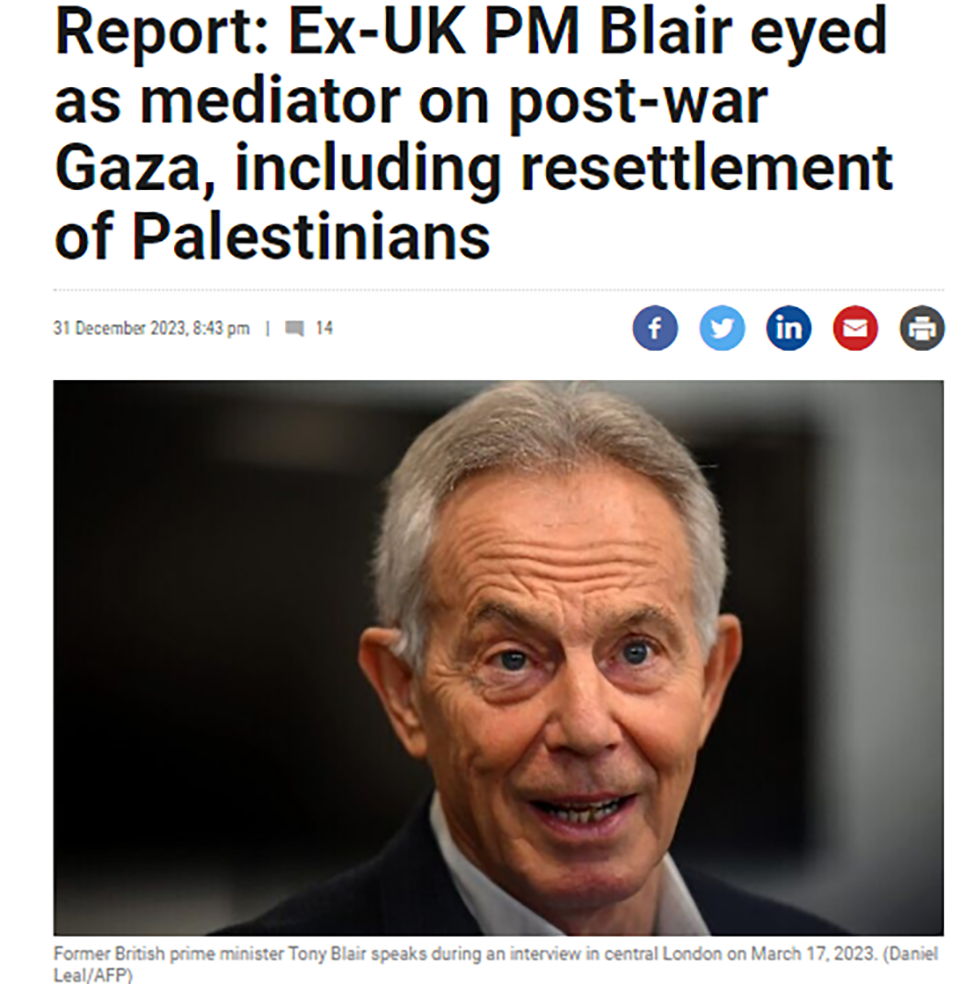
Another member of Netanyahu’s cabinet, Finance Minister Bezalel Smotrich welcomed the news and saw it as facilitating a situation in which the population of Gaza would be reduced from around 2 million to 100 or 200,000.
A spokesperson for the Blair Institute for Global Change denied that any such plan involving Blair was under consideration and that if it did come up, that Blair would “not even consider such a thing.”
There was some speculation that the denial was linked to the release of British state archives which appeared to show that Blair had previously considered, but not implemented, a much tougher stance on immigration than one with which one might normally associate him.
Nonetheless, whatever about the involvement of Blair, it is clear that the Israelis at senior levels are actively considering a policy of mass evacuation of people living in Gaza. While some have pitched that in terms of a “temporary resettlement,” not only is that not what is apparent from the public narrative, but such “temporary” resettlements seldom if ever turn out to be “temporary.”
A former Israeli Counsel General in New York, Moshe Yegar, wrote a piece for Srugim last week in which he declared that “The Gaza Strip must be emptied of its Arab population, at least most of them. It may not be an easy or short process, but it will be better, and cheaper than any other proposal that ends up taking us back to the previous situation that inflicted on us the October 7 disaster.”
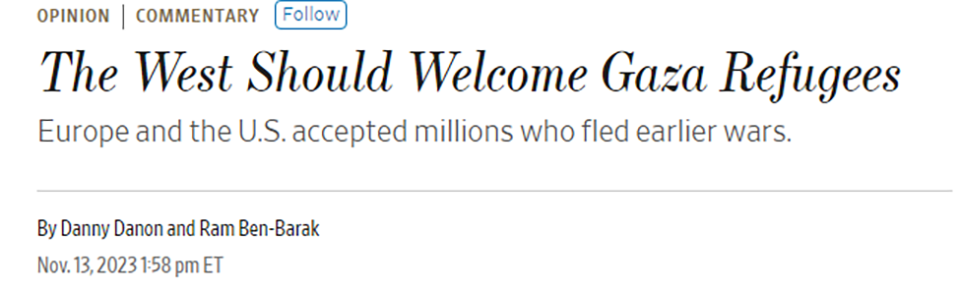
This theme has gained increasing prominence since the Hamas attacks led to the Israeli assault on Gaza. In November the Wall Street Journal published an op-ed jointly written by a member of the ruling party Likud and a member of the opposition liberal secularist Yesh Atid arguing for the west to take displaced Palestinians.
A Direct Polls survey of Israelis published on Christmas Eve showed that 83% of respondents were supportive of “encouraging the voluntary emigration of Gaza Strip residents.” Where do they think all of these displaced persons might go? And for how long might they remain there?
What is clear is where they will not go. Statistics from 2022, and therefore prior to the current conflict, show that of 8,552 persons from Palestine who claimed asylum worldwide, that just 511 did so in North Africa or the Middle East. Of that limited number, just 10 were accepted. There are no details regarding the reasons why Palestinians claimed asylum, and some proportion may have been people fleeing Hamas in Gaza or the Palestinian Authority controlled by Fatah.
On the 75th anniversary last May of the original 1948 displacement, the United Nations Relief and Works Agency (UNRWA), which deals exclusively with Palestinian refugees, reported that there were 5.9 million registered Palestinian refugees. Around 1.5 million of those refugees live in 59 camps operated by the UNWRA within the Palestinian territories, Lebanon, Jordan and Syria.
Others live in Arab countries such as Egypt which is home to 300,000 Palestinians. Around 2 million live in Jordan, with another million divided between Lebanon and Syria. Egypt has been the main destination of people from Gaza fleeing across the Sinai desert since the current conflict began.
Not surprisingly, Egypt which accommodates around 9 million refugees – 9% of the population of more than 100 million and mostly Sundanese, Syrian, Libyan and Yemeni – is not anxious to take in potentially more than one million displaced Palestinians.
Nor is Syria, traditionally the most sympathetic of host countries, or Lebanon and Jordan which have been significantly disrupted over the decades by their connection to the Palestinian diaspora in any position to do so.
The wealthier Islamic states such as Saudi Arabia, the United Arab Emirates and Qatar have much smaller numbers, despite their vast wealth and Qatar’s massive support both for Hamas and for those in the west who support Hamas and the more extreme positions on the existence of Israel. It is surely they who ought to bear the burden, on their own territory, for any new mass exodus?
What is more noteworthy is that Israel itself is clearly not favourable to displaced persons from Gaza moving into states on their borders, other than Egypt that is safely across the Sinai. Which explains their apparent enthusiasm for having what some clearly hope to be up to 2 million Palestinians taken in by western states, meaning overwhelmingly the countries of western Europe.
A cynic might describe this as potentially forming a part of any strategy Israel might have to end the conflict: “We will stop attacking Gaza, if you agree to take in people who will be safe in case we need to go back and teach Hamas another lesson.” Or perhaps even: “You like them so much, you have them.”
Whatever one might think about the rights or wrongs of how Israel chooses to police its borders, Europe ought not be part of a solution that would involve the transit of hundreds of thousands of Palestinians to be granted residency in EU states.
There is also the danger that the EU centrally might take the view that the Palestinian conflict if it is not resolved soon represents a similar crisis to that in Ukraine. Which would potentially allow the Commission to decide under Directive 2001/55/EC that the “mass influx of displaced persons” places an obligation on member states to accommodate such persons.
If that does come to pass, then it is vital that the Irish state invoke the provision outlined in Article 25 of the Directive to set a limit “in numerical or in general terms” on the “capacity to receive such persons,” and to refuse to take any more than the numbers indicated.
The Irish state would appear not to have set out any such figure with regards to the Ukrainian refugee crisis – which explains the disproportionate per capita numbers of refugees currently resident here. The state clearly lacks the capacity to accommodate current numbers of people claiming either Temporary or International Protection. In so doing it would merely be following the example of other EU states in either openly or tacitly setting such limits, as is also clearly indicated by per capita figures in France and other member states.
Failure to do so would see this state become a prime location for large numbers of displaced Palestinians should a scenario similar to the one suggested above come to pass. This is especially true given that there would be only too many within the political establishment and NGO sector who would regard this as another marvellous opportunity, even if it were to suit the interests of their current Enemy Number One.
Israel may feel that it has the right to do whatever it wishes in order to preserve itself. It does not have the right to do so at the expense of the entire West. Nor ought Europe again pay the price for extreme interventions against regimes that might perhaps be better kept in their place, but allowed to continue to exist once they did not interfere with the rest of the world – which appears to be the centre of the Egyptian peace proposals.
Of course, those who have contempt for the West are not going to be chastened by European and American leaders who no longer for the most part themselves have any respect for those traditions. Unless that changes, Europe will continue to be the fall guy.