The reaction of the Chinese Embassy in Dublin to the meeting of representatives of the World Uyghur Congress with United Nations Rapporteur Mary Lawlor Department of Foreign Affairs officials was interesting.
Its tone could be mistaken for nothing other than that of an exasperated and disappointed superior, annoyed at the temerity and bad manners of an underling who has forgotten their place. Obviously the Chinese feel that their recent magnanimous ransoming of Richard O’Halloran has earned them an exception on all their other business here.
The Uyghur delegation was led by WUC President Dolkun Isa. He was a leading activist during protests at Xinjiang University in 1988 at the beginning of what has become a brutal campaign of terror against the majority Uyghur population in that region. Isa fled China in 1994.
He has been accused of involvement with the East Turkestan Liberation Organisation which China claims is an Islamic State affiliated terrorist group but the evidence even for its existence let alone any meaningful activity is dubious. Most of the Chinese claims appear to be based on the torture and confessions of people who were arrested for what in other countries would be considered normal democratic and even academic activities.
The WUC team met with the UN Special Rapporteur on Human Rights Defenders @MaryLawlorhrds and with the Irish Foreign Ministry, @dfatirl in Dublin to urge them to take action on the #UyghurGenocide. pic.twitter.com/2LjyXE1bgp
— World Uyghur Congress (@UyghurCongress) February 21, 2022
His official engagement is significant in that the Chinese have successfully persuaded other countries to refuse entry by Isa in recent years, and he has been subject to a variety of harassments in the course of his attempts to highlight the Uyghur genocide.
Which is what has annoyed the Chinese, who are used to a much more subservient attitude on behalf of the Irish elite. The Embassy statement is quite strident and goes well beyond the type of language that would constitute normal private, let alone public, communications between two sovereign states.
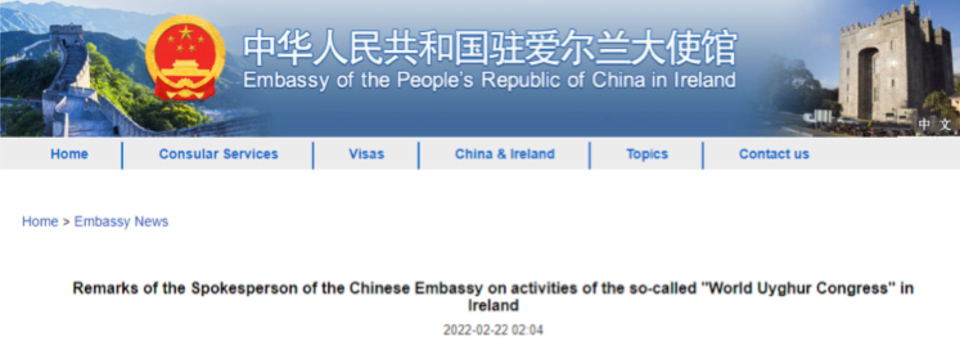
The Ambassador was certainly not mixing words.
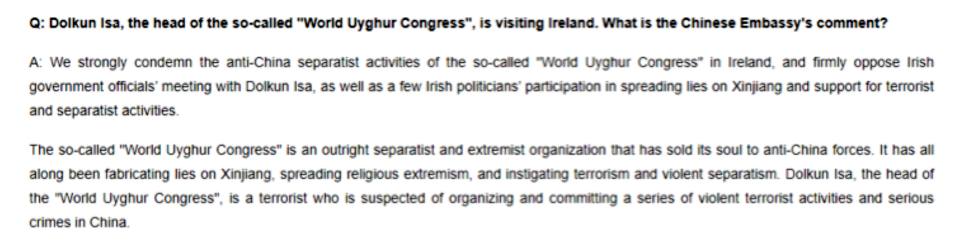
It is interesting that they particularly signal out those “few Irish politicians” – and they are shamefully few in number – who have taken the right stance with regard both to China’s treatment of its own citizens, and the unhealthy relationship that appears to exist between the Chinese Communist Party and powerful interests in Ireland.
The statement concludes with a warning or perhaps just friendly advice to those criticising China to “stop parroting disinformation.” Which segues nicely into another media story this week concerning China’s interests and interest in Ireland.
This was provided by a leaked email from the President of University College Dublin, Andrew Meeks, accusing unnamed faculty and staff members of having made “misguided” criticism of the Confucius Institute which operates on campus as it does in several other Universities here including Cork and Belfast.
The Confucius Institute is part of the Irish Institute for Chinese Studies at UCD and the Director of both is Professor Liming Wang, to whom we previously referred in connection with the activities of the Ireland China Institute of which he is a board member. Liming had formerly been a director of Mainstream energy which was the company established by Eddie O’Connor who is a former CEO of Bord na Móna and Airtricity and who was also a member of the board of the Ireland China Institute where he shared his admiration for the “great achievement of General Secretary Xi.”
More to the point, Liming Wang was a member of the Advisory Committee of the Overseas Chinese Affairs Council which operates as a section of the International Department of the Chinese Communist Party.
The Confucius Institutes were created by the party in 2004 by then General Secretary of the CCP Hu Jintao, so to imply as Professor Deeks does that they are somehow an independent academic body is at the best naïve.
There are around 500 Confucius Institutes based mostly in universities in the west where they have been described by David Shambaugh one of the foremost experts on the Chinese Communist Party as coming directly under the control of the Party’s propaganda department.
Confucius Institutes have been closed in other western countries due to concerns over their activities and influence. It is therefore quite proper that Irish academics and students, even if they constitute a minority, draw attention to their relationship with Irish universities. Particularly in the light of the fact that the Confucius Institute in UCD is involved in the teaching programme, and that a building used by the Institute for Chinese Studies was partly funded from China.