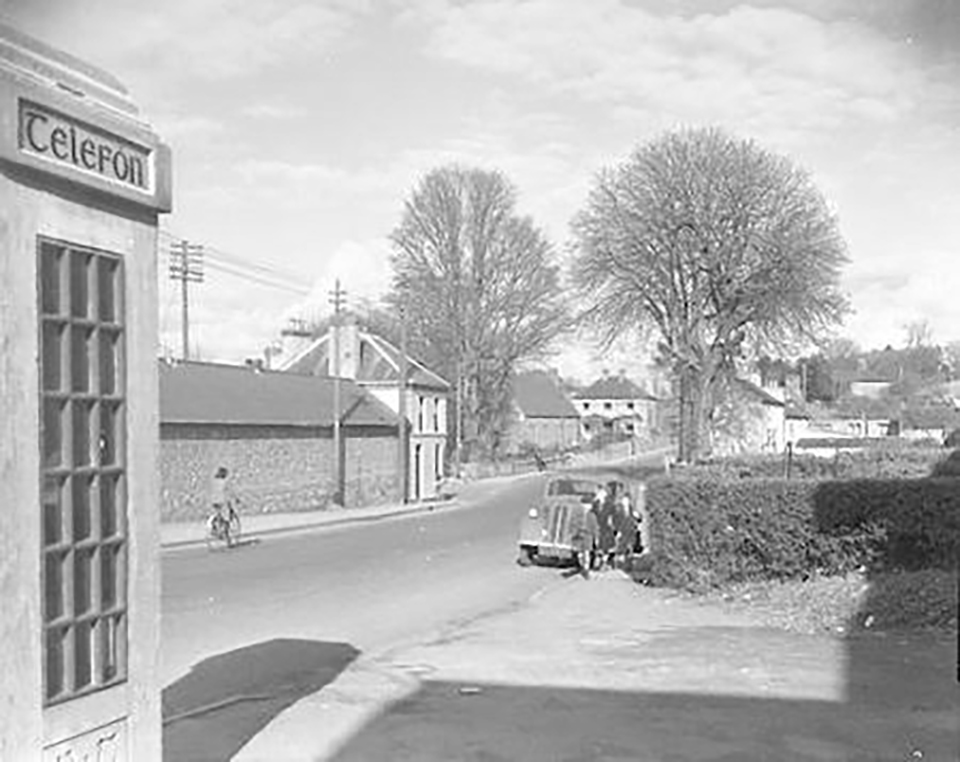
Browsing through the list of Parliamentary Questions, as one does when at a loose end, I came across one from Dublin Mid-West Independent TD Paul Gogarty which asked the Taoiseach for a breakdown of the population of Lucan as recorded in each Census since 1981.
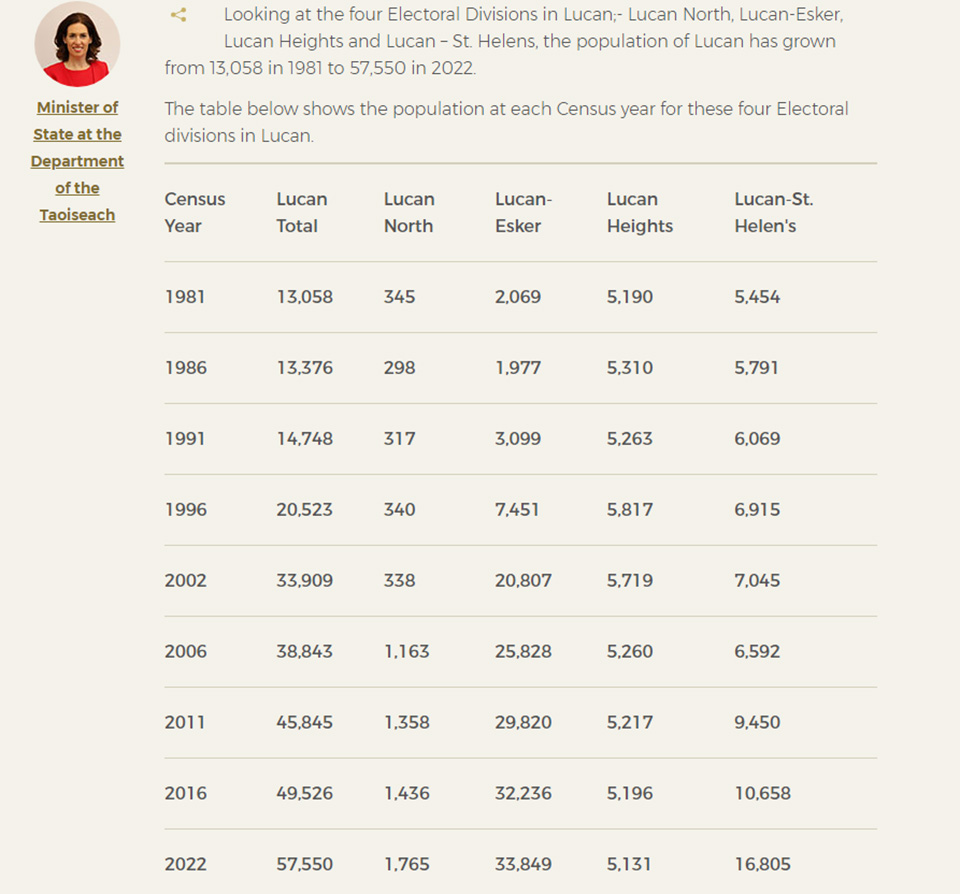
The Taoiseach being busy, the task fell to his Minister of State Hildegarde Naughton and the figures certainly jump out. The overall population of the four Electoral Divisions that make up the Lucan electoral area had increased by 341% between 1981 and 2022.
Which is quite astonishing for those of us who can hark back to the 1980s when a trip to Lucan to play the Sarsfields in hurling was almost the equivalent of making one’s way to the exotic and far off lands of Wexford. Not quite but you get the picture.
As with other parts of County Dublin, the rate of population growth in Lucan has outpaced that of the state as a whole. In 1981, the population of the 26 Counties was 3,443,405. That had increased by 1,705,734 to 5,149,139 up to the night of the 2022 Census. A much more modest increase than that of Lucan, but nonetheless a significant one of just under 50%.
So, what accounts for the difference? Well, a combination of inward and external migration. The first being made up of Dubs from older parts of the city and suburbs who moved out as the city expanded, and a lot of people who migrated to the Dublin suburbs and especially the newer estates from other counties. Hence, the improvement in the standard of hurling beyond in Lucan. (I joke.)
Ireland was a very different place back 44 years ago of course. If you were to subscribe to the revamped Angela’s Ashes narrative as retold by such towering public figures as Bambi Thug and others, it was the equivalent of Germany in the 1940s or Massachusetts during the 17th century witch trials as reimagined by Arthur Millar in The Crucible.
Of course it wasn’t. We had no mobile phones, electric cars or Netflix. Neither did anyone else. Not even in the cool places that our survivors look up to as exemplars of modernism. Every country is materially better off than they were in the 1980s.
Although, I might also throw in that an ordinary working class or even middle-class family was much more likely to be able to buy their own home during their own lifetime in the 1980s than they and especially their children and grandchildren are now.
1980s Ireland was also a time before the huge demographic change we have witnessed especially over the past 25 years. Lucan, as we have seen and as we will return to, is a particularly striking but not unique example of this.
In 1981, 93% of the population of the state as recorded in the Census had been born in the 26 counties. Of the 6.75% who had been born outside of the state, more than 40,000 were also Irish-born north of the border and 146,000 had been born in Britain, probably most of them to Irish parents who had returned here as many did in the 1960s and early 70s when the tide of emigration of Irish-born people was briefly reversed.
Of the remainder of the population of the state not born in the north or in Britain, just 45,509 or 1.3% had been born in other EU countries, the United States or elsewhere.
By 2022 we had seen an enormous change with the Census showing almost 20% of the population had been born outside of the state, with persons born in the north and in Britain now a far smaller and decreasing proportion of that.
The figure for people born outside of the state was under 17% in 2016 and both metrics can be seen clearly illustrated in Lucan. It should be pointed out as a statistical point that not everyone who filled in a Census form in 2016 or 2022 gave their country of birth. Thus, for Lucan, while the total population in 2016 was 49,526, 179 people did not provide a place of birth. That had increased to 393 in 2022.
Of the 49,347 who provided a place of birth in 2016 in Lucan, 36,427 or 74% said that they had been born in Ireland. Which means that 26% had been born outside of the state. A figure already much higher than the average for the state.
In 2022, 38,023 people living in the Lucan electoral district said that they had been born in Ireland. That was 68% of those living in Lucan compared to 17,762 or 32% who had been born outside of the state. Quite a significant change over the course of just six years. The population of Lucan itself only surpassed that figure shortly before the 1996 Census.
The citizenship figures are also interesting as we have noted before that many commentators use the total number of non-Irish citizens as a measure of the level of immigration. Which is, to be kind, not entirely accurate. Persons who are granted Irish citizenship were still born outside of the state so their place of birth is the relevant metric, not citizenship.
That can also be seen in the figures for Lucan where 4,481 persons who recorded themselves as Irish citizens had not been born in the state. So anyone using citizenship as a measure of the level of migration, as did RTÉ and others, would have claimed that the non-Irish population of Lucan in 2016 was 17.3%.
Likewise, in 2022, 78% of people living in Lucan claimed to be Irish citizens which is 10% higher than the actual number of people who were born in the state. The number of persons who had been born outside of the state but had become Irish citizens was 5,396.
Whatever one might think about whether all of this is a good thing or not, there is no denying that it is taking place. Some do, schizophrenically in not a few cases as they one the one hand will celebrate the ever-growing numbers of non-nationals living here as if it was the best thing that ever happened to us. On the other they will massage the statistics to pretend that it is not happening on the scale it is.