Ireland’s immigration debate often pivots around the issue of so-called “undocumented migrants” – that is to say, people who present to immigration authorities without any passport or travel papers.
This is significant, because in essence, this means that the government has absolutely no idea where these people are from, or who they are. Naturally enough, it’s impossible to vet such a person or investigate their background, considering the fact that they could literally be from anywhere. You don’t even know their real name or age, beyond what they tell you, and have to simply take this random stranger at their word.
Now, why is this noteworthy?
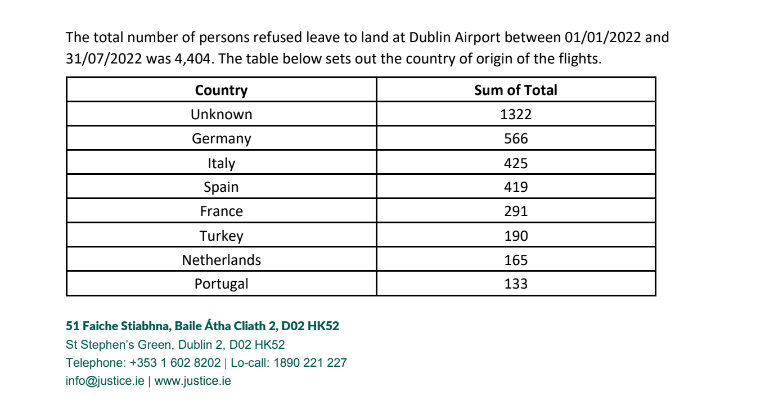
Well, according to a new FOI seen by Gript from the Department of Justice, between January and August of this year, a whopping 4,404 of people entering Dublin Airport were initially refused the right to pass through immigration into the country. And of these, 1,322 had their country of origin recorded as “unknown.”
NOTE: Not the full figures, the FOI contains another page
This means that these individuals refused to present any relevant papers, and would not even disclose where they had come from to the relevant authorities.
While one might want to be charitable and speculate that maybe there’s an innocent explanation for this, like someone simply “losing” their passport for example, the tiniest amount of scrutiny will show why this explanation cannot possibly be true.
For example, it’s obvious to anyone who’s ever taken a flight that you need a valid passport and a boarding card to be allowed to board a plane. There’s not an airport in the world that would allow you to rock onto an international flight with your arms swinging, and you would obviously be barred from boarding at the gate or earlier if you tried.
So logically, anyone who has boarded a plane must have had the relevant documents when they departed.
What this means is, if someone presents at Dublin Airport after getting off a plane, and they don’t have those documents to hand, there’s only one reasonable explanation: they have deliberately destroyed those documents during the flight.
After all, how else could you account for it? They had a passport when they got on, and they don’t have it at the other end – ergo, they have destroyed or disposed of it during the journey. Right? And what reason would one have for doing this, other than malfeasance?
If someone is innocent and fleeing war, let’s say, what possible justification would they have for erasing all documentation that would allow Irish immigration authorities to verify their story?
This is highly relevant because, as revealed by a previous FOI and covered last month by Gript’s Dr. Matt Treacy, 76% of those undocumented who arrive in Ireland are eligible for asylum, and the vast majority indicated their intent to do so.
"The most recent statistics on 'undocumented' people arriving at Dublin airport show no sign of this slowing."
Putting the individuals with no disclosed country of origin aside, while it’s possible that the remaining 3,082 with a country of origin listed may have had documentation, and could have been refused entry for some other reason, statistics indicate that the majority of these had issues with the documents they were presenting.
For example, we know for a fact that individuals are coming to Ireland using false EU passports purchased illegally, as two asylum seekers admitted to Gript earlier in the year in an exclusive interview.
WATCH: Gript interviewed an alleged asylum seeker in Kinnegad, who said he travelled to Ireland from Spain using a €4000 fake Bulgarian passport.#gripthttps://t.co/7xVIA6IQ6f
It’s probably also worth pointing out that of the 3,082 individuals who disclosed their destination country to authorities, 2,575 of these – or 83.5% – were from an EU country, meaning they cannot possibly be an asylum seeker. The Dublin Convention requires any would-be refugee to apply for asylum in the first safe country they arrive at.
The Irish Times further claims that 88% of those who are initially denied access to the country at the airport ultimately go on to claim asylum, and one can assume that this includes many undocumented, who make up by far the largest group of those who are denied.
At that point, once asylum has been applied for, the individual has to be taken into the country to be processed by Gardaí, in a process which can take years. During that period, the person has the right to remain in the country for those years, whether their claim is legitimate or not.
Further, under the government’s new plans, those who say the magic words of “I seek asylum” are to be granted their own taxpayer-funded own-door accommodation within 3 months of arrival.
In September Gript conducted an exclusive interview with an asylum seeker from Egypt, who said that he had lived in the UK for 15 years working on the black market. However, he came to seek asylum in Ireland after hearing about McEntee’s open visa policy.
EXCLUSIVE: An Egyptian asylum seeker told Gript that he lived in the UK for 15 years working on the black market, but travelled to Ireland after hearing about Justice Minister Helen McEntee’s open visa policy.https://t.co/fkCi1jzik1pic.twitter.com/gf05a5CpZt
It is abundantly obvious that anyone who would wilfully destroy their papers to obscure their past from authorities is in breach of the law, and cannot possibly be a legitimate migrant or asylum seeker. The only sensible thing to do would be to forcibly put such a person back on the first plane, boat or hot air balloon back to where they came from post haste, rather than allowing them to waste another second of authorities’ time and energy.
In reality, the fact that we have a system which rewards such behaviour, with accommodation and benefits and visas, is truly a symptom of a country which has lost its mind.