I had avoided watching the Oppenheimer movie until now, mostly because initial reports appeared to suggest that it majored on Robert Oppenheimer’s ‘persecution’ by the Feds. Oppenheimer was the key person in the Los Alamos project that bestowed the world with the dubious gift of the Atom Bomb.
Oppenheimer, well portrayed by our own Cillian Murphy, found himself in trouble in the 1950s, mostly it seems due to the machinations of Lewis Strauss of the Atomic Energy Commission. Oppenheimer had been investigated over his Communist Party associations before being cleared during the war, but the fact that Soviet Intelligence had infiltrated Los Alamos – and now had their own bomb – had focused minds.
This is somewhat eluded in the movie even though the main Soviet asset at Los Alamos, Klaus Fuchs, has a prominent and mostly nonverbal part. He was a long-time agent but not the only one. as there was another group which included Julius and Ethel Rosenberg who were arrested for their part in suborning people working in the Manhattan Project.
They were executed in June 1953. This led to outrage among liberals and leftists after a campaign that was largely funded and organised through the western Communist network ultimately run by the Soviet intelligence services who had recruited and paid them so that Stalin could have the means of mass destruction too.
The Rosenbergs are still heroes among much of the American left. For years they were considered to be innocent until the release of the VENONA transcripts conclusively proved that they were spies. As was Alger Hiss, codenamed ALES, who was a senior State Department and then United Nations official. Hiss turns up in VENONA and in several other sources, as does an even more senior Roosevelt official, Harry Dexter White.
What almost all of the spies had in common was that they had either been members of the Communist Party or had known sympathies. It was hardly surprising then that Oppenheimer came under suspicion. What the investigations, initiated by Whitaker Chambers’ testimony against Hiss, revealed was that the Communist Party of the United States of America was little more than a front for Soviet intelligence.
The Party and its agents voluntarily worked for Stalin who had the blood of millions on his hands. A man -who it is worth reminding the “anti-fascists” of today – was an ally of Hitler when the Red Army and the Wehrmacht jointly invaded and partitioned Poland. That alliance lasted until 1941 during which period the Nazis came within an ace of over running western Europe.
What were the consequences for the American Communists? Very little. The received wisdom on the left is that ‘McCarthyism’ led to mass arrests, internments and executions. The only people executed were the Rosenbergs. They were agents of Stalin. In total 144 members of the CPUSA saw jail time, mostly for a short time, between 1949 and 1958.
They were either active agents of Soviet intel or people who had no compunction justifying the murder and torture and immiseration of tens of millions of people. White and Hiss were key to handing China over to the monster that was Mao who managed to outkill his hero Uncle Joe during 30 years of utter horror that laid the basis for the most perfect totalitarian state in history.
So spare us the crocodile tears over the bourgeois dilettantes who missed a few Hollywood movies and cocktail parties.
If tears are to be shed, and the movie does this well I think, it is over the hundreds of thousands of those killed when the bomb was detonated in August 1945 in Hiroshima and Nagasaki. In the movie, Harry S. Truman – who famously told the world that “I do not intend to turn my back on Alger Hiss” in 1950 – dismissed Oppenheimer as a “crybaby” from the Oval Office.
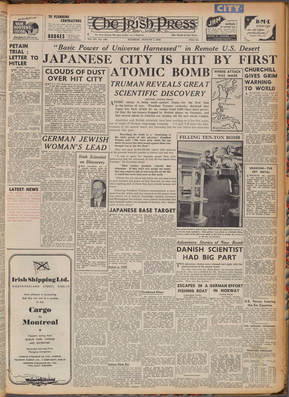
Truman’s argument and it still stands is that while the destruction and loss of life were dreadful they were justified by forcing the Japanese to surrender and thus save many more lives that would have been lost had an invasion been necessary. It is not without validity and in 1945 after the horrors of the years that had preceded few were going to take issue.
Oppenheimer has also been right, so far, in arguing that once it was used once not even the most vile regime would ever consider using it again. So far.
It marked an existential moment in human history with the Matt Damon character General Goves only half jesting when he asked Oppenheimer what the odds were against blowing up the entire world. Sometimes, attempts are made to capture such moments in poetry. Even if it does beg the literary cliché: “Can there be poetry after ….. [complete with latest horror].”
Yamamoto Yasuo, whose 13 year old son was killed in Hiroshima, wrote about finding himself “In the big shelter at the foot of Mount Hiji,” among “a naked group without skin.” Irish poet Eoghan Ó Tuairisc referred to August 6, 1945, as “Lá gréine na blaisféime,” the day on which “Shéideamar Hiroshima.”
He regarded it as an act of blasphemy, of humankind assuming the role of God. A note echoed by Oppenheimer himself when he quoted from Hindu scripture Bhagavad Gita where Krishna declaims “I am become Death, the destroyer of worlds.”
Krishna represents God. Oppenheimer and those who created and ordered the use of the bomb and carried it and detonated were usurping that role. As does every person who decides that other people are to die for reasons best known to the person who signs their death warrant.