Official and market statistics show that the average price of a new house in the state rose from €7,523 in 1970 (as adjusted from punts) to €322,602 in 2023. That represents an increase of more than 4000%. Or to put it another way, the price of a new house is now 43 times higher than it was in 1970. Real wages have increased by 3 in the same period.
All such figures are meaningless other than when placed in the context of what people can afford, and indeed their ability to secure a mortgage to buy a home – or even to be able to buy one in competition with people or investment funds wishing to buy new houses and apartments and even entire estates to then be placed on the rental market.
Davy’s last year pointed out that the average house price in Dublin in January 2023 – , €541,000 – was nine times the average annual income. According to the Central Statistics Office, the average industrial wage also increased substantially over the period after 1970.
The average real annual income in 1970 was €15,686 which meant that the average price of a new house was just half the average annual wage, a ratio of 1:2. Theoretically, though unlikely, a person earning the average wage could have bought two houses.
By 1980, a new house cost one and a half times the average income. That ratio had further leaped to over two and a half times annual income in 1990; to more than five times that in 2000; and to almost seven times income in 2010. Interestingly, that ratio has remained the same nationally since, with the exception of Dublin at nine times the average wage.
The overall take, however, is that it is now far more expensive to buy a house, and that the income ratio means that an average income will not be sufficient to allow a person to secure a mortgage.
Borrowing the money to be able to buy a house or an apartment is obviously a key factor, and mortgages have been central to both the housing market and related financial crises. As historical figures from the period between 1946 and 2011 show, there was a steadily increasing rate of homeownership up to the early 1990s when it peaked at 80%.
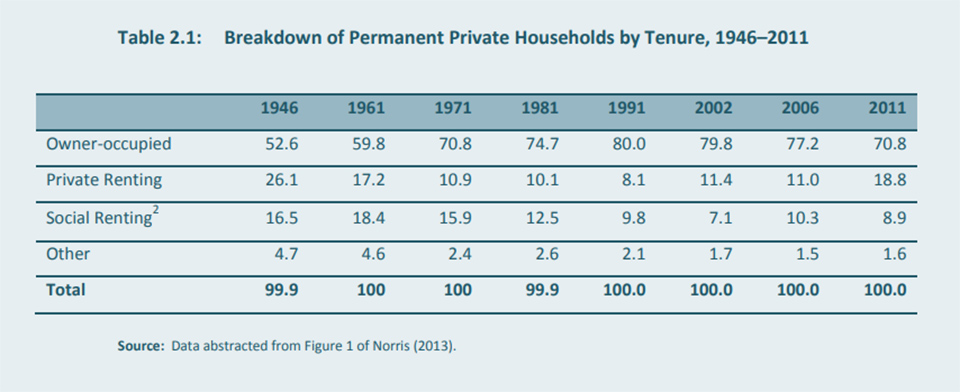
That trend began to be reversed sharply after 1991 and had declined to 71% by 2010 when a new house cost seven times what the average person was earning in a year. In 2022, the homeownership rate was 70.4% and is unlikely to increase. The outstripping of wages by prices was obviously a huge factor.
In the meantime the proportion of persons living in private rented accommodation has begun to climb steadily upwards again. It had fallen from 26% at the end of World War II to just over 8% in 1991. In the 2022 Census, that figure had reached 19%, and the overall % of households in rental accommodation was 29.2%.
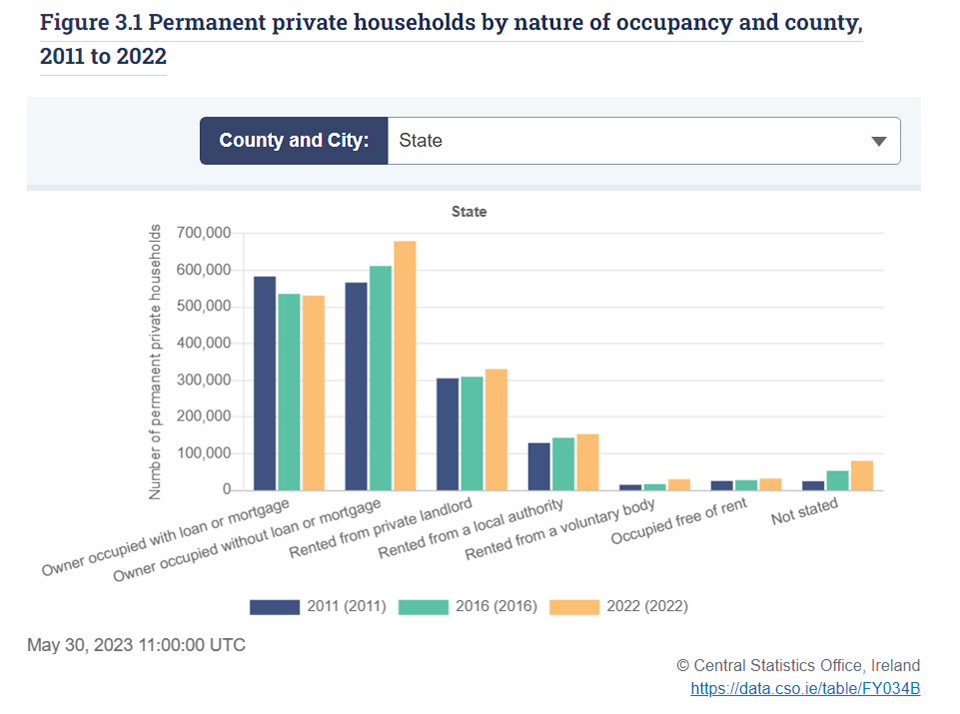
While there has been a certain amount of gaslighting of homeowners in recent years – making out that Irish people are somehow bizarrely unique and perhaps out of step with their EU “fellow citizens” in the rate of homeownership – in fact we are very close to the current EU rate. The average across the 27 member states is 70% owner occupied and 30% tenant, exactly identical to the Irish state as measured in 2021.
Such trends are not accidental. One of the striking aspects of Irish home ownership was that it expanded hugely over the first generations of the state founded in 1922. One of the reasons for that was that our people had for generations in the greater part been tenants; either on the land that had been taken by the landlord class through expropriation, or people living in cities and towns often living in appalling tenements. Owning one’s own home was regarded as providing stability after centuries of precarious existence for many.
The new state, and in particular successive Fianna Fáil governments up to the 1990s had made the expansion of home ownership a central political and social aim.
Likewise, we can see a similar phenomenon within the EU where the former socialist states of Romania, Slovakia, Hungary, Poland, Bulgaria, Croatia, Latvia and Lithuania have pursued a similar course since the collapse of the former Communist regimes that actively discouraged private ownership in every sphere. Those states now have home ownership rates above 80% – of more than 90% in some cases,
Another key change here, as can also be seen in the table above from the NESC, is the decline in local authority rentals. That peaked in the early 1960s as the state replaced private landlords, often as a part of clearing the dreadful tenements that blighted Dublin and other cities. Private landlordism fell almost as a direct consequence of that.
However, equally and indeed more significant was that local authority “social rental” began to fall as home ownership increased. That was no coincidence either as the state had actively encouraged local authority tenants to buy their own home.
Surely there is an argument that the state – in collaboration with the private construction sector – revive such a policy? Would that not make more sense than spending billions through the Housing Assistance Payment (HAP) and others to subsidise private landlords? Could the state not utilise public land for that purpose and thereby circumvent the huge costs of private land, often held in land banks.
There are those of course who will deny that the state ought to have any part in housing at all other than whatever interventions are required to facilitate the market. Which is fair enough but at what stage does a state or a society place social cohesion and stability and community above other issues?
The Irish state clearly did for a long period. It was a happy enough relationship between the state and the private sector and certainly benefited many people who were enabled to buy their own homes. From that, existing communities were strengthened and new ones formed.
What sort of communities are going to be rooted in places where a home is both costly and takes up a disproportionately large part of household income? Or when households cannot afford to support a family home on one income? Or when households are constantly on the move, or planning for a possible involuntary move, due to the precariousness of the private rental sector?
The evidence can be seen across the state. It is also one of the reasons why tens of thousands of younger people are leaving the country. It is a haphazard approach which makes the state’s own alleged housing strategies and targets almost completely contingent on external factors beyond their control. The National Development Plan and Project 2040 bear increasingly little relation to what is and will take place.
We shall return soon to delve further into the issues surrounding all of this.