Almost half of all dementia cases could be potentially preventable by addressing 14 possible risk factors, according to a recent report from peer-reviewed medical journal, The Lancet.
Over 64,000 people in Ireland currently live with dementia, with numbers expected to rise to 150,000 by 2050 – presenting an increasing health challenge.
Researchers behind the third updated report of the Lancet Commission on Dementia, published this month, offers some positive news for families and communities. Authors believe that clinicians, policymakers, individuals and family members can be ambitious about prevention and reducing the risk of dementia.
The report, authored by a group of medical researchers from a number of US universities. found “compelling new evidence” that untreated vision loss along with high levels of ldl (bad) cholesterol are risk factors for dementia – while arguing that around 45 per cent of cases could potentially be preventable by tackling 14 modifiable risk factors at different stages of life.
The report – a 2024 update of the Lancet Commission on dementia – points out that the number of people who live with dementia is expected to triple to 153 million by 2050, with global health and social costs linked to dementia reaching almost €925bn a year.
“More can and should be done to prevent dementia and to help people living with dementia and their families,” the update says, with a focus on “the need to identify and implement prevention approaches”.
The publication confirms 12 previously identified potentially modifiable risk factors from two previous reports – published in 2017 and 2020 – while offering new evidence supporting two additional risk factors: vision loss and vision loss and high levels of low-density lipoprotein (LDL) cholesterol, often called “bad” cholesterol.
The 14 other risk factors are:
- Alcohol
- Sedentary lifestyle
- Head injury
- Diabetes
- Smoking
- Diet
- Social isolation
- Low education
- Depression
- Air pollution
- Hearing impairment
- Hypertension
- Obesity
Key points in the report included improving general education in early life; addressing hearing loss, high LDL cholesterol, depression, physical inactivity, diabetes smoking, and traumatic brain injury in midlife; and reducing social isolation, air pollution and vision loss in later life.
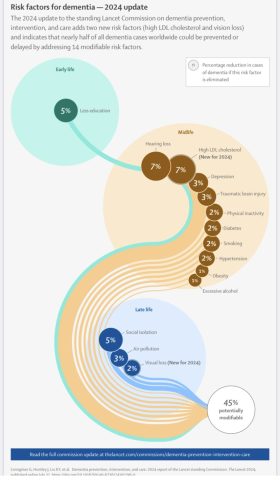
The dementia experts who authored the report added that the rapid growth of ageing populations across the world is in part thanks to improved public and personal health – yet they pointed to the lack of dementia care. The report highlights the importance not only of prevention but of supporting quality of life for those with a dementia diagnosis.
In addition, the report cites clinical trials which show that nonpharmacological approaches, such as using activities tailored to interests and abilities, can reduce dementia-related symptoms and improve quality of life.
Researchers believe that prevention approaches should aim to decrease risk factor levels early (ie, the earlier, the better) and keep them low throughout life (ie, the longer, the better).
“Although addressing risk factors at an early stage of life is desirable, there is also benefit from tackling risk throughout life; it is never too early or too late to reduce dementia risk. Much of the evidence suggests that midlife interventions are important, but some risk factors have their origins at societal levels and across the life course.
“All of the risk factors covered in this report have the potential for risk reduction at scale through policy changes that could affect risk across the life course. Additional evidence suggests that these changes are often cost saving and, for the first time, it is clear that risk can be modified even in people with increased genetic risk of dementia.”