Families at Cherry Orchard Hospital in Dublin are continuing their twice-weekly protests over bed closures which they say have caused devastation and loss of life.
Last November, the HSE informed 68 residents and families that they had 12 days to leave the Willow and Sycamore units on the campus to facilitate urgent repairs needed to floors in the building. The flooring issue was a fire risk highlighted in a HIQA report in 2022, with a fire assessment showing there was a “great risk.”
However, since the decision to move residents was made on November 4th, 16 residents have since died. A total of 40 residents have moved off-site, while 22 currently remain at the nursing home in Ballyfermot.
A vigil held at Cherry Orchard last Sunday heard of the “immense” emotional toll on residents, families and staff, with families urging the HSE to reverse the decision and prevent further harm.
Maria Stynes, whose 96-year-old grandfather is a resident of the nursing home, told Gript that the risk of transfer trauma for residents is greater than the fire risk. Ms Stynes said families will continue to urge the HSE to keep their loved ones at the nursing home, with many of those still housed there having dementia, being in palliative care with complex medical needs, and near the end of life.
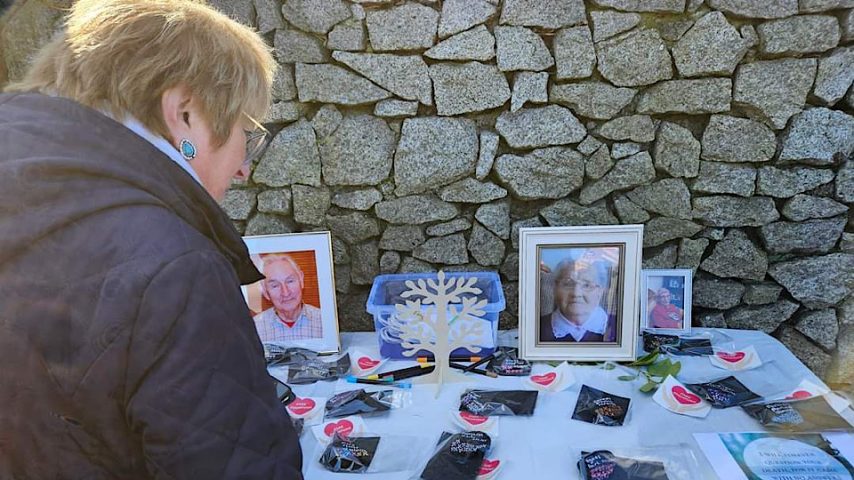
Among elderly adults, transfer trauma can lead to a decline in their physical and emotional well-being, causing significant health complications and even premature death. It can also trigger depression, psychological distress, and a withdrawal from social activities.

Ms Stynes said her grandfather was the one who sat her and another family member down after the nursing home broke the news that residents would have to move, and asked “Can you stop this?” prompting Ms Stynes to form a committee to act on his behalf. She has been joined by hundreds of family members since starting a picket in November, which continues twice a week,
Speaking to Gript, she said families have raised concerns about the processes used by the HSE, adding that families are now asking questions whether the number of deaths are normal.
“A lot of the residents remaining at Cherry Orchard have severely advanced dementia,” she told Gript. “To take them out of their normal environment would be a major trauma for them. In fact people can be in a new environment for up to six months and still die due to transfer trauma. We expressed our concern, and at all times the HSE came back and said they have to go, they have to go.
Transfer trauma is defined as a physical, behavioural, and emotional reaction to a sudden change in your surroundings which can happen with a move from a hospital to a care facility, from a care facility to a hospital, or even from one room to another.
“So at the moment there have been 40 people moved off site – of those 40, 16 have died (6 people died on site since we were informed, and 10 died off site). We are asking the HSE are those numbers normal, because it very much strikes us as an unprecedented loss of life.”
Ms Stynes told Gript that residents who have since passed away, including those who died on site, were “heartbroken” over being moved from the place they call home.
“So many of them had dementia, and they simply couldn’t understand why this was happening. One woman just stopped eating and said she would die – because she didn’t want to move.”
Families, she says, feel the HSE are unwilling to come to any form of agreement, and “do not have a plan B” in the case of residents not wanting to move.
She says a recent Parliamentary Question submitted by Sinn Fein TD Mark Warde has confirmed that there is no structural damage to the flooring in the units.
“That Parliamentary Question, which was responded to on 14 February, revealed that this is not a structural issue. There are cracks in the floor and in the corridors and bathrooms. Surely the cracks just need to be repaired.
“At one point, the HSE are telling families that there is structural damage, and it could cause a severe fire and its a health and safety risk, but then when a TD put a PQ in it came back saying there is no structural damage.”
Ms Stynes says families with loved ones remaining at the nursing home believe that works can be carried out without moving the residents off site.
She referred to an independent report from an engineer on the flooring, which she says backs up the view that the work can be done while the residents remain onsite.
“A huge bone of contention for us,” she says, “Is that from day on, this has all been about a structural issue.
“But then the director of estates who assesses all these things comes along and admits in a PQ that actually there is no structural issue. So we feel now at this stage, why would we put our family members at risk when there is no structural issues in that building?”
Ms Stynes points out that three corridors on the Willow Unit of the hospital have been completed, and there are ten empty beds in rooms that are fully refurbished.
“There are 22 residents left, and it is our belief that for those 22 people, there are enough beds on the three already refurbished corridors to house those residents.
“So it would be our proposal that the people that are in the sycamore building (which is the higher risk building as no work has been done there), it would be far safer for them to move over to willow unit because both units are actually identical visually.
“You would not know any difference between the two units because they are identical. We feel this would be best for residents, and that is what we are putting forward as a solution.”
“It would be a far less traumatic experience for those residents. However, at this stage we are terrified as we have heard that staff are being transferred and the numbers are dropping. We are now questioning how many staff will be left to look after our loved ones.”
The family member said that worry is compounded because the nursing homes being put in place for residents do not provide the medical care residents with complex medical needs require, sparking worry from families that their loved ones will have to be admitted to hospitals.
“The stories that we heard from family members on Sunday were heartbreaking and awful. We have heard of scenarios where end of life medication was prescribed for their loved ones without seeing a doctor. We are thinking how can we come on board with that?
‘IT’S AN AMAZING FACILITY – THE CARE IS BRILLIANT’
“Cherry Orchard Hospital is probably the only facility that is going right for the HSE in dublin. It’s an amazing facility, and the care there is brilliant. The only problem with it is this issue with the floor. For the HSE to pull a service which is run so well and doing so good, is baffling to us. There are so many bad services out there.
“The HSE have said residents can return in 12 months – but if 16 out of 40 residents have died in three an a half month period, how many will still be alive in a year?”
“We feel that the HSE are trying to put the onus back on the families, and telling us we are not asking in the best interests of our loved ones. But at all times we are – and we are terrified that this transfer could result in their deaths.”
The HSE, when contacted by Gript for comment, said there are “significant issues relating to the floors in the Willow and Sycamore Units, which require substantial repair work to ensure that they are safe for residents and staff.”
“The flooring defects throughout the two units include the jointing of the chipboard beneath the vinyl floor. With the normal traffic, trolleys, occupied beds, wheelchairs etc., these joints have bent and changed shape enough to crack the floor finishes and the surface is no longer level,” a spokesperson for the HSE said.
“These defects are particularly evident on the corridors, where there is a risk of trips and falls due to continuous changes in levels. This issue also impacts the ensuite bathroom floors, where the cracking in the floor covering has allowed water to enter the sub-floor timber sheeting.
“The timber sheeting has deteriorated as a result leading to soft spots and further risk of trips and falls. There is also inadequate bracing of the floor joists which is leading to further issues due to excessive movement in the floors,” the statement added.
“During inspections to scope out the works required to correct these floor defects, a further risk relating to fire safety was identified.
“Surveys undertaken of the sub-floor indicated that the compartment wall construction is not carried down below the suspended subfloor to the ground. This issue must also be addressed as part of the works required in the units to ensure fire safety compliance.
“To correct the problems with the floors in the Sycamore and Willow units will require the stripping of all floors, strengthening and stiffening of the existing floor joists, relaying all the subfloor timber sheeting and replacement of all the floor finishes.
“The compartment walls will be built below the suspended subfloor to ground, along all fire compartment lines once the floors are stripped. It will also be necessary to redo the wall finishes throughout given the extensive nature of the works,” the spokesperson added.
“There has been considerable investigation works to ensure that the building works are designed to fully address all issues uncovered.
“Because of the extensive and disruptive nature of the works in both units, residents will have to be accommodated elsewhere temporarily. All residents will be invited to return to the units once the renovation works have been completed. The project design team has advised that the project timeline for completion of works will be 12 months.
“There is insufficient capacity on the Cherry Orchard Campus to cater for the relocation of residents from the Sycamore and Willow units to facilitate the renovation works. Vacant units on the campus would require significant building upgrade works and registration by HIQA before any residents could be relocated to these units.
“Older Persons Services is supporting residents and their families with this temporary relocation using the principles of Assisted Decision Making (ADM). The HSE is offering residents the opportunity to transfer to Clondalkin Lodge Nursing Home temporarily. However, a resident can transfer to another registered nursing home if they wish.
The HSE said that a local transition support team has been established to develop a transfer plan. A key focus of this transfer plan, they said, is to minimise risk and to support residents and their families with this temporary relocation, being cognisant of the resident’s care needs, care plan, capacity, and communication skills.
The HSE said it regretted that residents would have to be accommodated elsewhere temporarily.
“Our residents’ health and safety are paramount, and we will address the structural issues promptly to ensure that the residents can return as soon as possible,” the HSE said.