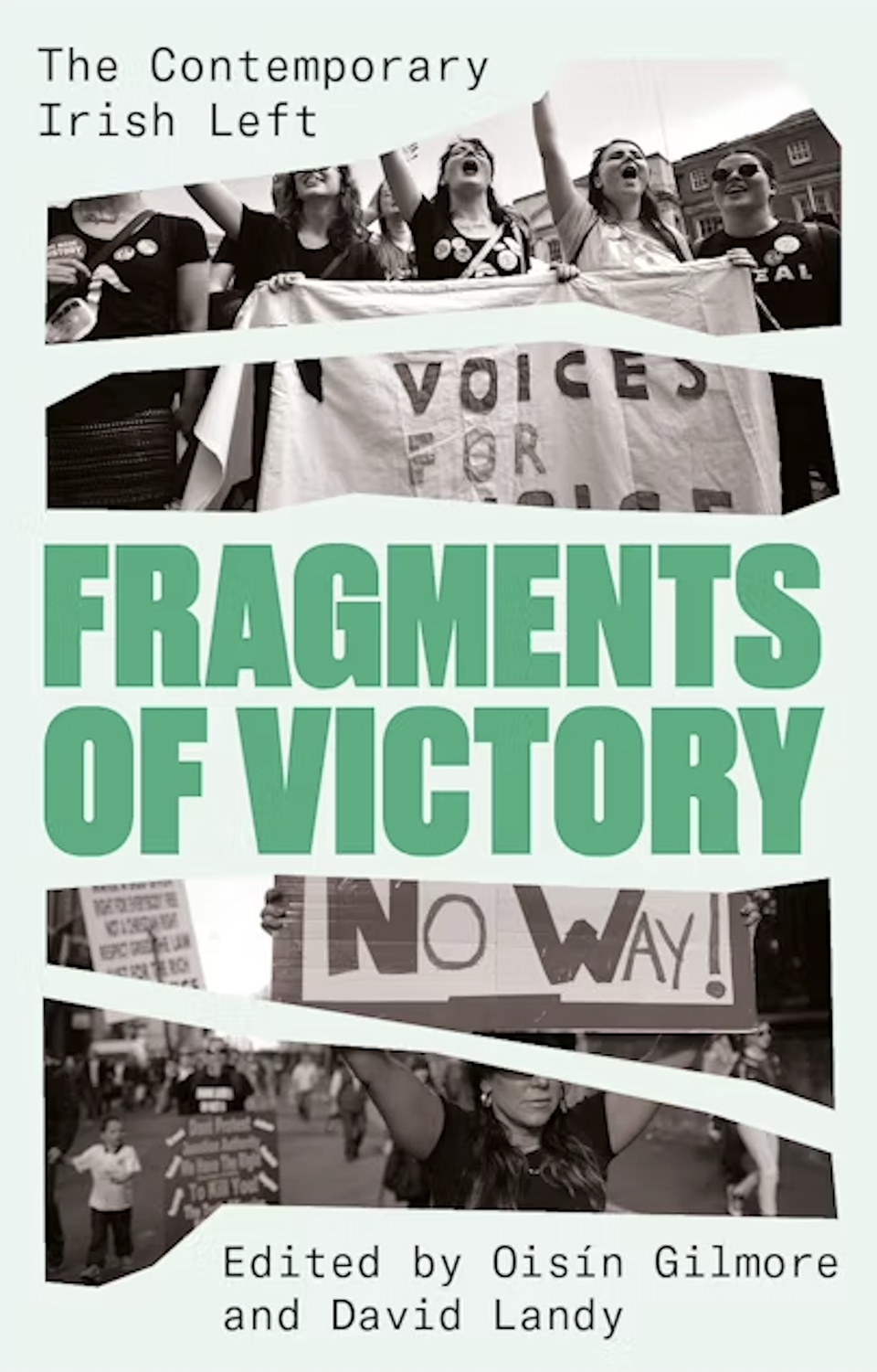
‘Fragments of Victory: The Contemporary Irish Left’ was published in January.
Edited by the Senior Economist at TASC Oisín Gilmore and Trinity College Dublin’s Assistant Professor in Sociology David Landy, the chapters are authored by prominent left-wing activists, academics and journalists.
There is no doubting the collectivist credentials of the assembled authors. The ‘Contemporary Irish Left’ is not defined here so as to include Labour or the Greens, while Sinn Féin’s progress is examined with a sceptical eye.
In spite of this, this is an exceptionally interesting book which reveals much about the state of Ireland’s far-left, and the present condition of the country writ large.
Gilmore and Landy’s introductory overview of independent Ireland’s economic history is a convincing one, drawing upon the work of Professor Cormac Ó Gráda.
As the book’s editors explain, the lack of a major industrial working-class hindered the development of a powerful left-wing alternative in Irish politics.
Left-wing politics only really grew in response to recent prosperity, and Gilmore and Landy’s argument that the post-crash Irish economic success is exaggerated also appears to ring true.
Declining unionisation is a key cause of the decline of left-wing parties across the Western world, and is noted here also. One contributor writes that union density in Ireland halved between 1994-2016, from 46% to just 23%.
Perhaps as importantly, she adds that “FDI-dominated industrial sectors have very low unionisation rates,” meaning that unions are even less relevant within the key sectors which allow the current economic model to function.
This is part of a wider trend which the authors possibly do not recognise.
As has been documented extensively by Harvard’s Robert Putnam,[1] people have become less likely to join unions or other social institutions.
Many on the Irish left express glee about declining religious practice as if that trend were occurring in a vacuum.
Party membership is down and local branches are nowhere near as active as they once were. More and more people are not even bothering to vote, as shown in the record low turnout for GE24.
Throughout this book, there is much lamentation of the fractious nature of Ireland’s far-left political parties, as evidenced by their ever-evolving names and acronyms: PBP, AAA, ULA, RISE etc.
The reasons for these groups’ inability to coalesce cannot solely be down to the impact of minor ideological disagreements.
Something more is at play, something that relates to the increasing unwillingness of people to work together in institutions in pursuit of a shared objective.
Furthermore, it seems that the atomisation of society is most keenly-felt among the less well off, who should be the basis of a political movement which challenges the current status quo.
A longtime activist in anarchist politics, Kevin Doyle, writes here that there has been a “steady decline in working-class self-activity since around the mid-1980s.”
Worse still, many on the modern left have little to say about this. The socialism aspired to by the late Desmond Fennell, who sought a “a multi-centred, communitarian society of shared ownership,”[2] is but a distant memory for politicians whose only interest is in promoting the growth of a Dublin-centric state bureaucracy.
A great deal of what is thought to be leftist activism is now directed and funded from above, rather than being driven from below.
Where community groups used to function, now NGOs make their voices heard, and the authors appear to be acutely aware of this.
In his description of the anti-austerity protests following the 2008 crash, Landy writes with admirable candour that NGOs did little to challenge government policies, as they “were largely dependent on government funding, and the government were adept at using this dependency as a disciplinary mechanism.”
The book’s chapter on the Repeal movement – written by two members of the Abortion Rights Campaign (ARC) – is also noteworthy.
They boast of how they “built strong international relationships,” while curiously omitting the key fact that the ARC was ordered to return an illegal grant from George Soros’s organisation.[3]
Recent revelations about the abuse of USAID funding to support Diversity, Equity and Inclusion initiatives in Ireland poses more questions about the degree to which various kinds of left-wing activism have been and are being funded from abroad.
There is one obvious obstacle to a move to the left, and that is the upsurge in public concern over mass immigration.
Fragments of Victory’ makes the scale of the left’s collective self-delusion abundantly clear.
In his description of how attendees at a water charges protest expressed unwelcome views on immigration, the co-founder of Right2Water writes that some audience members had “argued against taking refugees, with the usual ‘let’s look after our own first’ jibe,” before assuring the reader that his comrades “produced a slide for our PowerPoint presentation that killed off that argument.”
Earlier on, the same writer states that “[w]orking-class people have great instincts when it comes to the economy and how it doesn’t serve them.”
Indeed they often do, and perhaps those “great instincts” extend to other policy areas as well?
Working-class people see how their communities change, often beyond recognition, when newcomers arrive in unprecedented numbers.
They experience competition in housing and social services in a way that the affluent do not.
They are often more sentimentally attached to familiar cultural symbols (like the Tricolour) than their more cosmopolitan counterparts in better-off areas – areas which are of course unlikely to ever host many immigrants.
Nothing in this book suggests that the contributors are remotely interested in assessing whether continuing to ignore the concerns of working-class communities is the right approach to this.
Instead, the reader is treated to multiple examples of the priorities of those who consider themselves the resistance to the establishment, and whose politics are generally just a form of protest, occasionally imported from the American college campus.
Yet the radical left (and their more orderly equivalents on the centre-left) have achieved successes.
Besides pointing to the two major examples of left-wing victories in ending water charges and legalising abortion, Gilmore concludes by arguing that “Ireland is a more leftwing country than it was in 2007.”
He is surely correct in this assertion, though at first glance this appears paradoxical.
An assessment of the recent general election gives little encouragement to a left-minded voter.
The combined number of seats in a 160-seat Dáil won by Sinn Féin, Labour, the Social Democrats, the Greens and PBP Solidarity in the 2020 general election was 66.
The combined number of seats in a 174-seat Dáil won by Sinn Féin, Labour, the Social Democrats, the Greens and PBP Solidarity in the 2024 general election was 65.
Even though Ireland’s left has stalled electorally, its influence on the country’s direction grows.
Interestingly, Gilmore cites as evidence the consensus in support of “far greater state involvement in the housing market,” along with Ireland’s increasingly strong support for Palestine and criticism of Israel – something which he suggests came about “largely because of the strength of the left.”
Both of these examples are interesting, given that they are primarily symbolic in nature.
The key left-wing demands in housing are often examples of gesture politics such as the insertion of a right to housing into the Constitution (which will not lead to a single house being built) or the creation of a state construction company (which would probably just shift some workers from the private construction sector to a public entity which might well be less efficient).
Similarly, support for Palestine is seldom accompanied by calls for actions which would impose a burden on this country, like taking in large numbers of Palestinian refugees or dramatically increasing Irish contributions to Palestinian groups.
All of this is evidence of leftward tilt, but one which is designed to not disturb the current economic model of this newly modernised and prosperous Ireland.
For now, the Irish establishment’s desired socio-economic approach shows no sign of collapsing. Dramatic increases in government spending enabled by the windfall corporation tax receipts have paid off. The left is not winning any additional seats, and a populist alternative to Fianna Fáil/Fine Gael has also failed to develop.
The truth appears to be that many in Ireland’s ruling class continue to soothe their economic consciences by emphasising their social progressivism, and the ultra-Woke activists highlighted in ‘Fragments of Victory’ willingly go along with this.
Instead of fighting a class war, they prefer the easier approach of pursuing a culture war. Whenever they strike upon an issue which appears to be popular with the public, FFG choose to embrace it too.
In his startlingly perceptive book on the hypocrisies of America’s new cultural elite, ‘We Have Never Been Woke,’ Musa Al-Gharbi suggests that ‘symbolic capitalists’ (college graduates in well-paid roles in knowledge industries, tech, finance and so forth) have come to embrace a strident Wokeness on issues such as race, gender and sexuality as a means of disguising the real class divisions which still exist in the US.[4]
Applying this theory to our national context, Ireland also has symbolic capitalists, who happen to still be in a dominant position, having failed to receive the bloody nose which their American counterparts suffered in November 2024.
Some of Ireland’s symbolic capitalists could just as easily be referred to as symbolic socialists, and would probably welcome that more fashionable label.
Such people are always going to be willing to embrace a fashionable cause so long as it imposes no real cost on themselves, regardless of the damage it does to the nation: whether that be increasing atomisation or increasing abortion.
‘Fragments of Victory’ shows how hollow the Irish left’s victories have been, for those fragments are actually splinters of a society coming apart.
[1] Putnam, R. (2001) ‘Bowling Alone: The Collapse and Revival of American Community’
[2] Fennell, D. (1996) ‘Dreams of Oranges’
[3] RTE (2017) ‘’Abortion Rights Campaign returns grant to US-based foundation after SIPO warning,’ https://www.rte.ie/news/2017/0401/864315-irish-abortion-rights-campaign-returns-grant-to-us/
[4] Al-Gharbi, M. (2024) ‘We Have Never Been Woke: The Cultural Contradictions of a New Elite’