Irish local authorities have spent €1.8 billion on homelessness services since 2014, Gript can reveal.
In an email to this publication, a Department of Housing and Local Government spokesman said it was “important to note” that the Department “does not fund homeless service providers directly,” clarifying that “this is done by the relevant local authority.”
“However, financial reports from each of the homeless regions, setting out homeless services and expenditure on these services, are published on the Department’s website,” he added.
The Department figures break down the amount of money spent by local councils across the country, listed by year and region, such as “Dublin”, “Midlands,” “North West”, etcetera.
According to these reports, money is spent on a variety of homeless services, including emergency accommodation, day services, homeless prevention supports, and more, and it is often paid to NGOs and charities providing services in these areas, such as the Dublin Simon Community, the Peter McVerry Trust, Focus Ireland, Drogheda Homeless Aid, and many others.
Gript examined the reports between 2014 and 2023 – the only figures publicly available – and here’s what they said.
THE FIGURES
As the data shows, the majority of homelessness spending in Ireland is consistently concentrated in Dublin, where the highest number of homeless individuals reside. The capital city’s homeless services saw the largest funding amounts in each year from 2014 through 2023, with total spending in 2014 amounting to €49.7 million, rising to €70 million in 2015. By 2023, the amount spent on homelessness services in Dublin reached €254.5 million.
Nationally, the total expenditure on homelessness services has steadily grown. From €66 million spent across Ireland in 2014, this figure increased to over €180 million in 2020 and reached more than €340 million in 2023.
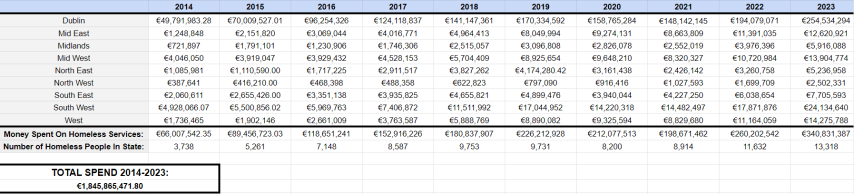
In total, €1,845,865,471.80 was spent on homelessness services between 2014 and 2023. However, during the same period, the number of homeless individuals more than tripled.
In December of 2014, there were 3,738 homeless individuals resident in the State according to Focus Ireland. By 2023, this number had ballooned to 13,318.
As of the publication of this article in December 2024, that figure has risen even further to 14,966, and is expected to soon surpass 15,000.
THE DEPARTMENT’S RESPONSE
After compiling the figures, Gript asked the Department of Housing and Local Government if they have “any comment or reaction to the significant amount of money the State has spent on homeless services over the years, contrasted with the deteriorating homelessness situation, in terms of the high numbers of people recorded as homeless and also the rate of homeless deaths?”
The Department’s response is provided in full below:
“Expenditure on homelessness services is demand-led. The rise in homelessness over the past number of years has seen a corresponding rise in expenditure on homeless services.
Inflationary and cost of living pressures have impacted on the operational costs of services.
Despite the increased delivery of social and affordable housing under Housing for All, the number of households in need of homeless emergency accommodation continues to rise.
However, the most recent Homeless Progress Report underlines the significant progress made in preventing individuals and families entering homelessness. The 979 households, including 1,247 adults and 504 families, prevented from entering homelessness in Q3 2024 represent an increase of 37.3% in household preventions, an increase of 41.4% on adult preventions, and an increase of 54.6% in family preventions on Q3 2023.
The Q3 2024 Progress Report also records a total of 699 households, including 862 adults and 327 families, exiting homelessness in the quarter. These figures represent significant increases on the same period in 2023: an increase of 23.5% in household exits; an increase of 22.6% in adult exits, and an increase of 36.8% in family exits.
Government remain committed to reducing the number of people in homelessness while also providing a high standard of emergency accommodation to those who need it. The Department will continue to prioritise the funding of prevention and sustainment measures that are vital in providing housing solutions to those most vulnerable.”