Newstalk recently posted a clip from their Breakfast show where presenter Shane Coleman made a number of claims about global warming – including the claim that it was directly contributing to the death of Irish people because it creates more extreme weather.
He made some other uncorroborated claims which his co-host, Ciara Kelly, pushed back on such as that Irish people were dying from extreme temperatures – but amongst the statements made without question was one that Irish people are dying because of more extreme storms.
We have looked into Coleman’s claim – that climate change causes extreme temperature which causes storms which is killing Irish people every year – and found it to be false.
Shane Coleman said:
“People in Ireland are dying because of global warming. People have died in Ireland because of global warming. Not to the same extent – well, because of extreme temperatures for example, we have had people, because of storms. We have had people dying in storms. We have had people dying in heat waves…. We have had extreme temperatures earlier on this summer and people have died because of that.”
While it is always true to say that people have died during storms, it is false to claim that storms are getting more frequent or that more people are dying because of storms. On a global level both of these claims are false.
This paper by Roger Pielke found that in the past 22 years there is “little evidence to support claims that any part of the overall increase in global economic losses documented on climate time scales is attributable to human-caused changes in climate”.
Contrary to the prevailing “climate disaster” zeitgeist, Pielke found that the consequences of hurricanes, floods, and other natural disasters aren’t getting worse and, in fact, they’re getting better.
Globally, the death toll and economic toll of natural disasters have declined precipitously in the past 100 years. Since the 1920’s there has been a 90% decline in deaths caused by natural disaster. That is the total number of deaths, not deaths as a % of world population.
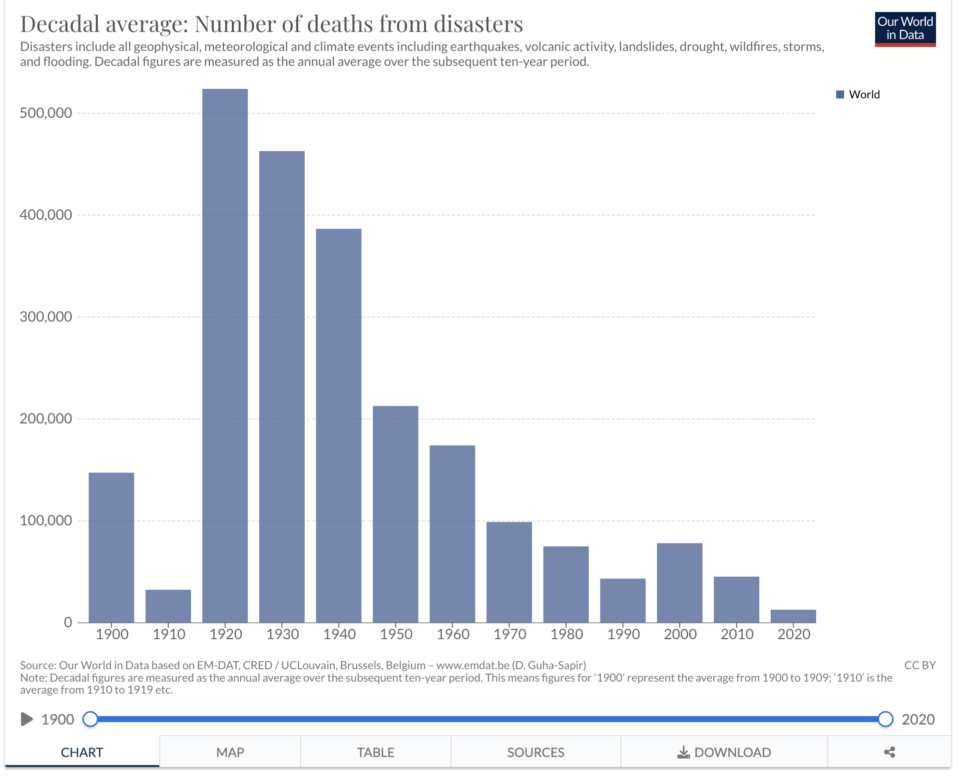
GRAPH: Natural Disasters Data Explorer – Our World in Data
The graph shows death for a period when the world population quadrupled and simultaneously carbon emissions increased radically – yet simultaneously the death toll through natural disasters fell by 90% from 523,892 deaths to 45,274 deaths (from the 1920s to the 2010s).
The reason for this massive improvement has been the increased prosperity of the people of the earth, a human flourishing caused by cheap and abundant energy. The improvement in the death toll numbers was likely driven, then, by the very thing climate activists most decry, the burning of fossil fuels.
Many analysts of this marked improvement attribute it to increased prosperity and increased monitoring and warning systems which are improved by technology and prosperity.
In poorer countries with poorer quality buildings the damage done by hurricanes takes more lives and causes much more human suffering, even if the monetary cost of the damage is considerably less.
For instance, on January 6, 1839, a storm swept over Ireland which became known as “Oíche na Gaoithe Móire”. There was no forecasting ability and the storm which blew for two days with gusts of 115 mph caused massive devastation. It is estimated that up to 300 people died during the storm, countless houses were demolished, and strands of forests levelled, and that livestock were scattered and died.
The other claim that Coleman made was that storms are getting more extreme because of climate change.
This is a common claim made by the main stream media with platforms from the Washington Post to the Irish Times flying the flag for climate change causing atypical storms. “More extremes may be coming our way from the Atlantic as a result of global warming,” the Irish Times recently warned.
However, the most extensive database of hurricanes globally is maintained by the National Oceanic and Atmospheric Assessment (NOAA) and they have not noted an increase in hurricanes in the past century.
Tom Knutson, a senior scientist at NOAA and GFDL (Geophysical Fluid Dynamic Laboratory) writes that “there is essentially no long-term trend in hurricane counts. The evidence for an upward trend is even weaker if we look at U.S. landfalling hurricanes, which even show a slight negative trend beginning from 1900 or from the late 1800s.”
Knutson also said that for Atlantic Basin-wide hurricanes: “there is not strong evidence for an increase since the late 1800s in hurricanes, major hurricanes, or the proportion of hurricanes that reach major hurricane intensity”.
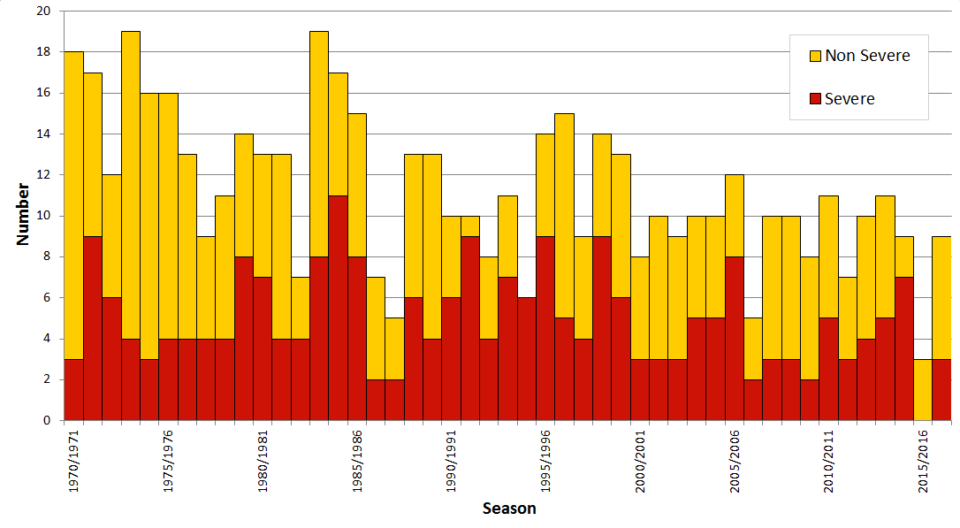
In the southern hemisphere a similar story exists. This graph by the Australian Bureau of Meteorology shows a decline in tropical cyclone trends since the 1970s. Since continuous satellite records started in 1979 there has been a decline in cyclones, both severe and non-severe.
On Newstalk, Coleman also said that “1200 people die every year prematurely because we burn fossil fuels every day”.
Though the clip doesn’t give context on what he means by that; how he draws the correlation, or what are the claimed causes, and where the sample is particular to, it is a claim that is rebuked by environmentalist, Michael Shellenberger, who says that the effect of moving from dirty fuels such as dung and wood, to clean fuels such as gas and electricity saves lives because it reduces the exposure to harmful smoke particles produced in the household by cooking and heating.
A WHO report in 2012 claimed that 7 million people died annually because of air pollution (CO2 is not air pollution) with the worst effects being in South East Asia. It said that South-East Asia and Western Pacific Regions had the largest air pollution-related burden in 2012, with a total of 3.3 million deaths linked to indoor air pollution and 2.6 million deaths related to outdoor air pollution.
That’s 3.3 million deaths due to indoor pollution, meaning dirty fuels such as wood and dung with bad ventilation and evacuation. The solution to this health challenge is not less fossil fuels, including electricity generated from gas, coal, and oil, it’s more fossil fuels and cleaner cooking and heating methods using gas and electricity.
In this analysis, it is claimed that 4 million people die annually from cooking with dirty solid fuels such as wood and dung.
Shellenberger goes on to list some inconvenient facts that Irish broadcasters might consider studying before further forays into climate activism – and offers evidence that “Humans are not causing a ‘sixth mass extinction'” and “The build-up of wood fuel and more houses near forests, not climate change, explain why there are more, and more dangerous, fires in Australia and California.”
Coleman also said “The reality is, global warming, its estimated, is already killing 5 million people a year. That is the population of this country is dying because of global warming every year already. And things are only going to get worse. And we can keep putting it off and we can keep saying “we can’t do it now because” but what we’re doing is killing future generations.
Twitter commentators were quick to point out the errors of Coleman’s claims. Sean Ó Sé just pointed to that graph of a century of declining deaths.
5 million 🤔…the opposite is true pic.twitter.com/Cjix4PhJDn
— Sean O'Sé (@SeanOSeIreland) September 21, 2022
Many activists claiming that 5 million people a year are dying because of a climate emergency make reference to 2021 study which claimed that 5 million deaths a year worldwide were attributable to excessively hot or cold conditions, then a closer inspection is required. The study did not attribute those deaths to climate change. Here’s what it said:
Cold-related death decreased 0.51 per cent from 2000 to 2019, while heat-related death increased 0.21 per cent, leading to a reduction in net mortality due to cold and hot temperatures.
The study’s authors believe that global warming in the long term may increase heat-related mortality.
Professor Guo, from the Monash University School of Public Health and Preventive Medicine, said this shows global warming may “slightly reduce the number of temperature-related deaths, largely because of the lessening in cold-related mortality, however in the long-term climate change is expected to increase the mortality burden because hot-related mortality would be continuing to increase.
That’s a prediction, not an outcome that has already occurred. The study doesn’t say that 5 million people a year are being killed by climate-change driven changes in weather.
Coleman’s claims, flatly, are false.