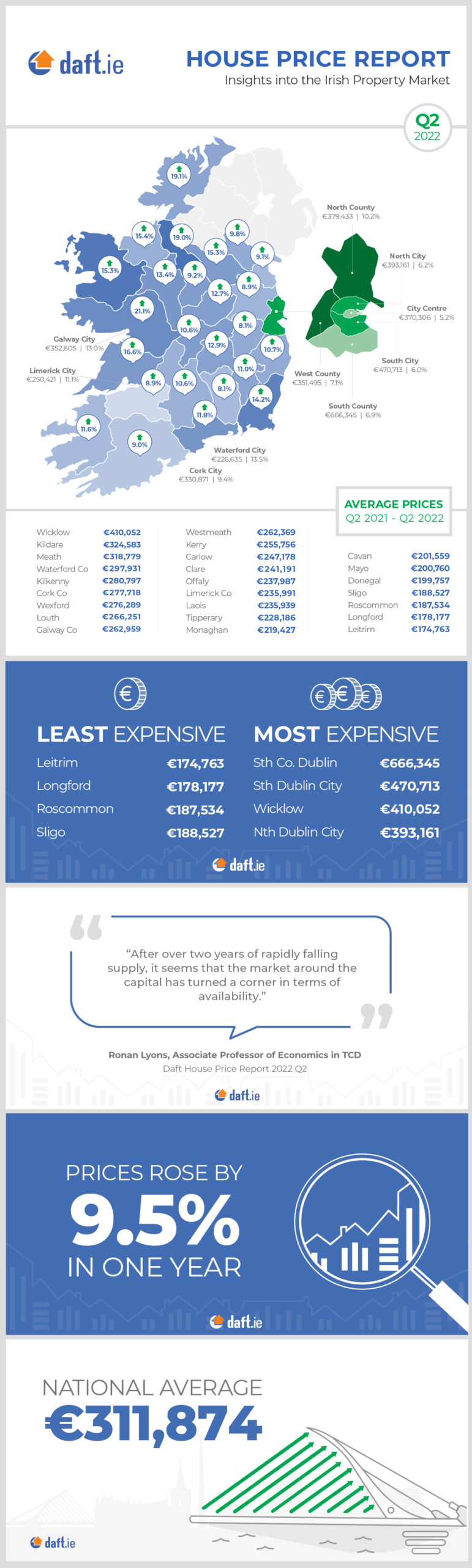
The latest housing sales report from Daft.ie showed house prices in Ireland in the last three months rising by the biggest quarterly gain in almost two years – with average house prices up 3.8% in the second quarter of 2022.
The average cost of a home in Ireland has now increased to €311,874, and the Daft report notes that that average price is up almost 10% on the same period last year.
Economist Ronan Lyons said the “annual rate of inflation in housing prices, nationally, was 9.5% in the second quarter of 2022, up slightly from the Q1 figure of 8.9% but in effect marking the fourth consecutive quarter where inflation stood at close to 9%.”
However, he noted that “urban inflation is on the rise, while inflation outside the five main cities is cooling off.”
Mr Lyons said that supply of homes to buy were still tight – with just over 12,400 homes available to buy at the start of June, compared to an average of 24,000 available to buy at any one time between 2015 and 2020,.
He added, however, that” “supply in Dublin ‐ and in the rest of Leinster ‐ has started to increase again.”
“There were almost 5% more homes for sale in Dublin on June 1st this year compared to last year ‐ and the equivalent figure for the rest of the province was 10.8% more homes. After over two years of rapidly falling supply, it seems that the market around the capital has turned a corner in terms of availability,” he said.
“Looking at the flow of homes on to the market ‐ rather than the stock available at any particular time ‐ is a more direct window on to supply. In the twelve months to May 2022, just under 60,000 homes were advertised for sale nationwide. That is up from 52,700 a year previously and a low of less than 46,000 in the year to February 2021. The market is still somewhat off its pre-covid 12-month total of 65,000 ‐ but recovery, in terms of fresh supply, is well underway and perhaps even almost complete.”
And he warned of the likely effect of potential rises in interest rates on demand for housing
“Looking ahead, it may not be supply that shapes the market over the rest of the year, but instead demand. On the one hand, interest rates are rising ‐ something that will feed into the mortgage market soon enough and which will temper demand from new buyers. Ironically, interest rate rises are normally associated with cooling off booms but these rises come at a time when sentiment is somewhat fragile ‐ on the back of war and supply chain disruption.”
“Indeed, one statistic jumps out from the Sentiment Survey undertaken every quarter as part of this report. For over a decade, the survey has asked respondents what they expect to happen to the sale price of housing nationally over the next year. Since 2014 ‐ with a small wobble around the very start of covid ‐ the typical person active in the housing market has expected prices to rise. As recently as the first quarter of this year, respondents expected prices to rise by 5.1% on average. But respondents in the second quarter expected an increase of just 0.9%.” he wrote.
Rental availability remained “at an extraordinary low level,” the economist with Daft.ie said.
Image from Daft.ie Sales Report