September 1st was proclaimed a day of prayer for the environment by the late Ecumenical Patriarch Dimitrios I in 1989. The Orthodox church’s liturgical year starts that day with a commemoration of how God created the world. On 4 October, we commemorate Francis of Assisi, author of the Canticle of the Creatures. Therefore September 1-October 4 is known as the Season of Creation, encompassing the church in both Eastern & Western traditions.
In 2016, Pope Francis and Patriarch Bartholomew I released their special messages for the World Day of Prayer for the Care of Creation, kicking off the month-long Season of Creation celebrations. Prior to this, in 2015 Pope Francis issued his encyclical “Laudato Si” – a sustained panegyric in honour of, and appeal for the protection of, Mother Nature. One would have to be willfully obtuse to maintain that all’s well with the environment.
At our theology school in Davao (Southern Philippines) we decided to do our bit. It was with a sense of partaking in a rather important matter that we set out to do our tree-planting. And even if we cannot entirely reverse the damage done to Mother Earth, at least we hope to make our own little positive footprint by planting, not only seeds of trees, but also seeds of hope.
Our theology school caters for Redemptorist students from our own Cebu province (Southern Philippines), Manila vice-province (Northern Philippines), Indonesia, Vietnam, Sri Lanka, Singapore & Thailand, as well as seminarians from other congregations. Among our students are Franciscans, followers of a man who had a positively infectious reverence for nature and its sublimities; so it was a bit incongruous that, of the five jeeps going on our mission to safeguard the environment, the Franciscan van was a veritable smoke-belcher! Maybe they took the vow of poverty of Il Poverello so literally that it precluded spending money to have the van’s engine cleaned.
At any rate, we arrived at our destination about 15 miles outside the city; the local village leaders were there to welcome us. The tree planting was preceded by a prayer service; this is de rigueur in this country, where every occasion is placed under the protective canopy of divine blessing. Like the similar procedures at civic events (singing of the national anthem, followed by a “pep talk” consisting of the usual platitudes and clichés by the mayor or some other local politician), I suspect that not many actually paid too much attention. The actual tree planting was a simple affair: using our spades or crowbars, we dug holes, placed the seedling inside and then brought some water from the nearby stream. Such a location was altogether fitting and inspirational as it reminded me of Psalm 1: the one who delights in the word of the Lord is likened to a tree planted by running water, yielding its fruit in due season and generally flourishing. So we were off to a good start, but things were only going to get better!
We returned to our starting place and prepared to have lunch. This was a meal with a difference. Some tables were put in a row and these were covered with banana leaves to serve as tablecloths, (maybe 7 or 8 yards long). Then the food was put directly onto the leaves and everyone ate, using their hands, (no plates, no cutlery), standing around the table. Admittedly it’s not gourmet dining, but it does create a grand spirit, and there’s no washing-up afterwards. Then something really special happened.
Native Indonesian instrumental music was played and everyone joined in an impromptu Indonesian dance, the Indonesian students leading the way. It was truly mesmerizing. In the noon heat, but under the shade of the majestic mango trees, we moved, or better, swayed following a very simple step. It was a local example of the United Nations working in harmony, the various nationalities all instinctively harmonizing in a wonderfully simple synchronicity. The whole scene was utterly relaxing and enjoyable, a group of people at ease and at play in idyllic surroundings; it really was some enchanted noontime.
There was still to be a cherry on the cake of our happiness. As we made our way back to the city in our convoy of five jeeps (including the smoke-belcher!), we received a text from the rector who was in the lead vehicle: “let’s stop for snacks.” We stopped at a very simple eatery where the specialty is “halo-halo”. “Halo” is the verb to “mix” so “halo-halo” is literally “the mixture”. Well, let me tell you, it’s a very tasty mixture. The succulent meat of the young coconut (innumerable in this country) is mixed with ice-cream, jelly, sweet-corn, and all topped with some cornflakes, all served in the coconut shell . Absolutely scrumptious, especially after the rather Spartan lunch earlier.
Halo-halo or Fruit Salad? You be the judge! Watermelon slush, raisins and seasonal fruits topped with Ube Ice Cream served in coconut shell is @haranasurf’s take on the all-time favorite “Halo-halo”. pic.twitter.com/Jd4ZyFVV1k
— Anton Diaz (@antondiaz) April 17, 2018
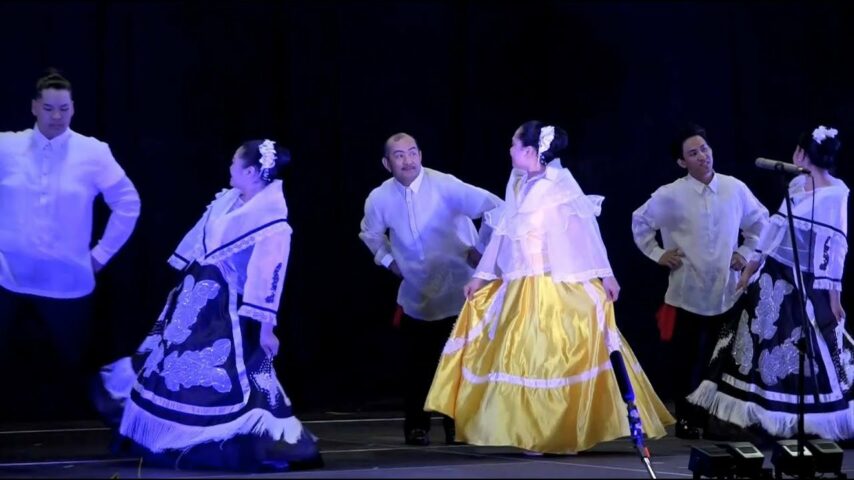
Our impromptu dance reminded me that the Philippines has a wonderful heritage of folk dances, some with a Spanish flavor, others entirely indigenous. (The Philippines was a “colony” of Spain for more than 300 years, and in 2021 we celebrated the 500th anniversary of the arrival of the Christian faith; the Muslim faith was in the country prior to that). One of the dances is called the “Tinikling”; it’s named after a bird called the “Tikling”. The bird has a somewhat raucous call and an unusual and ungainly gait, as it hops and skips along. And such fancy footwork is exactly what’s required to dance the Tinikling. Dancers take turns hopping and twirling as, under them, four long bamboo poles are rhythmically beaten together at ankle-height. One false step, any mistimed move would result in very bruised feet! But the Filipinos are expert at the Tinikling and they dance with a sureness of step and fluid litheness which is a joy to behold.
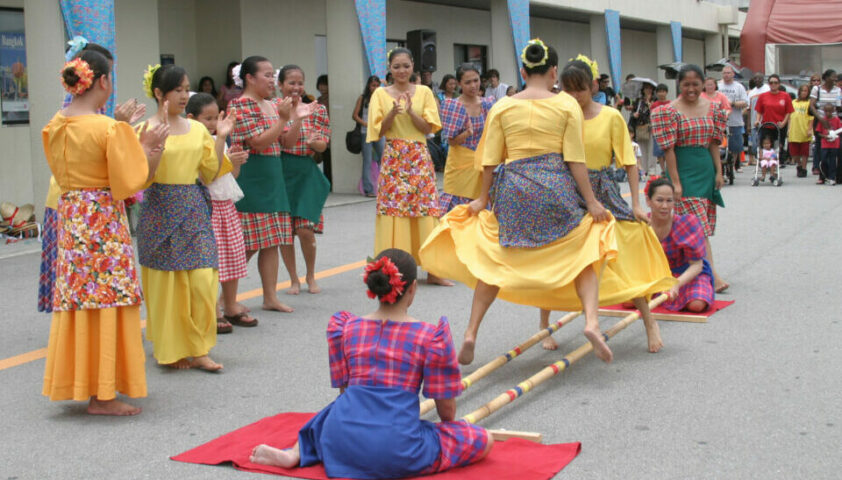
(U.S. Air Force/Senior Airman Nestor Cruz)
_ _ _ _ _ _ _ _ _ _ _ _ _ _
The “Fandango of Light” is an altogether unusual dance. Individual dancers carry on the back of their hands lighted candles placed in holders, and another such candle on their head. It is an exquisite display of controlled beauty and suppleness, as the dancer keeps in a delicate balance her steps and the fragile flame in her hands and atop her crown. The Fandango of Light simulates the light and flight of fireflies at dusk. It depicts the courtship of a young man to a maiden who has captured his interest.
I think my favourite is the Kariñosa, probably of pre-Spanish origin. It is a lovely, touching, sometimes humorous dance-duet as the starry-eyed suitor seeks to woo the girl of his dreams. It is a delightful display of courtship choreography as the hopes and dreams, doubts and trials of love’s adventure are on display. The steps, the poses, the postures, the flourishes are intriguing, and, as you watch the performance, you ride along on a veritable emotional rollercoaster. The man looks longingly into the eyes of his beloved; she turns sideways in a (real or feigned?) rebuff; not missing a beat, he flourishes his scented kerchief as the chase continues. She remains aloof, looking insouciantly into the distance as if he is not present; he pirouettes and ends on bended knee in front of her – surely by now her resistance has been overcome; no, not quite yet! She opens her fan and calmly cools herself in an action of seeming disdain. This only inspires our heroic lover to even greater efforts to win his long sought-after. The dance continues and it’s an altogether splendid portrayal of the power of love and the lengths and efforts to which we will go for its fulfilment.