Why is a widely used, clinically trialled and out of patent drug now suddenly considered “controversial” by the media? Youtube now explicitly forbids mention of the same drug – ivermectin – in its “community guidelines”, which have become a sort of continually-shifting technocratic blacklist that you have to abide with to stay out of the digital gulags.
Ivermectin is an antiparasitic drug developed by Merck and prescribed as a treatment and a prophylactic all over the world for over 40 years. It is not some sort of snake poison it would seem. Its effects and side effects are well documented, having gone through medical trials and FDA-approval, and more importantly having gone through the real-world trial of over 40 years of use.
For the record: it was discovered by two men, one of them the Irish biologist William C. Campbell, who jointly won the nobel prize for the discovery, alongside Japanese scientist Satoshi Ōmura:
“Japanese microbiologist Satoshi Ōmura isolated and cultured many varieties of natural soil-based bacteria from the group Streptomyces. Campbell led a team at Merck in studying Ōmura’s cultures and examining their effectiveness in treating parasites in domestic and farm animals. From the sample Streptomyces avermitilis, naturally produced in soil, he derived macrocyclic lactone. After further modification, it was named ivermectin (generic) or Mectizan”
The drug is used today to prevent against many tropical parasitic diseases such as river blindness. As such it is widely administered in large swathes of the world, particularly in Africa, so we have the conditions set for a natural experiment. This has produced some very interesting results which we will look at later.
Yet ivermectin is portrayed as some sort of snake oil by the Covid czars who tell us how scared to be; who to listen to; what and who to shun; and how to live our lives for evermore. Mention ivermectin, the story goes, and you are flogging an unmentionable conspiracy theory that might cause catastrophic harm. This all seems very odd.
Two provinces of India have recently announced their intention to administer ivermectin to prevent outbreaks of Covid-19. Justifying this decision, the health minister of Goa, one of the two provinces, said the “decision was evidence based.” He added that “an expert panel from Europe found the drug shortened recovery time and reduced the risk of death.”
With all this in mind, why is it that when the University of Minnesota announced it was about to embark on randomised trials of ivermectin to assess its effectiveness as a treatment for Covid-19, news reports described this as “controversial”. Why is an FDA-approved drug now controversial? Why would its use in a clinical trial be considered anything other than positive? Describing it as “controversial” seems baldly political.
During the Covid crisis, some commentators observe, science and medicine seem to have become politicised with facts being questioned according to the perceived politics of the source rather than what the data actually says. This sort of Lysenkoism is unworthy of any organization or media platform which purports to ‘dispassionately investigate the story and inform the public’.
One possibility for the lack of interest in ivermectin as a tool against Covid-19 is that the drug is now off-patent and the players in the pharmaceutical industry don’t see much to be gained in pursuing clinical trials.
Another possibility is that ivermectin just doesn’t work. After all it’s an anti-parasitic drug so why would it be an appropriate treatment for a virus?
But if that’s the case, aren’t clinical trials the exact course of action called for? Why the resistance?
The fact of the matter is that in the early days of the pandemic in-vitro trials showed that Ivermectin showed very promising results. It was known from a 2012 scientific paper that Ivermectin inhibited a key mechanism used by some viruses such as HIV and Dengue Virus from invading cells. Similar trials were conducted with ivermectin on Covid-19 in-vitro, which over 48 hours showed a 5,000 fold reduction in Covid-19 cells.
That was an in-vitro trial and the dose used was 15 times higher than treatment doses in humans, but nevertheless it looks like the authors of the report were justified in saying “ivermectin therefore warrants further investigation for possible benefits in humans.” Cautious optimism seemed appropriate.
When it came to clinical trials, though, Merck, the original patent holders (expired 1996), declared they were out. Small scale trials began in some poorer countries and Ivermectin was publicly endorsed in some Latin American countries. Peru, however, withdrew it from use a few months later.
Based on negative coverage in the media and the lack of enthusiasm with which it was pursued by Big Pharma, it looked like the ivermectin/Covid-19 investigation was a dead end. As passive observers, the public might think that the avenue had been exhausted and proved unpromising.
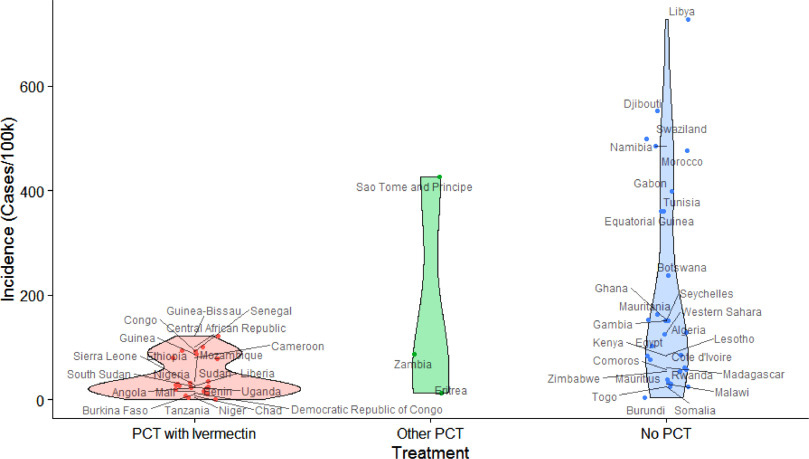
But, as we mentioned earlier, there is a massive natural experiment underway in Africa with many countries prescribing Ivermectin as a parasitic prophylactic. In effect, we should be able to observe the prevalence and severity of Covid-19 in entire populations treated with ivermectin. A recent paper published in the Journal of Anti-Microbial Agents reports on this.
The report states: “countries with routine mass drug administration of prophylactic chemotherapy including ivermectin have a significantly lower incidence of COVID-19. Prophylactic use of ivermectin against parasitic infections is most common in Africa and we hence show that the reported correlation is highly significant both when compared among African nations as well as in a worldwide context. We surmise that this may be connected to ivermectin’s ability to inhibit SARS-CoV-2 replication, which likely leads to lower infection rates.”
Findings like this should always come with the caveat that ‘correlation does not equal causation’ – and the authors do make this disclaimer – but it does warrant further trials.
The following graph from the paper is fascinating and does seem to indicate a direct relationship between the mass prescription of ivermectin and the severity of Covid-19. (PCT = Prophylactic Chemo Therapy)
1-s2.0-S0924857920304684-gr3.jpg (809×459) (els-cdn.com)

This indicates that ivermectin may prevent the spread of Covid-19. It does not indicate that it will cure it. But then again, even vaccines are not guaranteed to give long term immunity.
An Indian study of 3,532 health care workers, of which 67.5% took the ivermectin prophylactic, showed that it gave 83% level of protection from Covid. 2% of those who took the Ivermectin prophylactic contracted Covid, whilst 11% of the non takers did.
Again this is an encouraging finding. If it is replicable it might make ivermectin approximately as effective as vaccines at fending off covid-19.
Obviously, that’s a proposition that would need rigorous testing. So why the resistence to large scale clinical trials?
When the “factcheckers” talk about ivermectin they say things like “No evidence ivermectin is a miracle drug against Covid-19”. This is clearly a garbage headline, because it negates a claim that was never made. Imagine you asked was it possible to swim in the sea and these ‘factcheckers’ replied “there is no evidence you can swim in the ocean on Saturn.” Well that headline is just as ridiculous.
Dr John Campbell made an interesting back of the envelope calculation and estimated that the bulk pharmaceutical cost of a 1 month prophylactic ivermectin treatment for an average adult is just 1/3 of a cent (US). In short, it costs next to nothing.
That’s sort of interesting when you consider the Emergency Use Authorization (EUA) of Covid vaccines which have not undergone widescale clinical trials. The FDA’s guidelines state that an EUA can only be issued if there are no alternative treatments available.
As if they were in cahoots, the legacy media and big-tech oligarchy are strangely uniform in their silence on the findings we talked of here. Youtube removed a video of the testimony of Dr. Pierre Kory before the US senate last December, who was advocating for the use of ivermectin. Which might lead you to ask ‘who made the bureaucrats in youtube the arbiters of truth?’ They can call this fighting disinformation, but it is clearly raw censorship, and it serves to hinder the search for truth.
While natural immunity after recovery appears to be robust according to the WHO, some experts are unsure if immunity to Covid may not last indefinitely. We know there are new variants of the disease and that the symptoms people have experienced from Covid have changed somewhat between January 2020 and now. It is mutating and it seems that we could be required to get booster vaccines every year. That’s a lot of money going to the pharmaceutical industry.
If the trials showed positive results, a monthly dose of Ivermectin would be a very cheap alternative and would also increase takeup from vaccine-reluctant people. This, as a third cohort of protected people (the others being vaccinated and recovered covid patients), could contribute towards achieving herd immunity. Ivermectin has a long safety record, so its take up could meet much less resistance amongst the public.
It seems that the trials will happen whether the media or the WHO like it or not. Anyone with an interest in science and the search for truth should welcome that, albeit with a cautious approach to the findings and their implications.
Over the past year the legacy media have abandoned their task to question and investigate. As an institution they have disgraced themselves over the Wuhan lab origins theory, and are now frantically backtracking on their previously dismissive claims. These people look more like press agents for multinational power players at each passing scandal. Whether it’s diligently spreading the CCP’s propaganda or launching smear campaigns on non-conformist scientists, we have seen the legacy media scramble to conform with the prescribed narrative.
Hopefully the truth will out without them.