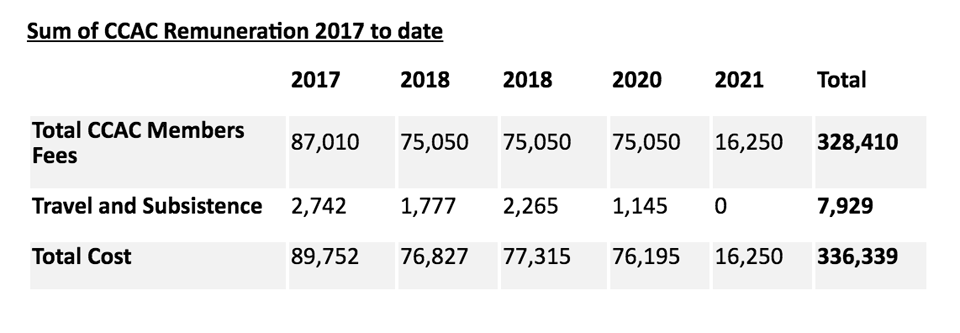
The Minister for the Environment, Climate and Communications Eamon Ryan has confirmed that the costs paid out by his Department to the members of the Climate Change Advisory Council in terms of pay and benefits including expenses amounted to three hundred and thirty-six thousand euros.
The fees and expenses for the part time roles cover the period from 2017 to date.
Minister Ryan was responding to a Parliamentary Question from the Independent TD for Laois Offaly, Carol Nolan.
The Climate Change Advisory Council was established in January 2016 and consists of eleven members appointed by Government, acting in a part-time capacity for a statutory five-year term.
Under the provisions of the controversial Climate Action Bill currently making its way through the Oireachtas, an independent Climate Action Council, will be created as a successor to the Climate Change Advisory Council.
This new Council will have significant and far-reaching powers in terms of carbon budgets. The Climate Bill also ensures that the new Council will have a key role in setting carbon budgets and evaluating all political commitments in this area.
This has been described as profoundly undemocratic as there is effectively no capacity for the Dáil to have oversight of, or make changes to, the carbon budgets proposed by the Climate Action Council.
There is also no mandatory requirement for anyone with expertise in just transitions or industrial relations to be a member of the new Climate Action Council.
The overall costs associated with the operation of the Advisory Council are provided for through the budget of the Environmental Protection Agency (EPA), which is funded through Minister Ryan Departmental budget.
Ordinary members of the Advisory Council receive an annual remuneration of €9,800, with the Chair receiving an annual remuneration of €16,250, in line with the scale of Department of Public Expenditure and Reform approved fees for chairpersons and members of State Boards.
Minister Ryan also informed Deputy Nolan that in certain cases, remuneration is paid directly to the member’s parent institution to offset the costs of that member’s commitments to the Advisory Council.
Members of the Advisory Council also receive travel and subsistence expenses in line with public service rates.
According to the Environmental Protection Agency EPA that fees and expenses from 2017 to date by members of the Advisory Council is as follows: