They say that all politics, along with all hatreds and other things – and the first two are closely related – are local. In that spirit I am going to have a closer look at the Dublin City Council ward of Ballymun-Finglas in which I reside.
The electoral area is interesting as it may be somewhat of a microcosm for what is likely to happen in the rest of the City Council area and perhaps even reflect some of the emerging trends in the rest of the state. The following comes with the caveat that – despite having had a TD up until 2020, and recovering recently in the opinion polls – Finglas and Ballymun have turned into somewhat of a disaster zone for Fine Gael.
It is a six-seater. In 2019, the seats went to Paul McAuliffe and Keith Connolly of Fianna Fáil, Anthony Conaghan of Sinn Féin, Mary O’Callaghan of the Social Democrats, Caroline Conroy of the Green Party and Independent Noeleen O’Reilly.
Two of those elected in 2019; Paul McAuliffe of Fianna Fáil who was elected as a TD for Dublin North West in the 2020 general election and who was replaced on the City Council by party colleague Briege Mac Oscar, and Noeleen O’Reilly are not running this time. Of the current six Councillors, all are defending their seats with the exception of O’Reilly.
The breakdown of party support in 2019 was more or less in line with the distribution of seats. Fianna Fáil took 27%; Sinn Féin 18.4%; Independents and others almost 24%; while Fine Gael, Labour and People Before Profit trailed in at under 6% and 3% in the case of PBP.
Both Fianna Fáil and Sinn Féin performed better here than within the City Council area as a whole. Fine Gael, Greens and Labour did far worse while the Independent vote was 7 points higher than the city average and the Social Democrats who have a sitting TD in Roisín Shortall, did slightly better than their overall tally.
The 2020 general election turned the local election results, not only in Dublin North West (in large part comprised of the Ballymun-Finglas ward) but nationally on their head. Dessie Ellis of Sinn Féin took a massive 44.4% of the first preferences and was joined in the Dáil by McAuliffe on 12% and Shortall on 19%.
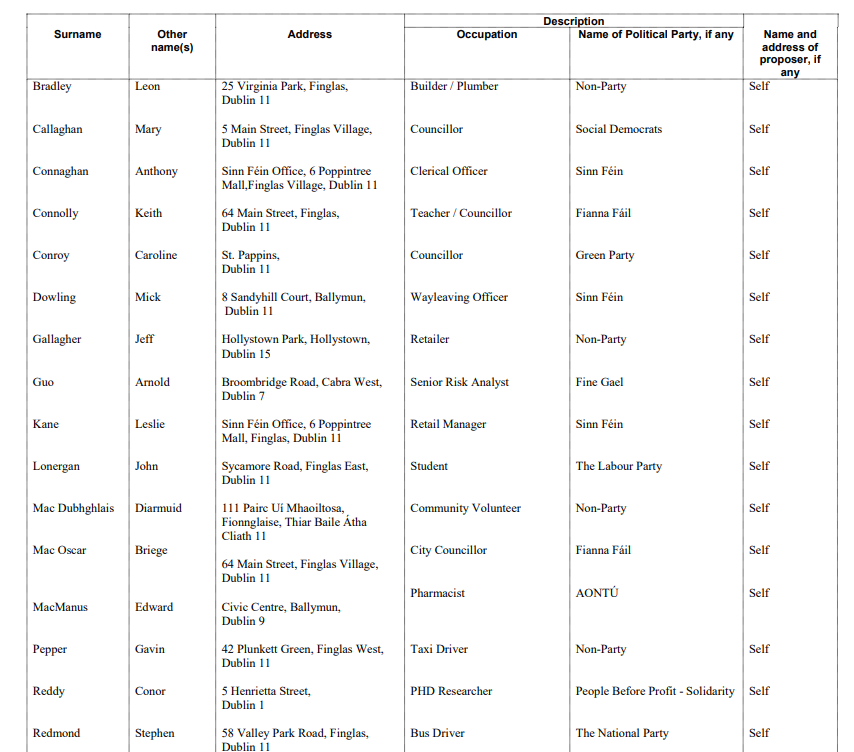
There are 16 candidates on Friday’s ballot paper. The only non-incumbent from 2019 who is putting themselves forward again is Diarmuid Mac Dubhghlais who took 261 first preferences as a candidate for Republican Sinn Féin the last time and who appears to be part of the independent left grouping that supports European MEP Clare Daly.
There is somewhat of a geographical and socio-economic divide within the constituency and local election ward. The middle-class part of east Finglas is likely to favour O’Callaghan of the Social Democrats and Conroy of the Greens. It might also boost the chances of one of the Fianna Fáil candidates; possibly Mac Oscar more so than Connolly who will be under pressure one suspects in West and South Finglas.
The Fine Gael candidate Arnold Gou will need to do very well in East Finglas and the part of Ballymun some prefer to describe tenuously as Glasnevin as he has little profile and Fine Gael is very weak in both Ballymun and the rest of Finglas.
Sinn Féin ran four candidates the last time which possibly cost them a second seat and have opted to run just two candidates apart from Councillor Anthony Conaghan. Neither of them have appeared to have established much of a presence but they should have a reasonably good chance of picking up the seat vacated by Councillor Noeleen O’Reilly in who had been elected as a Sinn Féin Councillor in 2014 but who had left after claiming to have been bullied and threatened. Her base was in Ballymun.
Sinn Féin, along with the other established parties, will face a strong electoral challenge from candidates who are contesting on the basis of opposition to a proposed International Protection accommodation centre that was the centre of protests in Finglas last year and their support for a similar protest in Ballymun.
There are three candidates; Stephen Redmond of the National Party, and Independents Gavin Pepper and Leon Bradley. All three have a local profile and all three, judging by local talk, would appear to be in with a chance of being elected although it is highly unlikely that all three will be. Redmond ran as a candidate in the 2020 general elections and did modestly well in part of the constituency and if that localised support remains solid and increases he will be in a strong position to take one of the seats. Gavin Pepper is the other independent who is most likely to benefit from what is almost certain to be a strong vote related to issues surrounding immigration.
It is perhaps foolhardy to forecast the outcome here but I will have a go. Given the strength and popularity of Sinn Féin TD Dessie Ellis, they are assured of one seat and in the absence of O’Reilly may take a second. Fianna Fáil, again on the basis of having a TD and on polling figures should retain one but not both seats.
The same factor, of having a local TD in Roisín Shortall, favours Mary O’Callaghan of the Social Democrats over Conroy, Gou or the Labour candidate Lonergan who is also from the leafier part of the hood. I am also tentatively predicting that Redmond and Pepper will take seats which would leave the final shake up as SF: 2, Ind: 2, FF: 1 and Social Democrats 1.