The Athena SWAN Charter was established in the United Kingdom in 2005 to promote gender equality in higher education and research. Originally focused on improving the representation and career progression of women in STEM (Science, Technology, Engineering, Mathematics and Medicine), its remit later expanded to encompass all academic disciplines, professional staff and broader issues relating to gender equality.
Although Athena SWAN is often associated with wider diversity initiatives, it is primarily a gender-focused programme; race equality is addressed separately through the Race Equality Charter.
Supporters describe Athena SWAN as an important tool for tackling barriers faced by women in higher education. Critics see it rather differently: as a growing bureaucracy built on the assumption that unequal outcomes must always be the result of discrimination.
The disagreement goes far beyond a debate about administration. At its heart lies a fundamental question: should universities actively shape social outcomes, or should they simply ensure that everyone is treated equally under the same rules?
The scheme operates through a system of Bronze, Silver and Gold awards. Universities and departments collect data, analyse staffing patterns, conduct surveys, establish self-assessment teams and produce detailed action plans designed to address perceived inequalities. Institutions are then assessed against these plans and may receive recognition for their efforts.
Athena SWAN is now deeply embedded in higher education across the United Kingdom and Ireland. Every Irish university participates in the programme, and there are more than 150 Athena SWAN awards across Irish higher education institutions and research organisations. In the UK, hundreds of universities, faculties and departments have participated since the scheme began.
In some cases, participation has been encouraged through funding incentives. For example, between 2011 and 2020, eligibility for certain National Institute for Health Research funding schemes was linked to holding a Silver Athena SWAN award, creating a strong incentive for institutions to engage with the programme.
The stated goals of Athena SWAN are difficult to object to in principle. They include increasing representation, supporting career progression, promoting inclusive cultures, improving transparency in recruitment and promotion, encouraging flexible working practices, and addressing barriers that may disadvantage particular groups. Few people would openly oppose fairness or equal opportunity.
The controversy begins when one asks a simple question: what causes unequal outcomes?
Supporters of Athena SWAN argue that persistent disparities between men and women in academia are evidence of structural barriers, unconscious bias and institutional practices that need to change. Critics are less convinced.
They point out that differences in outcomes do not automatically prove discrimination. Career choices, subject preferences, willingness to relocate, working hours and family responsibilities may all play a role. From this perspective, Athena SWAN risks treating every statistical imbalance as a problem requiring intervention.
Athena SWAN Objectives and Common Critiques
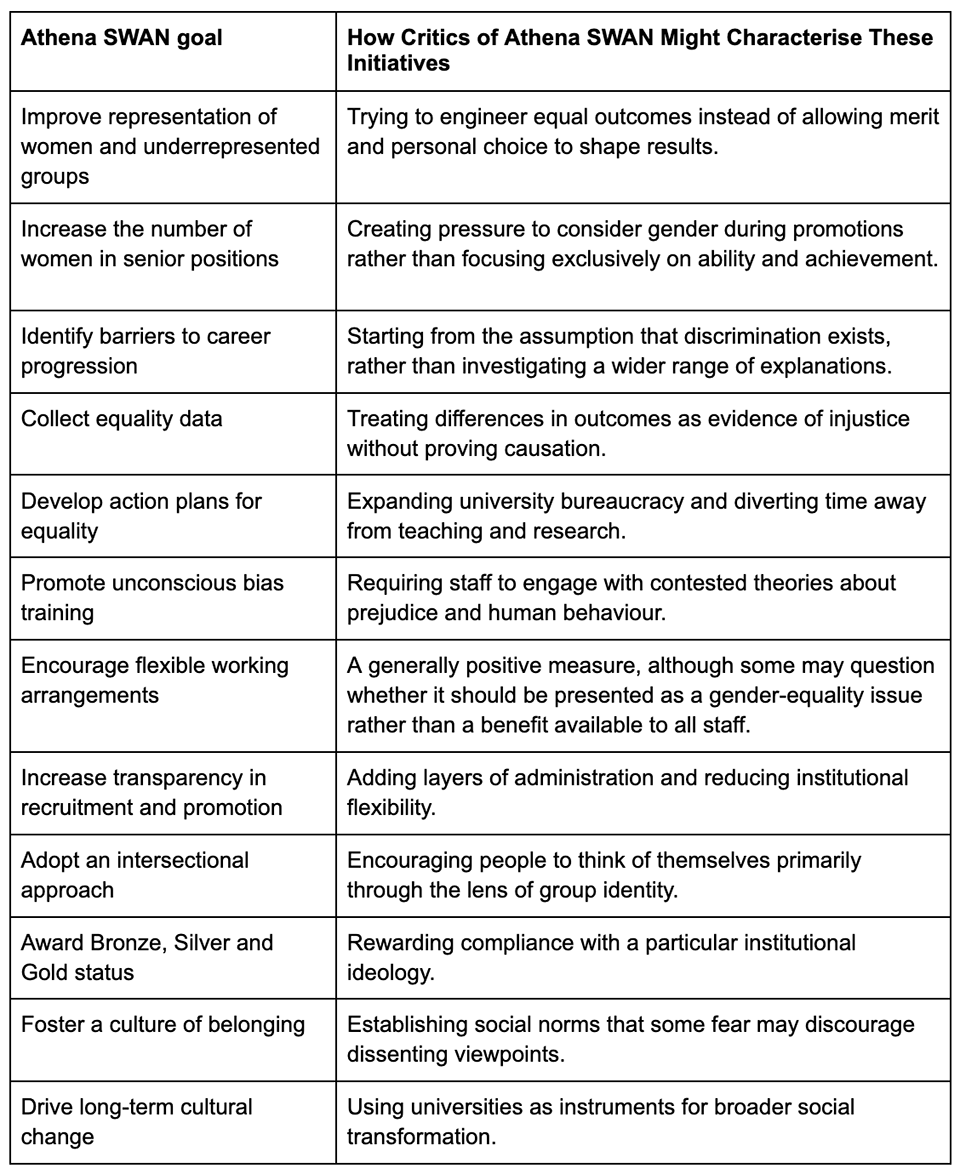
Supporters of Athena SWAN reject these criticisms. They argue that without deliberate intervention, subtle barriers may continue to disadvantage talented individuals.
They also point to studies suggesting that Athena SWAN has increased awareness of gender-related issues and encouraged organisational change. For example, Ovseiko and colleagues (2020) found that tying research funding to equality initiatives encouraged universities to focus more on gender-equality policies.
At the heart of the debate lies a broader question. Do disparities in outcomes necessarily indicate barriers that require intervention, or can they also reflect differences in individual choices and preferences? Supporters tend to emphasise structural factors, while critics warn that a commitment to equal opportunity can gradually become a pursuit of equal outcomes.
Athena SWAN emerged from good intentions. Most people agree that discrimination is wrong and that universities should be fair. The disagreement concerns diagnosis and remedy: are gender imbalances primarily the result of institutional barriers, or do personal choices also play a significant role?
Universities should be places where both perspectives can be discussed openly. Whether Athena SWAN represents a necessary corrective or an expanding bureaucratic project remains a matter of continuing debate.
Examples of Gender Equality Initiatives in Irish Universities
SALI: Women-Only Professorships
While programmes such as Aurora focus on leadership development, Ireland has also experimented with more direct interventions. In 2019, the Higher Education Authority launched the Senior Academic Leadership Initiative (SALI) to increase the representation of women in senior academic positions. The initiative funded new professorial posts that, in its initial phases, were open only to female applicants under the positive-action provisions of equality legislation.
Supporters argued that SALI was necessary because women remained significantly underrepresented at professor level despite decades of equality policies. Critics questioned whether restricting applications by sex was compatible with merit-based recruitment and equal treatment. Unlike Athena SWAN, which operates through institutional action plans, SALI directly influenced hiring by funding specific academic posts reserved for women.
By 2021, 30 senior academic positions had been approved under the initiative, with a longer-term target of 45 posts. Professors appointed through SALI received the same salaries as other professors, typically earning between €105,000 and €184,000 per year, depending on grade and experience.
Aurora: Leadership Development for Women
Aurora is a leadership development programme for women in higher education delivered by Advance HE. Through workshops, mentoring and networking opportunities, it aims to support women’s progression into leadership roles.
Supporters view Aurora as a practical response to the underrepresentation of women in senior academic positions. Critics question whether programmes restricted to one sex are consistent with principles of equal treatment. Unlike SALI, Aurora does not influence recruitment or create reserved posts, focusing instead on professional development.
Women-Only Mentoring and Leadership Networks
Beyond SALI and Aurora, many Irish universities have introduced women-only mentoring schemes, leadership networks and career-development programmes as part of their Athena SWAN action plans. These initiatives typically provide mentoring, coaching and networking opportunities exclusively for female staff.
Ireland also hosts women-only recognition schemes, such as the Women in STEM Awards, which include categories including STEM Woman of the Year and Female STEM Graduate of the Year.
Supporters argue that such programmes help women overcome barriers, build professional networks and prepare for promotion. Critics respond that restricting participation by sex risks replacing one form of unequal treatment with another, even when the intention is to address historical imbalances.
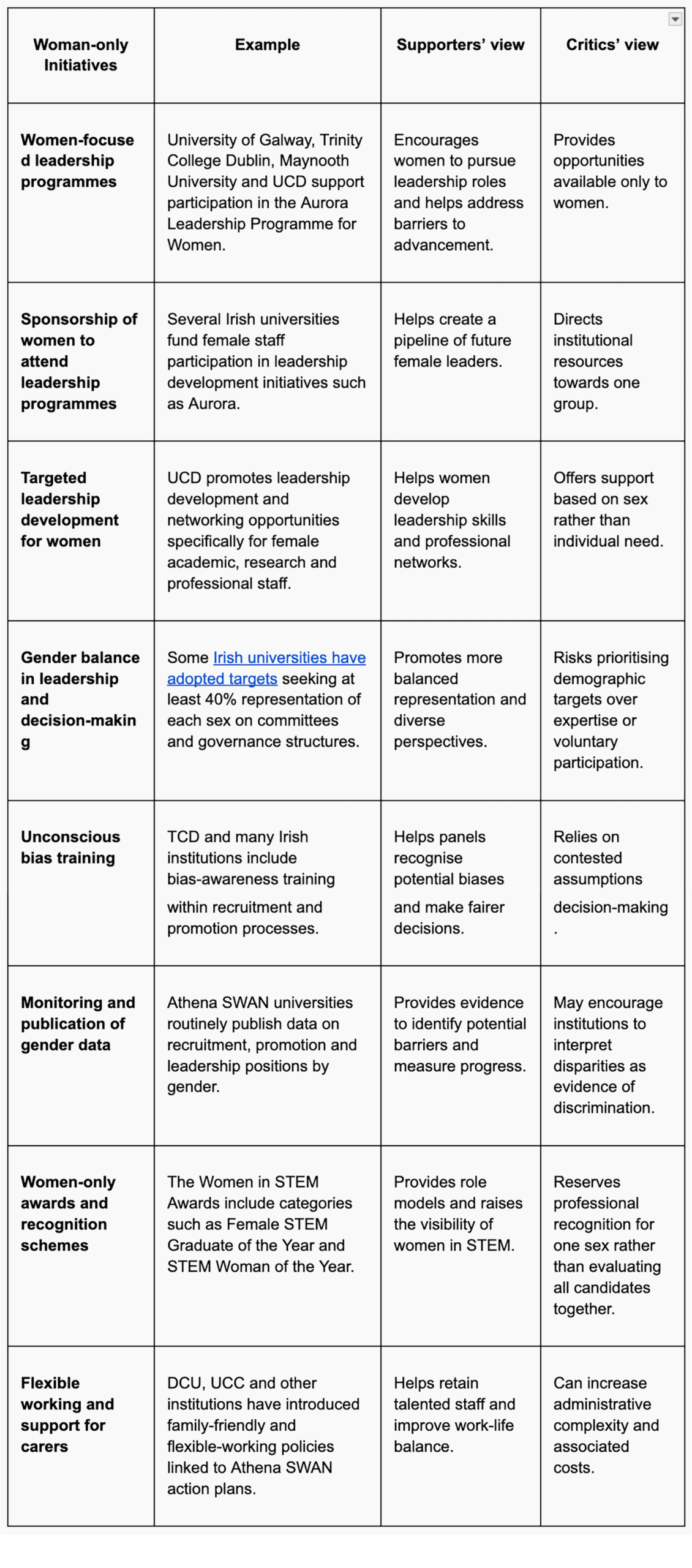
OVERVIEW: Gender Equality Initiatives in Irish Universities: Supporters’ and Critics’ Perspectives
References
Athena SWAN and Gender Equality
Advance HE. (2025). Athena SWAN Charter. Available at: https://www.advance-he.ac.uk/equality-charters/athena-swan-charter
Advance HE. (2025). Athena SWAN Ireland Award Holders. Available at: https://www.advance-he.ac.uk/equality-charters/international-charters/athena-swan-ireland/award-holders
Barnard, S. (2017). The Athena SWAN Charter: Promoting Commitment to Gender Equality in Higher Education Institutions in the UK. In Gendered Success in Higher Education. Palgrave Macmillan.
Drew, E. (2021). “Navigating unChartered waters: anchoring Athena SWAN into Irish higher education institutions.” Journal of Gender Studies, 30(3), 311–323.
Higher Education Authority. Gender Equality in Higher Education. Available at: https://hea.ie/policy/gender/
Research on Athena SWAN Outcomes
Ovseiko, P. V., et al. (2020). “Effect of Athena SWAN funding incentives on women’s research leadership.” BMJ, 371, m3975.
Xiao, Y., Pinkney, E., Au, T. K. F., & Yip, P. S. F. (2020). “Athena SWAN and gender diversity: a UK-based retrospective cohort study.” BMJ Open, 10(2), e032915.
Perceptions of gender equity and markers of achievement in a National Institute for Health Research (NIHR) Biomedical Research Centre (BRC): A qualitative study. Lorna R Henderson, Rinita Dam, Syed Ghulam Sarwar Shah, Pavel V Ovseiko, Vasiliki Kiparoglou medRxiv 2021.07.29.21261318; doi: https://doi.org/10.1101/2021.07.29.21261318
Senior Academic Leadership Initiative (SALI)
Higher Education Authority. Senior Academic Leadership Initiative (SALI). Available at: https://hea.ie/policy/gender/senior-academic-leadership-initiative/
Aurora Leadership Programme
Advance HE. Aurora Leadership Development Programme. Available at: https://www.advance-he.ac.uk/programmes-events/developing-leadership/aurora
Trinity College Dublin. Aurora Women in Leadership Programme. Available at: https://www.tcd.ie/equality/news/2023/aurora-women-in-leadership-programme-202324/
University College Dublin. Aurora Leadership Development Programme. Available at: https://www.ucd.ie/eacollege/edi/auroraleadershipdevelopmentprogramme/
University of Galway. Aurora Women’s Leadership Development Programme. Available at: https://www.universityofgalway.ie/equalityanddiversity/editraining/aurora/aurora/
Maynooth University. Maynooth Participates in the Aurora Leadership Development Initiative. Available at: https://www.maynoothuniversity.ie/athena-swan/news/maynooth-participates-aurora-leadership-development-initiative-20192020
Higher Education Authority. Senior Academic Leadership Initiative (SALI) Call for Applications 2020. https://hea.ie/assets/uploads/2019/07/Senior-Academic-Leadership-Initiative_Call-for-Applications-2020-1.pdf
University Athena SWAN and Gender Equality Initiatives
Trinity College Dublin. Athena SWAN. Available at: https://www.tcd.ie/equality/athena-swan/
University College Dublin. Gender Equality Action Group. Available at: https://www.ucd.ie/equality/groups/genderequalityactiongroup/
University College Cork. Athena SWAN at UCC. Available at: https://www.ucc.ie/en/athenaswan/
Dublin City University. Athena SWAN Silver Action Plan. Available at: https://www.dcu.ie/people/edi/athena-swan-silver-action-plan