On Friday came another report from the Department of Housing with the latest dismal new record figures on homelessness. The inexorable rise in numbers is appalling – with more than 10,000 people (adults and children) now without a home in Dublin alone, matching the national figures which caused such public disquiet as recently as 2019.
The number of homeless adults have more than doubled in ten years, a progression that, the latest figures revealed, means that the number of people in emergency accommodation rose again last month to 17,308 – with 11,851 adults and 5,457 children homeless without a home at the end of February.
While much of the commentary focused on child homelessness, which is particularly dreadful, and significantly harmful to educational and other outcomes, it is true that the figures also revealed that Irish people now make up less than half of the adults who are numbered in the 11,851 homeless people in the latest report.
That’s surely is a significant aspect of the homelessness data, and in fairness, the Department of Housing makes this breakdown available in its monthly report, but – as observed above and elsewhere – most media platforms don’t seem interested in reporting on same.
So what do the figures reveal? Disgracefully, there are 5,457 children who are in emergency accomodation. 60% of homeless adults are male. More than half of adults who are homeless are aged between 25-44, though 280 are over 65.
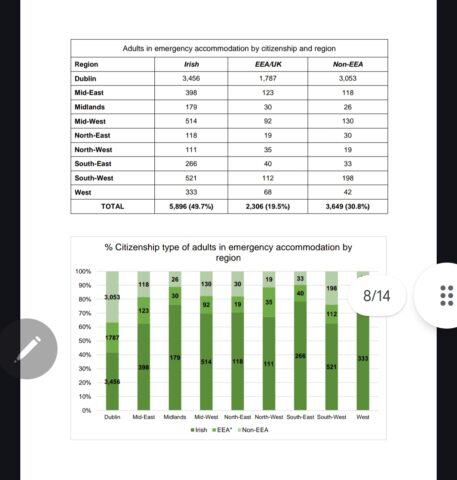
And yes, slightly more than half of the adults who are homeless are non-Irish. The report shows that 5,896 of the 11,851 homeless adults are Irish – 49.7% of the total, 30.8% are from non-EEA (European Economic Area) countries, and another 19.5% are from EEA or the UK.
This trend has been evident for some time, even if it is mostly underreported, which is curious given that the taxpayer-funded Irish Human Rights and Equality Commission is busy suing the state on behalf of asylum claimants who are don’t have accommodation provided for them by the state.
When Simon Harris broached the subject last year to say that significant numbers of homeless people did not have a right to housing, there was a predictable media storm of outrage. But there were also critics who noted that Harris and the successive governments he has been party to or led caused the crisis in immigration in the first instance.
In January, Ben Scallan reported for Gript that “more than half of the adults in emergency homeless accommodation in December were foreign nationals” according to the December report on homelessness.
Of the 11,546 homeless adults, 5,812 were foreign nationals – 2,289 from the EEA or UK and 3,523 from outside the EEA. This compares to 5,734 Irish nationals.
And in July 2025, Gary Kavanagh reported that: “the majority of people who entered emergency accommodation in Dublin for the first time last year were not Irish, according to data from the Dublin Region Homeless Executive.”
An analysis of the past year and a half of the Executive’s ‘Monthly Report on Homelessness in the Dublin Region’ report shows that only 48% of families, and 42% of individuals, who entered emergency accommodation in Dublin, for the first time in 2024, were Irish nationals.
Among individuals, 42% came from non-EU countries and a further 16% from EU or EEA states. For families, 30% came from non-EU countries and 22% from the EU/EEA.
The number one reason listed for individuals needing to access emergency accommodation was “Having left direct provision,” at 26%, with another 5% being individuals who had “newly arrived from abroad.”
As was observed this week in relation to national figures: “Since April 2022, the number of adult non-EEA in emergency accommodation has increased by 252% from 1036 to 3649”, with an increase of 27% in past 12 months for that cohort alone, while in contrast single digits increase in the Irish and EEA/UK categories were recorded.
The impact of immigration on homelessness is evident, then, as the impact is also evident in relation to housing and cost of renting and healthcare and education. It’s just that most media platforms would rather not discuss the elephant in the room.