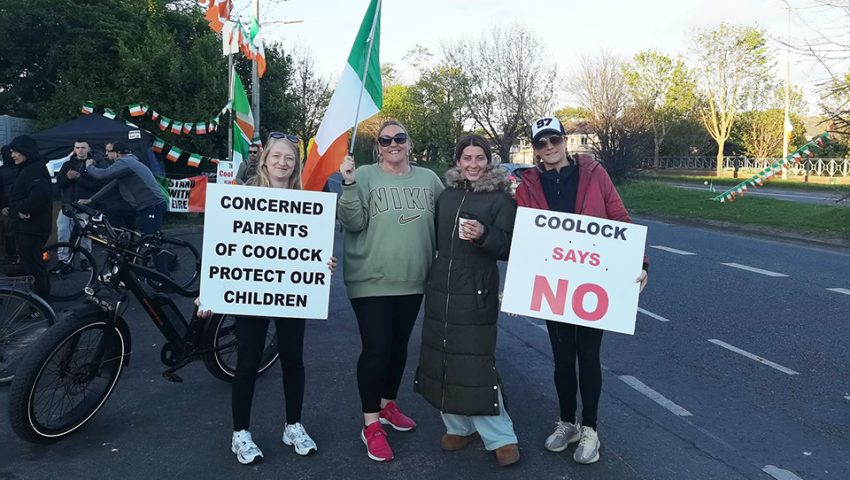
Amid the reactions to the announcement last Friday of the State having decided not to proceed with the development of an IPAS centre on the former Crown Paints site in Coolock, one stood out for me.
That was from Labour MEP Aodhán Ó Ríordáin. Now, he is a chap of whom it is fair to say that he would not expect praise from this quarter, nor the other way around. It is important, however, to recognise consistency and standing by one’s guns. So, in that respect kudos to Ó Ríordáin for having the gumption to reiterate his support for the now abandoned IPAS project, and indeed his antipathy to those who objected.
Full marks too that while he still claims that the asylum proposal had been wildly popular and had much goodwill, he tipped his hat to the opposition by telling RTÉ that “the protesters had won.”
He also, perhaps inadvertently, recognised the efficacy of the protests and presumably the legal case taken by claiming that Coolock had provided a “template” for other communities opposed to centres.
As I say, at least Ó Ríordáin accepts that his team lost. Unlike others who would now have you believe that they were not on the team at all, at all. Indeed, that, although you might have missed it, they had togged out at centre half forward for the other lot and that if they did not score the winning goal then they certainly provided an assist.
Step up onto the podium Sinn Féin TD Denise Mitchell. Her reaction to the statement from the Department of Justice on Friday was to state that the area should never have been considered in the first place.
Which is not exactly the position that Sinn Féin, either locally or nationally, adopted when the proposal was first made, and when protests involving several thousand local people were held. At a policing committee meeting of Dublin City Council on March 25 the leader of the Sinn Féin group on Dublin City Council, Daithí Doolan, demanded of Garda Assistant Commissioner Angela Willis an explanation as to why the Gardaí had not taken a sterner approach.
He also claimed that one of the leaders of the protest was a convicted drug dealer and that the protests were “anti-community, it’s anti-demographic.” A rather interesting formulation given the concerns many people – and not just protestors – have over the impact of all of this. It was left for the Assistant Commissioner to remind the Sinn Féin Councillor that people have an entitlement, “under the Constitution and under the European Convention of Human Rights, to peaceful assembly”.
Anyone familiar with political reaction to the opposition to IPAS centres will be well aware that Sinn Féin was at the forefront of the campaign to isolate anyone and any group who took an opposite view to themselves.
It was only after Sinn Féin’s poor showing in the local elections last June that Mary Lou decided to call for the State to “engage” with the community. A dramatic volte face that has continued in the aftermath of the general election when the party also did badly. This mostly opportunistic change of strategy which has not gone unnoticed.
Why did none of these people express this opposition at the outset? Rather than row in full force behind the State and the millionaire contractors Townbe? From my observations Fianna Fail Councillor Daryl Barron appears to have been the only locally elected political representative to engage openly with the people opposed to the IPAS centre. The entire political establishment including his own party had, as the record shows, set itself totally against any of the consultation that some of them are now claiming to have supported all along.
Aside from the across-the-board political condemnation and refusal to engage, there was a relentless media campaign that included a full-length film broadcast last September by the State television company RTÉ.
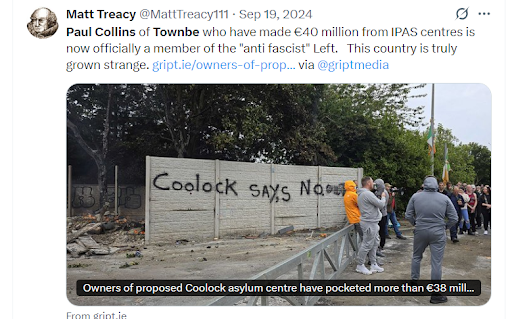
The highlight of that was an emotional interview with Paul Collins, one of the principals in Townbe, the contractor for the centre – a company that has and is still drawing down millions and millions of taxpayers money for the provision of asylum accommodation. Collins assured the nation that his interest in the whole business was certainly not motivated by profit. The very thought.
In an interview yesterday, Minister for State at the Department of Justice Colm Brophy claimed that the decision to withdraw the proposal was part of a plan to switch to large scale state centres. He denied that the Government had surrendered to the objections but he will be aware that the plan for the state centres has already run into difficulties in Crooksling, Lissywollen and Thornton Hall.
The fact is that the decision to withdraw from Coolock represents a huge victory for communities opposed to IPAS centres. All the indications are that it will not be the last. And that the exemptions which have been handed out over the past years are and will continue to come under much greater scrutiny.