Roger Scruton is a controversial character, ‘controversial’ being euphemistic for not going with the flow, the zeitgeist, the establishment or commentariat position. Most famously, controversy followed him to disrupt the final few years of his life with false accusations of racism and bigotry which also resulted in him being removed as Chair of the Building Better, Building Beautiful Commission in the UK. He was redeemed, reinstated and apologised to, but some mud always sticks. Mark Dooley goes to some lengths to contribute to Scruton’s redemption in this accessible compilation of 57 short examples of Scruton’s columns and commentaries.
This last attempt at destroying his name and reputation was not the first time Scruton was cancelled. He spent most of his life cancelled by a very left-wing UK academia for amongst other things: being a conservative, writing about conservatism, supporting Margaret Thatcher, thinking deeply and critically. He withstood it then and was able, even in his frail final years, to withstand it again, in part thanks to the work of Douglas Murray, who he acknowledges on a number of occasions in this collection. He was reinstated to the Commission and receiving apologies from many. Unfortunately, shortly after this redemption, cancer was to take him to his eternal repose at the age of 75.
But Scruton was an easy target as his writings of forty years had repeatedly ruffled feathers amongst the fools, frauds and firebrands of the [new] left, being labelled, to put it nicely, a controversialist for refusing to roll over to the “narrow set of orthodoxies [which are] instantly punished by a band of self-appointed vigilantes.”
Dooley’s collection includes a list of examples that contributed to getting under the skin of the outrage-ati. (Twitter has made morons of us all, sweeping us along in a storm of rumour and spite.) Feminism repeatedly attracted his ire. In 1983, refuting the narrative and warning of the risks of the emerging sexual and societal liberation: ‘This brilliant tactic, which bears all the marks of masculine perfidy, calls itself ‘feminism’, rather in the way the communist enslavement calls itself ‘peace’. It propagates the extraordinary myth that the division of sexual roles, the institution of the family, the ideals of modesty and chastity are all male inventions, designed to confine women to the situation that thwarts their true development. In truth, of course, these are precisely the bonds from which men have always sought to free themselves.
In 1997, he prophetically wrote “Whether or not affirmative action is introduced over here, it is certain that the American feminist conception of women, of the family and of employment, will gain a hearing. Lawsuits for sexual and racial discrimination will increase, and victim status will become universally coveted. New classes of victims will be discovered by the week… everyone in Britain will be a victim, apart from the minority of hard-working, over-taxed, middle class males”.
Later, in the same piece: “advisory bodies will be composed of political activists with a track record in anti-racist, anti-sexist, anti-nuclear, anti-homophobic and other forms of anti-bourgeois agitation”, predicting the merging of quangos and government to turn politics and socio-economic policy into a form of moral engineering. In 2018, writing in the Spectator, he re-visits the subject of victimhood: ‘ignorant and malicious people have discovered a new weapon in their unremitting assault on the rest of us, which is the art of taking offence’.
In 1983, taking on many of those same advisors masquerading as academics who have created a divisive politics of identity and victimhood in every nook of society through (not only) making education ‘relevant’ by establishing ‘studies’ which, “[W]hen added to a relevant-sounding prefix (such as ‘media’ or ‘communications’, ‘black’ or ‘gay’) this word adjoins to even the most half-baked enthusiasm an air of superior knowledge. Not only are you right, it says, to be interested in the problems of the media, of blacks, or homosexuals: there is also a way of converting enthusiasm into expertise.” In one sentence, he makes enemies of just about everyone employed (and unemployed) in the disciplines employed only to write and attack the beliefs and perspectives Scruton holds dear. And attack they did.
The changing face of education, from one of ‘transmitting knowledge and skills, not illusions’ to ‘child-centred education … encouraging false expectations and discouraging effort’ is another area that Scruton made enemies of those same purveyors of equality whose ‘decades of egalitarian propaganda’ has induced many to deny that ‘the acquisition of knowledge requires aptitude and hard work’, mirroring society that is ‘shaped by competition, conflict, friendship and love, all of them forces that have distinction rather than equality as their natural outcome’.
Through his writings, Scruton is withering of utopian approaches to all aspects of life (his book, The Uses of Pessimism is a beautiful and underappreciated piece of writing), whereas success and failure is what drives society forward – “feeling bad now is the price of feeling good later. The culture of self-esteem has the opposite effect: by making children feel good now, it makes them feel bad later – so bad indeed that they blame everybody else for their failure”.
He highlighted the irony of those who make (to take from Douglas Murray’s latest book) war on the west, criticising the history, tradition and politics that make it possible for them to be able to do just that:
“America: the only country in the world that rewards those who denounce it with the honours and opportunities that make denouncing it into a rewarding way of life. It is proof of Professor Chomsky’s success that his diatribes are distributed by his American publishers around the world so that they end up in the hands of America’s critics everywhere – Venezuela’s President Hugo Chavez included”.
Although never an outspoken anti-abortion crusader, he did feel compelled to engage in the discussion from a philosophical perspective, when the idea of surrogacy was in its infancy in the 1980’s: “The unborn child is no longer a human person, attached by indelible right and obligations to the mother who bears him, but a slowly ripening deformity which can be aborted at will … in surrogate motherhood the relation between mother and child ceases to issue from the very body of the mother and is severed from the experience of incarnation. The bond … is demystified, made clear, intelligible, scientific – and also provisional, revocable.”
He even dared to use the ‘s’ word, one hardly used in church-going circles, never mind secular ones in relation to issues of fleshly morality: “We should never lose sight of the fundamental truth that some uses of the body are sinful, and none more so than those which enable to escape the obligation that the body itself imposes.”
Speaking of the acceptability of blasphemous and worthless pieces of art in film painting and sculpture, in contrast to Islamic society and the reaction to the Danish cartoons of Prophet Mohammed (and in contrast to the increasingly censorious and intolerant liberal culture of the West) “we do not cry out for vengeance … nor do we believe the law should punish them … a reminder we are living in a society rotten with respect”.
Upsetting those who want to get rid of the nation, open borders, and eliminate the historical, territory related ties that made liberal democracy possible, Scruton defends the idea of nationhood in an era of virtue-signalling cosmopolitanism: “What makes a Democrat possible? The answer is: the nation. When you and I define our loyalty in national terms, we can put aside differences of religion, tribe and ethnicity and submit to a shared system of law … which operates over the territory that is ours”
On architecture, it was his vocal and passionate criticism of the destruction of rural England and the evisceration of urban areas that resulted in his chairing the Building Better, Building Beautiful Commission.
“What happened to Reading happened to Birmingham … and a hundred other once beautiful towns – the wholesale demolition of genial streets and their replacement by buildings deemed to be functional, which lost their function in a matter of years. The point is that there is a deep human need for beauty, and if you ignore that need in architecture, your buildings will not last, since people will never feel at home in them.”
More than conservatism, more than hunting, and possibly even more than good wine, beauty was what stirred the soul of Roger Scruton. And the beauty of Scruton is in his ability to write with beauty and grace – often about beauty and grace:
“Without the guidance of beauty and good taste we find it difficult to relate to each other in a natural or graceful way. Society itself becomes fractured and atomised”.
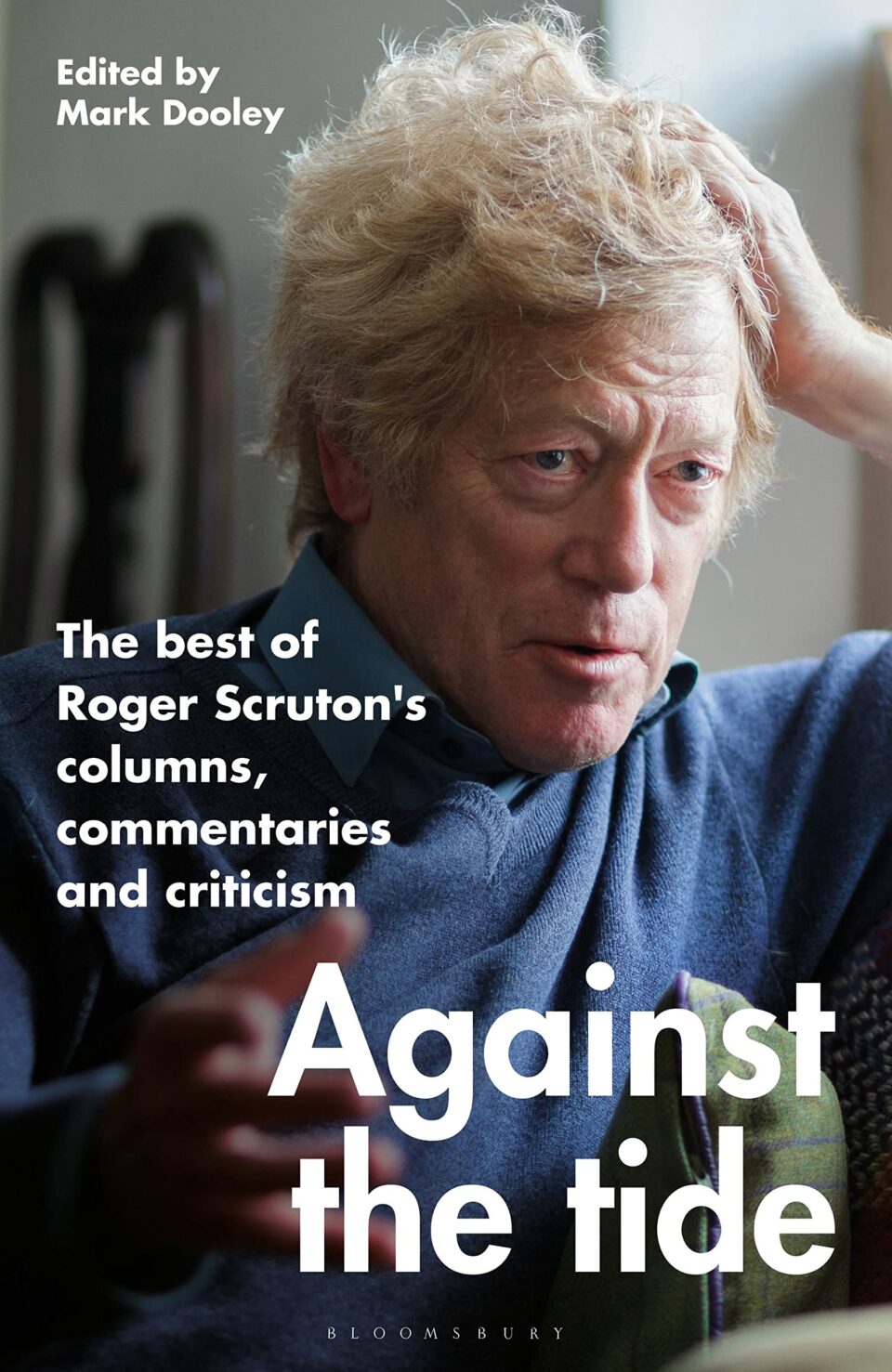
Against the Tide: The Best of Roger Scruton’s Columns, Commentaries and Criticism, Edited by Mark Dooley
- Author : Mark Dooley
- Publisher : Bloomsbury Continuum (20 Jan. 2022)
- Language : English
- Hardcover : 256 pages
- ISBN-10 : 1472992938
- ISBN-13 : 978-1472992932
- Dimensions : 16.33 x 2.64 x 23.9 cm
Dualta Roughneen