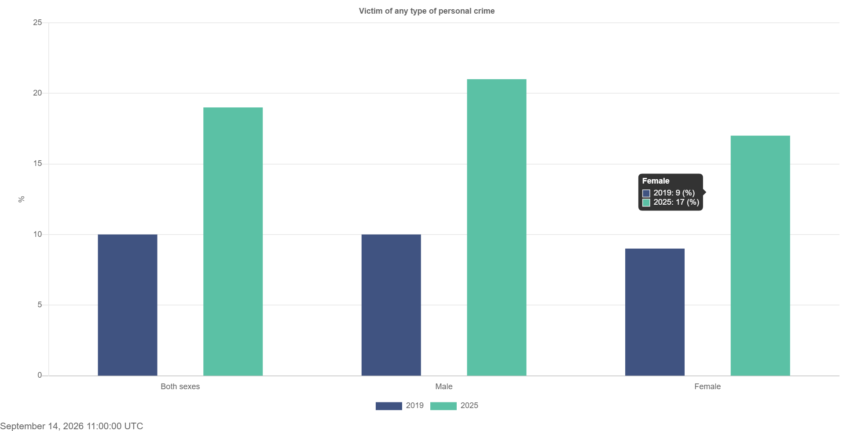
New figures from a Central Statistics Office survey show that the percentage of people saying they had been the victim of a personal crime almost doubled between 2019 and 2025, increasing to 19% of respondents compared with 10% in 2019.
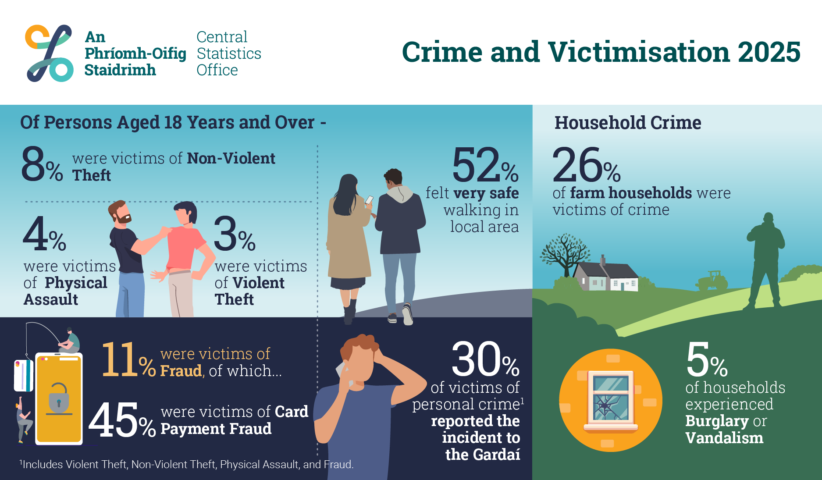
Some 70% of victims of personal crime did not report the incident to the Gardaí.
Reporting of personal crime fell from 39% in 2019 to 30% in 2025. For household crime, the reporting rate fell from 59% to 47%. Victims said the perceived inability or reluctance of Gardaí to action was a main reason for failure to report.
Fraud crime was up significantly, affected 11% of respondents in 2025 compared with 4% in 2019 – and Card Payment Fraud accounting for 45% of such crimes.
And the 2025 survey showed that less than half (43%) of respondents felt very or quite confident that the wider justice system was bringing people who commit crime to justice in Ireland.
The Crime & Victimisation Survey – which was carried out in 2025 – also show that respondents were less inclined to report crime in 2025 than in 2019 with the minor nature of the crime and the inability or reluctance of An Garda Síochána to take action cited as the main reasons for not reporting.
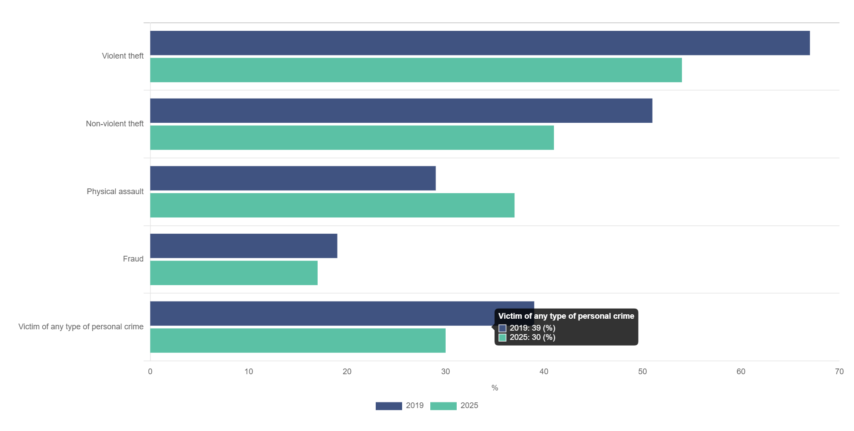
Personal crime includes Violent and Non-Violent Theft, Fraud, and Physical Assault. The number of people who said they had been the victim of Physical Assault doubled from 2% in 2019 to 4% in 2025. Almost six in ten (58%) victims indicated they did not sustain any injuries from this crime, 24% had to visit a doctor or GP, while 8% reported minor cuts / bruises that did not require medical attention.
Respondents were increasingly worried about being a victim of crime in 2025 compared with 2019, the CSO said. For example, the share of people who worried all the time or often more than doubled for Fraud crime and Internet-Related crime (e.g. identity theft) between 2019 and 2025.
However, most people surveyed (85%) felt very safe or fairly safe while walking in their local area, whether alone or accompanied.
While An Garda Síochána were viewed as very effective or quite effective at tackling crime in their local area by 57% of respondents in 2025 and this was down from 68% in 2019.
The CSO said that respondents aged 18 years or over were asked to consider the 12 months prior to the interview and rate how crime had impacted their lives and how effectively it was dealt with by the justice system in Ireland. Respondents were also asked about their own personal experiences and that of their household of certain crimes.
In addition, they were asked whether they had reported the crime to An Garda Síochána (AGS), the reasons for not reporting the crime, whether they felt the crime had been motivated by discrimination, and other contextual details relating to the crime.
Concerns about Crime
The re71sults show that people aged 18 years or over were increasingly worried about being victims of selected crime types in 2025 compared with 2019. T
his is evident in the higher percentage of people who reported worrying all the time or often about being a victim alongside a decline in the share of people who indicated that they did not worry at all.
In 2025, 23% of people surveyed worried all the time or often about the possibility of being a victim of crime that could result in physical injury or harm compared with 15% in 2019. The share of people who did not worry at all fell from 51% in 2019 to 32% in 2025.
Across all crime types, females expressed greater concern than males about the possibility of being victims of crime. For example, in 2025, 29% of females reported being worried all the time or often about the possibility of becoming a victim of crime that could result in physical injury or harm compared with 17% of males. For crimes leading to a loss of or damage to property, 36% of females worried all the time or often about becoming a victim compared with 29% of males.