Figures released to Councillor Gavin Pepper by Dublin City Council show that non-Irish households now make up 42% of the social housing waiting list – with the Independent councillor describing the situation as a “dramatic change”.
Cllr Pepper asked Dublin City Council for the total number of households on the social housing waiting list, broken down by nationality/citizenship, and the total number of social housing allocations made, broken down by nationality/citizenship.
In addition, he asked for the total number of allocations made through Approved Housing Bodies (AHBs), broken down by nationality/citizenship. AHBs are increasingly expanding their role in public housing building and allocation.
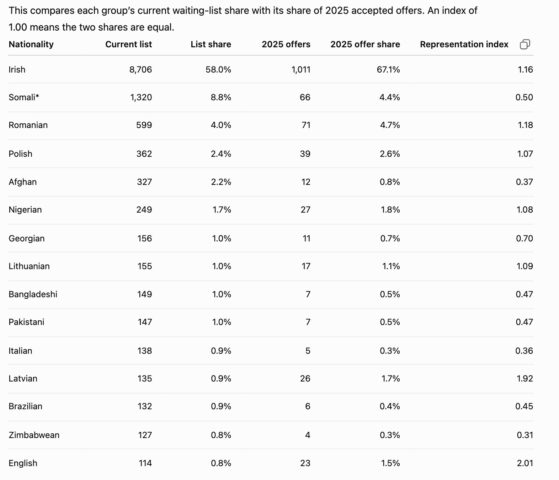
According to the reply received from Dublin City Council, of 15,005 households waiting on social housing, 8,706 or 58% are Irish – while 6,299 or 42% are non-Irish.
Cllr Pepper said the figures showed that Somali households alone account for 1,320 applicants or 8.8% of the entire list. Romanian households account for 599 of those on the list or 4% of the total.
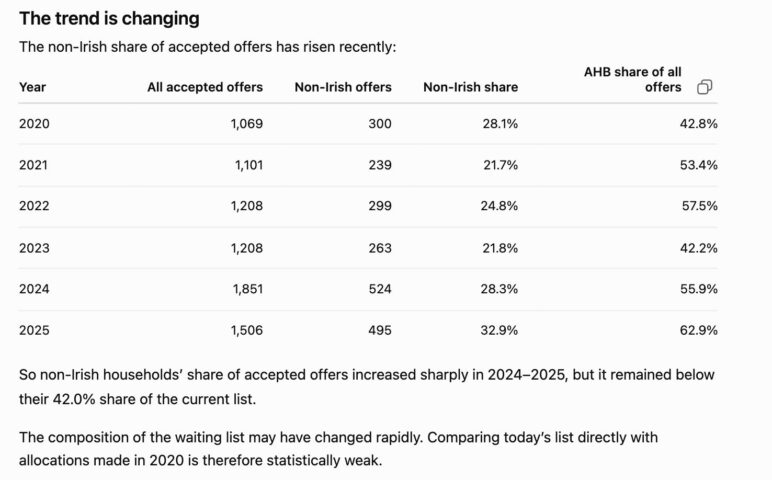
Cllr Pepper said the data showed that the non-Irish share of accepted housing offers rose from 21.8% in 2023 to 32.9% in 2025.
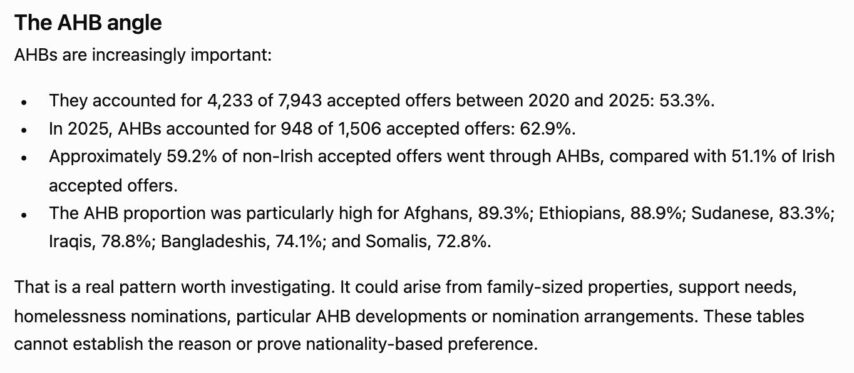
Approved Housing Bodies now provide almost 63% of all accepted offers in 2025, he said – with 59% of non-Irish accepted offers going through AHBs, compared to 51.1% of Irish accepted offers.
In addition, the data showed that the AHBs provided a higher proportion of housing offers for Afghans, Ethiopians, Sudanese, Iraqis, and others, Cllr Pepper said.
“Yet Dublin City Council admits it does not monitor allocation outcomes or waiting times by nationality,” the Independent Cllr said. “It cannot tell us who waits longest, who refuses offers, why AHB nominations fail, or properly explain these enormous demographic changes.”
He said that Dublin City Council was operating a housing system distributing thousands of homes without transparent data. “We must have transparency on this, its not good enough that, in the middle of a housing crisis, this information is not available,” Cllr Pepper told Gript.
Cllr Pepper said that the data showed that there were serious questions to be examined – and that Irish people needed to be prioritised in all policies around housing.”
“After two years in international protection some people are allowed onto the homeless band, which means they are competing with people who are years on the housing list,” he said. “People can see this happening in real life, and they are coming to me as a councillor upset and asking questions about where the priority is being given. They deserve answers.”
“The truth is that we are importing a homeless crisis in regard to some aspects of immigration, and Irish people are deeply unhappy with what’s happening,” he said.
Dublin City Council said that “The Council does not currently monitor or report allocation outcomes by nationality/citizenship. However, following the Equality and Human Rights Impact Assessment undertaken as part of the review of the Scheme of Lettings in 2026, it was agreed that equality monitoring would be undertaken annually. The Council will therefore commence this reporting during the current year, in accordance with the commitments set out in the Scheme.”
Commentator Nick Delehanty said that the data released by DCC showed that one in three houses awarded last year went to non-Irish people last year – and that the Approved Housing Bodies were now playing an “outsize role” in housing provision.