Portlaoise Prison in the period which ended in the ceasefire of August 1994 was a surreal place. Some chaps were still avidly following the progress of an increasingly erratic ‘war’ with the blind faith of stranded Japanese soldiers on a Pacific atoll convinced that some stroke of military genius would turn the tide in favour of the Army of the Republic.
Men were still getting captured on operations or minding the arms dumps containing what had meant to be the materiel for the final offensive that would drive the Brits into the sea. The actual plan was that the arsenal of the IRA – on whose protection they had staked and lost their freedom – was already on the agenda to be destroyed.
It was around this time that we were “briefed” on the Tactical Use of Armed Struggle (TUAS) document as endgame approached and there were intensified efforts to bring the IRA and the prisoners along with what was the inevitable dénouement.
A text of the TUAS document only became public after the first ceasefire. It is an interesting insight into both where those closest to Adams wished to go, and what they believed they had to tell those of us who comprised the ranks of the Old, and soon to be redundant, Brigade in order to keep us on board.
The document began by stating that republican goals; “A united 32 county democratic socialist Republic,” had not changed. However, in order to achieve that they needed to create a “nationalist consensus” backed by “the USA and EU,” because the movement was too weak to achieve its objectives on its own.
The objective remained a “united and independent Ireland” but in the meantime “an agreed Ireland needs the allegiance of varied traditions to be viable.”
Exactly what this “agreed Ireland” might look like has never been clearly defined. It is implicitly something far short of the Republic either in the traditional constitutional understanding of what that would mean or attached to the concept of a sovereign nation in its economic as well as every other sense.
I cannot recall if we in Portlaoise were given prior notice of the ceasefire before it was announced at mid-day on Wednesday August 31. It did not come as a surprise, and had been presaged by a joint statement on August 28 from Hume and Adams forecasting a major development that would bring about a radically different political situation.
Some of us were openly pleased about the announcement, some were openly hostile or sceptical, and some seemed genuinely shocked; an indication that they had not been keeping up with what was going on.
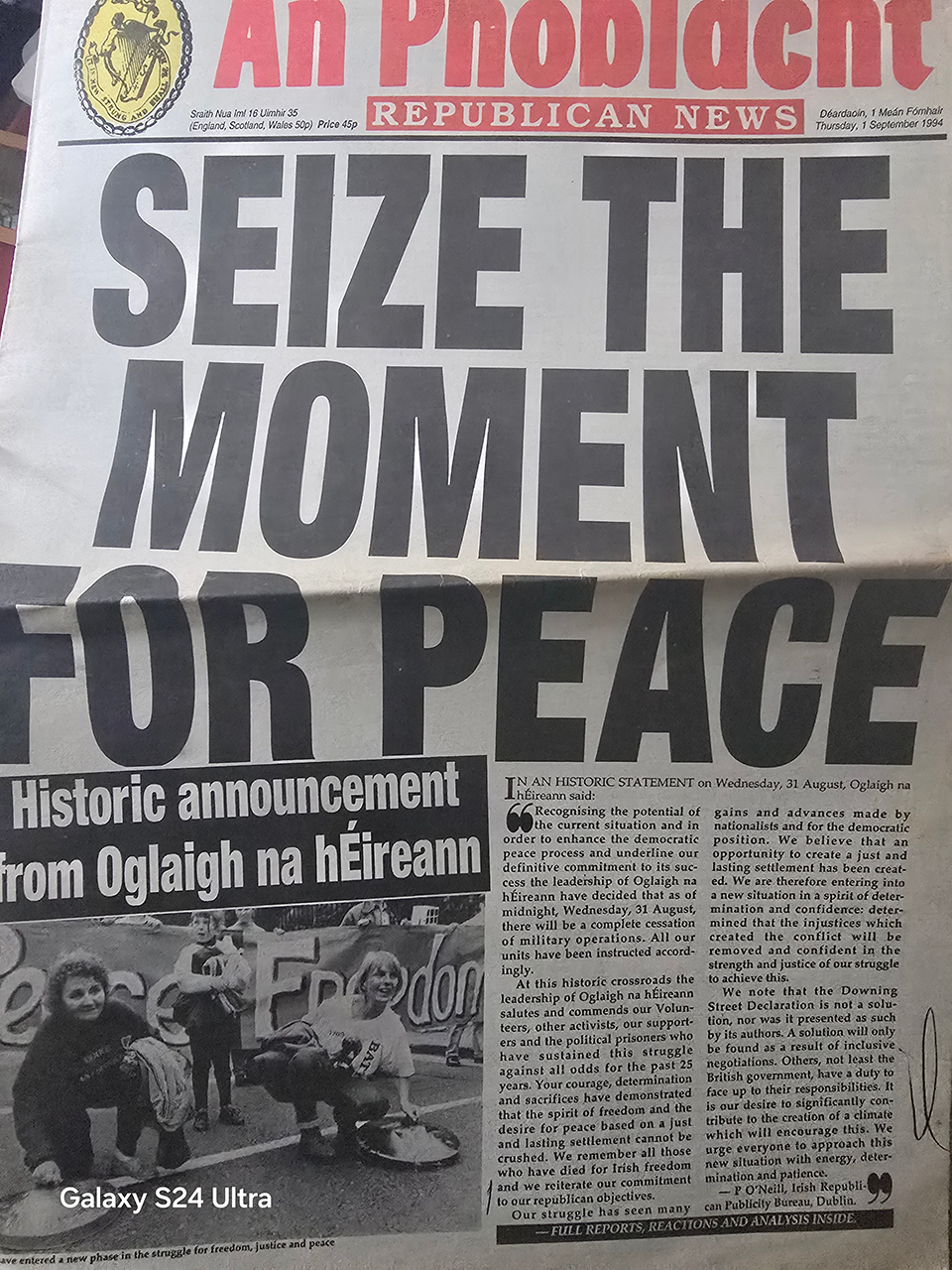
The Army statement noted that “the Downing Street Declaration is not a solution, nor was it presented as such by its author. A solution will only be found as a result of inclusive negotiations.” There was no reference to the fact that the Declaration by its emphasis on the consent of a majority within the Six Counties had already effectively ruled out the solution to which the IRA was dedicated to.
I do remember that night recalling over a few glasses of the finest house rice wine what Brendan Behan had written about the Felons of Our Land, and pondering what sensual and other rewards a chap might reap that very evening were he to be amongst the republican people of Ireland celebrating, if you went by the ironic ‘victory’ cavalcade in West Belfast, a momentous triumph for the Irish Republican Army.
“Wasn’t it the great pity that the fellow that was doing the suffering couldn’t be where the singing was to get the benefit of it. Mother of Christ, wasn’t there a thousand places between Belfast and Bantry Bay where a fellow would be stuffed with grub, not to mind drowned in porter, if he could only be there and here at the same time?”
Unfortunately, we who were the “real goat’s genollockers” could only await the day when a grateful nation would shower us with its favours.
Matt Treacy’s book A Walk on Part in a War has been just published by Brocaire Books and is available in paperback and other formats on Amazon https://shorturl.at/Evv5d