Ireland is notorious for it’s inefficiency when it comes to delivering just about anything of any scale, the causes for this are manifold and hotly debated, but one aspect which can fall by the wayside is the fact that due to our very weak local councils all major political and economic decision making is made in Dublin.
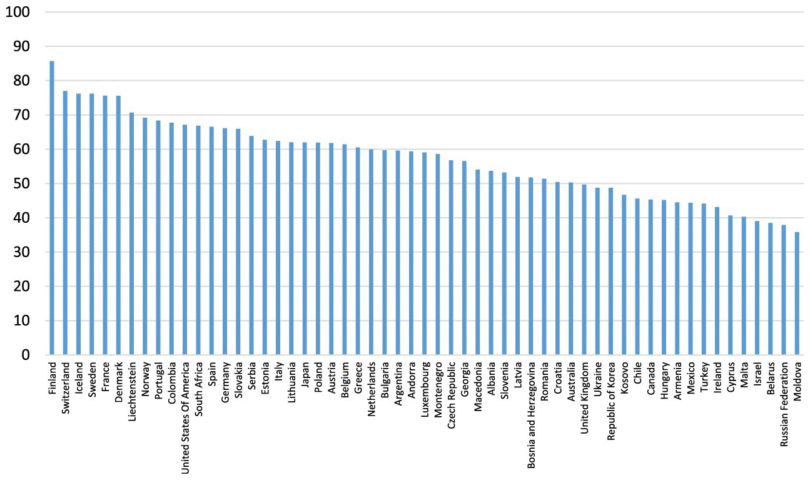
According to the Local Autonomy Index in 20211, which measures and aggregates different indicators of the strength of local government, Ireland has a score of just 43, making us the country with the 3rd lowest level of local autonomy in the EU, beaten only by the much smaller countries of Cyprus and Malta with scores of 41 and 40 respectively.
Our County Councils have autonomy scores closer to Russia’s 38 than similarly sized fellow EU members like Denmark or Austria’s respective scores of 76 and 62.
Figure 1: Local Autonomy Index 2021
Source: https://www.tandfonline.com/doi/full/10.1080/13597566.2023.2267990
There are many negative impacts that are associated with this centralisation, most obviously is the fact that since most planning occurs in Dublin, it leads to more development in and around Dublin than in the rest of the country. Smaller and less populated Counties like Longford or Leitrim often feel as if they get left behind due to their lack of representation in Leinster House. Even the cities beyond the Pale can be seen as playing a supporting role as vassal cities of the Dublin’s Delian League as the Dáil in Dublin has a huge amount of influence over city development in these places.
I would argue that this has been a significant contributing factor to the housing crisis as, in truth, there is a decently large amount of homes available in regions beyond commuter range of Dublin, the problem is that there are very few jobs for people to live off in these areas. As people continually leave these places in search of jobs in the capital, it exacerbates the unavailability of homes in Dublin. This increases further the demand for development to be focused on Dublin, neglecting again the rest of the country in an eternal cycle.
This is compared to a country like Switzerland, which scored a 77 on the LAI and where their 26 Cantons have ultimate responsibility over law enforcement, education, healthcare, welfare, and perhaps most importantly, taxation. This allows for development to be approached by each Canton on an individual basis, meaning a more balanced development across the whole country as Cantons are competing with each other to attract businesses and individuals.
Income tax, for example, varies heavily between the Cantons, ranging from Obwalden’s flat tax rate of 1.8% to Geneva’s policy of progressive taxation which ranges from 17.58% to 76%. This results in Switzerland having a robust and decentralised economy, where no one city or region is kingmaker. Indeed, the de facto capital city, Bern, is only the fifth most populous city in the confederation.
In Switzerland, the economy isn’t run by one city for the whole country, the aforementioned issues we have in Ireland of rural Counties being ignored resulting in internal migration to the Greater Dublin Area are much less of a problem there. Naturally, young professionals still often move to the cities like Basel, Geneva or Zurich, causing some local strain on housing, but this is nowhere near the scale we see in Ireland.
The key difference here is that Swiss cities have a much greater ability to plan and grow by themselves. The five biggest cities in Switzerland all have populations above 400,000 and are prosperous independent of each other. The fifth largest city on the island of Ireland, Galway, doesn’t even crack 90,000 people, and is hardly as self sufficient as Switzerland’s fifth most populous city of Bern.
Another fault of the strong centralised government we have in Dublin is that such systems are extremely prone to bloat and corruption. It nearly goes without saying that the more people and area you have to look after the more difficult it becomes to do anything either time or cost effectively. Even in the government heartland of Dublin, development projects are often hilariously over budget and delivered far too late.
If such projects were handled on a more local level by people who are from the area and personally passionate about it and without the burden of having to be overseen alongside the entire rest of the country, it would be far less likely that we would see the levels of waste we currently do. In fact, if local authorities had to make their own budgets via their own taxation, it is unlikely that they would even have the huge budgets required to ignore issues of inefficiency and corruption, thus creating a system of incentives which forces them to adapt and become more efficient!
Whenever I happily extol the virtues of this style of federalism to anyone who’ll listen I am inevitably met with the argument that Ireland is ‘too small’ for such a system to work. I completely disagree with this and I would instead argue that we are actually too big to not federalise. As shown in the Local Autonomy Index, most European countries with a similar size and population as Ireland are much more decentralised. Switzerland for example has a population of 8.9 million, only 1.8 million more than the whole of Ireland.
There are also some people who would agree with the case for federalism, but would argue for it on the provincial level, rather than my county level. To such people I would like to point out that the smallest Swiss Canton, Appenzell Innerrhoden, has a population of just over 16,000, which is less than half the population of the least populous Irish County, Leitrim, with it’s population of roughly 35,000.
The Swiss Cantons are also each broken up into smaller Municipalities, 90% of which have a population below 5,000 people. The abilities and responsibilities of these Municipalities vary by Canton, but they are generally analogous to Ireland’s County Councils as they currently stand, though again they often have more powers than we allow our Counties. Typically it is these Municipalities that manage and oversee services like education and healthcare based on the policy of the Canton on this even more local level.
I would like to briefly interrupt myself with a quick appeal to tradition for any Irish nationalists reading, as Ireland was, historically a famously decentralised country with hundreds of competing Kings and Chiefs all functionally independent of each other. Our modern centralised regime based in Dublin is a direct product of our colonisation by England. Indeed, the Irish language already has all the terminology required for a more regional approach to government, where the Swiss have their Canton, Municipality and Landsgemeinde, Gaelic Ireland had it’s Ríocht, Tuath and Dáil.
Finally, I would like to talk about how a federal system would help address several cultural issues seen in modern Ireland. The urban-rural divide, for example, has been growing steadily in recent years in Ireland, most recently manifesting itself as a key factor in the fuel protests. I believe that a massive contributing factor to this divide is the fact that they share Leinster House and have to compete with each other for national policies that will benefit their specific constituency, often at odds with the desires of other parts of the country. Rural voters feel as if they’re looked upon with scorn by the urban population while urbanites can feel as if they’re being held back by the farming lobby. A federal Ireland where local issues are discussed and dealt with locally could go a long way to help heal any animosity between these two groups.
Perhaps the most common complaint made about Irish politics is that the line between national and local politics is extremely blurred, as the national parliament in Dublin is regularly host to discussions about fundamentally local issues out in the country. Could it be that strong regional governments with the ability to handle such issues by themselves could save the Dáil from having to deal with it and allow TDs to focus more of their time dealing with much broader issues that affect the whole nation? I believe so.
This ability to cope with cultural differences is also a huge boon when we consider the prospect of Irish reunification. Simply forcing Unionists to work within the framework of a 32 county Leinster House would result in catastrophic failure with things as they currently stand, I believe an Irish confederation where the Northern Counties can each sort out their own issues locally would be the best solution.
This can easily be showcased through comparison with Switzerland, which has 4 official languages and is also quite religiously diverse, trying to govern such a place in a unitary system like Ireland’s would result in complete and utter disaster. Instead of watching the different parts of the country tear each other apart as if it were the Austrian Imperial Council, the Swiss federal model allows for French, German and Italian Cantons to deal with their own cultural issues while having to make as few concessions to other ethnic groups as possible.
While Switzerland is by no means a perfect country, I believe that their federal system holds many lessons for us in Ireland. I would like nothing more for us than to take these lessons to heart, and to wake up in 2100 to see an Ireland where the Kingdom of Kerry, Waterford Soviet, Galway Gaelstát and Craigavon Republic are all locked in an eternal battle of trying to out compete each other and in turn keeping each other in check alongside the Confederal Council in Athlone.
Tadhg O Néill
Image shows Appenzell Cantonal assembly – Vote by a show of hand. A Cantonal assembly is an annual open-air political assembly. Appenzell Switzerland. Sunday, 28 April 2024