In September 2023, I submitted a Freedom of Information request to the Department of Education and Skills seeking all records relating to the introduction of mixed sex toilets in new build or refurbished second level and primary schools.
I specifically requested copies of any risk or impact assessments conducted on the introduction of mixed sex facilities.
A month later I received a Dropbox link to 95 documents accompanied by a letter that seemed anxious to emphasise that while the Department facilitated the introduction of mixed sex toilets, the final decision on whether they were adopted rested solely with individual school management.
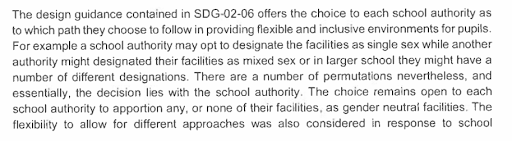
Extract from letter that accompanied the FOI.
Over the following weeks I worked my way slowly through every document looking for any sign of an official, recorded concern about the potential impact of mixed sex facilities on girls and boys. I found none.
What I did find was evidence of a Department profoundly disconnected from what most students and parents want. Among the documents was a presentation delivered by the Department in May 2019. It was titled ‘Equal Access and Safe Toilets’. But equal and safe for whom?
It included a slide stating that toilets should be described ‘by identifying the facility provided, not by defining the user’. As though avoiding any explicit reference to who the space is intended for could somehow avoid the potential problems of males and females using these facilities together.
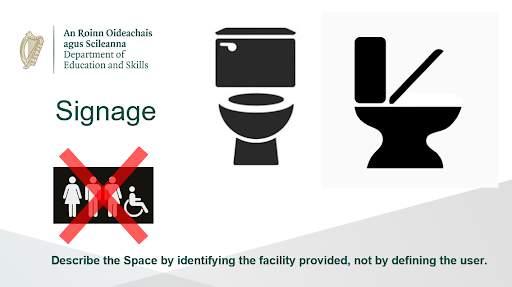
The issue is not simply that the toilets might be designated ‘mixed sex’, the layout itself is also deeply troubling.
The Department claims that removing the wall between the school corridor and the toilet stall area improves visibility and supervision, thereby reducing bullying. Yet the language used to defend the design drifts into a surreal detachment from reality. The Department encouraged designers to evoke a sense of the ‘powder rooms of yore’, an image more suggestive of Downton Abbey than the reality of being an adolescent boy or girl in the local comprehensive.
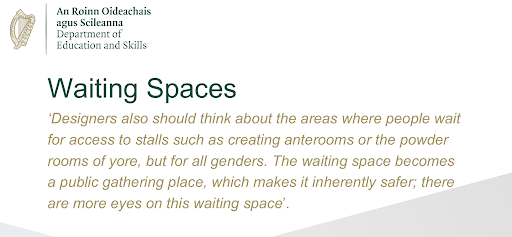
The claim that waiting areas outside toilet stalls will naturally become ‘public gathering places’, made safer simply because there are ‘more eyes’ present, reads more like an architect’s fever dream than evidence based safeguarding policy.
Did anyone give any serious consideration to how adolescents behave and interact? I doubt the civil servant responsible for the idea has ever had to wash out a mooncup or apply acne cream in what is effectively a public corridor, yet that is precisely the sort of exposure students are now expected to accept in the name of equality and safety.
And this brings us back to the remarkable absence of any evidence that proper risk or impact assessments were carried out before these changes were proposed.
NO RISK ASSESSMENT
In a second level school context this should include a child safeguarding assessment examining supervision, bullying, voyeurism, harassment, intimidation, recording with mobile phones, and the effects of reduced privacy on all students. From an equality and human rights perspective, the assessment would consider how the loss of privacy or single sex provision affects different groups differently, including girls, students with disabilities, students with religious or cultural privacy concerns, and students with personal experience of sexual or physical abuse.
A health and wellbeing assessment might examine whether pupils would avoid using toilets altogether, reduce fluid intake, or skip school because of diminished privacy. It remains genuinely bewildering to me that none of this appears to have been done.
The Department stated that consultation on school design can take place before the new designs were implemented, but crucially it did not require it. This failure to insist that students and parents are properly consulted, surveyed and, more importantly, listened to has led directly to situations such as those faced by Gaelcholáiste Chiarraí in Tralee and, more recently, Harold’s Cross Educate Together Secondary School, where parents and students have expressed deep unhappiness about the imposition of the new layouts and the introduction of mixed sex facilities without meaningful consent or engagement.
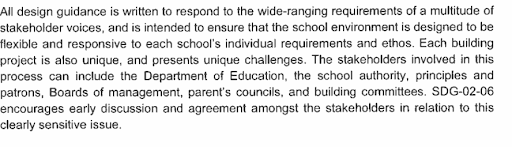
Extract from letter that accompanied the FOI.
Maybe we should not really be surprised by any of this. The toilet fiasco is simply the latest example of official Ireland suffering an attack of the ‘exceptionals’. Not the belief that we are especially good at something, but the conviction that we are somehow uniquely enlightened, or exempt from the ordinary rules and realities that apply everywhere else, and that despite all evidence to the contrary we can pursue a particular social outcome and manage to deliver a result that has eluded everyone else.
Around the world the basic principle underpinning single sex toilet and changing facilities is largely accepted without controversy. The United Nations and international development agencies routinely fund the provision of safe, private, sex separated toilets for women and girls in developing countries precisely because privacy, dignity and safety are recognised as universal human concerns. Yet in Ireland policymakers are willing to argue that adolescent girls no longer require that same principle of separation or degree of consideration.
NOT JUST A GIRL’S ISSUE
It is also important not to frame this solely as a girls’ issue. Adolescent boys are equally entitled to privacy and dignity. They are also navigating puberty, are anxious about their appearance and awkward about their developing bodies. They also deserve spaces where intimate bodily functions are not presented to the world for scrutiny under the guise of ‘passive supervision’.
At the same time, we cannot ignore obvious physical realities. An 18 year old boy who is 6ft 3in and heavily built may be the gentlest soul imaginable, but he will still present an imposing physical presence to a much younger 13 year old girl in a confined space. That is not a moral judgement on boys, it is simply recognising human perception and developmental differences. Good safeguarding policy does not pretend these realities do not exist. It seeks to avoid placing either boys or girls in situations that are unnecessarily uncomfortable or intimidating in the first place.
If the Department of Education and Skills genuinely wants toilets that are both equal and safe, the answer is not to pretend that differences between boys and girls no longer exist, nor to treat the desire for privacy as an act of selfishness or an unfashionable relic of the past. Equality should not require students to surrender their dignity, and safety cannot be secured by ignoring reality.
============
Sandra Adams is a commentator and a former Independent Seanad NUI panel candidate. She advocates for women’s sex-based rights, child safeguarding and fact-based education.