There was a time when the Irish ‘left’ would have been overcome with joy at an anti-Government protest being able to pretty much bring the country to a halt.
The last time the ‘old left’ accomplished such a feat was during the PAYE ‘tax revolt’ of the late 1970s and early 1980s whose highlight was a January 1980 general strike involving around 750,000 union members.
These days there are around 200,000 fewer members of trade unions and they make up less than 25% of the workforce. Much of those are in the public service and very few of either the lower paid or the higher skilled and increasingly non-national ‘tech’ workers are members of a union.
The unions have proven to be ineffective in combatting the impact of the ‘free movement of capital and labour.’ Most of their officials are not from a working background and have replaced militant trade unionism of the Connolly/Larkin brand with liberal left cheerleading of the very forces that are pushing the Irish working class to the sidelines.
The only equivalent perhaps to this week was the water charges movement which culminated in two protests of an estimated 100 – 150,000 people in October and November 2014. Although ostensibly the baby of the far left, later opportunistically taken over by an initially reluctant Sinn Féin, that movement was – for the want of a better word – ‘populist.’
At the local level, in particular, it engaged people who have an instinctive antipathy to the establishment on almost every issue. It is no coincidence that much of the anti-IPAS centre protests took place in the same parts of Dublin which were the most militant against the water charges. Indeed, there is not an insignificant crossover of activists between the two.
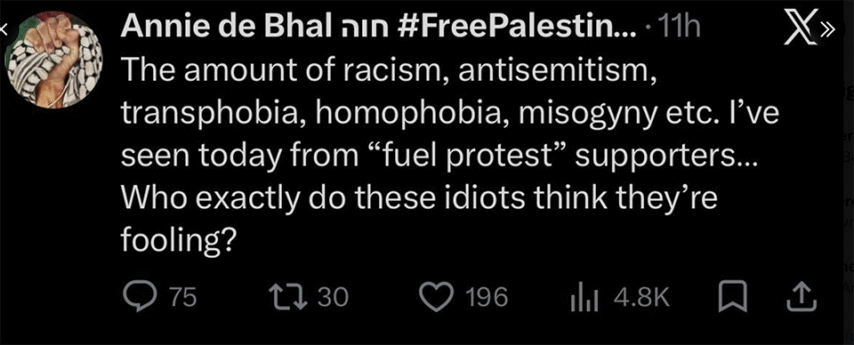
However, much of the left is now instinctively averse to such manifestations as is evident from some of the hysterical social media commentary. One post on X – from a person who appears to be the editor of the far-left Beacon – claims to have found evidence of racism, antisemitism, misogyny, transphobia, homophobia and God knows what other horrors in her interaction with the For Roysh protestors.
Sinn Féin, having seemingly put their own Woke extremists on the Naughty Step as Matt Carthy and others attempt to do a u-turn on immigration, has been astute enough to associate itself with the protests, but appears uneasy with it in many respects.
It is noticeable that their main social media account has not shared footage of the protests or any of the speakers at the meetings including their own TDs.
Ógra Shinn Féin did share a shot of their candidate for Galway West electioneering at one of the protests in Galway City but has mostly reserved its emotional engagement this week for things far away from Paddy’s Green Shamrock Shore.
The reason for the discomfort among the left is that the protests have tapped into something that probably even the original organisers did not envisage. One of the organisers, John Dallon from Kildare, when interviewed on TV did make reference to what he claimed was the preferential treatment of Ukrainian refugees. Others have referred to the billions of tax funds spent on asylum accommodation.
That theme has been echoed on social media and in some of what has been broadcast from the protests. It has become almost a spontaneous outpouring of frustration that has led many people – including those commuters inconvenienced by the protests – to voice their ‘solidarity’ with the boys on the tractors and driving the trucks, or not driving the trucks.
It is also clear that there is no ‘leadership’ and previously little-known chaps like James Geoghegan and John Dallon have been propelled from relative obscurity to national prominence. Nor is there any ‘political’ demand beyond that the State act quickly to provide relief from the hike in fuel costs.
If there is an ideological element to that then it has mainly been the focus on the Carbon Tax whose suspension would provide an instant and significant reduction. There has also, however, been reference to why the turf sector was shut down and the criminal dependency of the Irish economy on imported fuel – a flaw that some this week have claimed could be addressed by bringing onshore the oil and gas off our coast.
The left is not the only part of the political spectrum to find the whole thing rather uncomfortable. The traditional ‘centre right’ here, in common with the RINOs in the States, the British Tories, French and Dutch and Italian and German mainstream conservatives, have also instinctively recoiled from the ‘Deplorables’ whether riding a tractor or objecting to the consequences of mass immigration.
Likewise, the organisations that formally represent the two main groups involved – the Irish Road Haulage Association and the Irish Farmers Association – have appeared nonplussed by the protests. While many of the participants in the protests are members, the leaders of those groups did not organise nor approve them. A fact underlined by the overwhelming refusal of the protestors to hand over the negotiations to the IRHA and the IFA.
It is also interesting that a whole other constituency that the left and the centre right has lost or abandoned appears to have taken the protestors to their hearts. The rural deplorables have generally been greeted warmly by their urban equivalents if the evidence of the streets in Dublin is any indication.
That support is pretty much unanimously reflected across the disparate and inchoate range of ‘far right’ and nationalist opinion from the parties that seek to give electoral voice to that, to social media accounts. Some of the sentiment expressed is batshit crazy. A lot is contradictory.
That is what happens when a spontaneous mass movement, or potential mass movement, emerges. Historically the main example of that we have is the post 1916 Rising Sinn Féin. That, as it emerged from the 1917 Ard Fheis, was an uneasy alliance of elements that agreed on one thing and one thing only: the refusal any longer to accept the authority of the British State in Ireland.
It was the most successful mass movement in Irish history, albeit one that fell short of the objective of the independence and sovereignty of the island.
What will become of the ‘Rough Beast’ that has crawled along the highways and motorways to confront Ozymandias in Government buildings and its satellites across the entire Establishment which pretty much includes every officially constituted organisation in the State?
Time will tell.