Countries across Europe are carving up their taxes on fuel amid the continent’s ongoing energy crisis.
The shift stands in stark contrast to the policy being operated by the Irish government, which has insisted its moderate reduction of duties last month was as far as it could go in terms of reducing the burden on the public.
Last month, the Polish government announced a series of measures aimed at curbing the rising cost of fuel driven by the conflict in the Middle East.
The package included cutting VAT on fuel from 23% to 8%, reducing excise duty, and introducing a daily cap on fuel retail prices.
This is despite an edict published by Brussels claiming that reducing VAT on motor fuels could be in breach of EU law.
Prime Minister Donald Tusk said it was his hope that this would reduce the checkout cost of fuel by about €0.28 per litre with a view to rolling out the measures by Easter.
The announcements came a day after diesel prices in Poland reached a record high, as a result of the US and Israeli intervention in Iran, which triggered the closure of the Strait of Hormuz, which is the shipping route for approximately 20% of the world’s oil and liquefied natural gas supply chain.
Although Poland’s Minister for Finance, Andrzej Domański, warned that the VAT cut would impact the state budget by 900 million zloty (€211,104,000) a month, with the loss in excise duties predicted to cost monthly losses of around 700 million zloty (€164,188,500), he added that tax rates would be adjusted with changing market conditions.
At home, the government announced a 20c reduction on the cost per litre of diesel until May, with a 15c cut per litre on the price of petrol for the same period.
Other member states that have lowered retail costs in response to the crisis are Italy, Portugal, Slovenia, Hungary, and Spain.
Madrid was one of the first in the bloc to reduce excise duties on petroleum products, while also reducing the VAT rate on gasoline and diesel from 21% to 10%.
Spain also moved to suspend the excise duty on hydrocarbons, to trigger an immediate reduction in the price of diesel and petrol of between 30c -40c per litre. 5% of tax on electricity consumption was also due to be axed.
Italy also quickly opted to reduce excise duty by 30% on both gasoline and diesel, or 20c per litre, before announcing a 25% excise duty cut until the 1st of May.
Minister for the Economy Giancarlo Giorgetti said that the tax cut “already adopted for fishing has been extended to agricultural businesses”, adding that €500 million was to be allocated to cover the cost.
He said that exceeding the 3% European Union-mandated deficit limit was “inevitable” if the situation [with Iran] does not change.”
Portugal lowered excise duties by 21% on diesel (reductions of 7.6 eurocents per litre), while the Spanish government also reduced the VAT rate on gasoline and diesel from 21% to 10%.
Serbia, Montenegro, Albania and Iceland have also cut retail prices, with the Norwegian Government voting in favour of similar action.
Across the EU, the price of diesel rose by an average of 27.6% between the 26th of February and the 26th of March, with Sweden experiencing the highest increase at 43%.
The Czech Republic recorded an increase of 42%, with Poland a 40%.
The lowest increases were noted in Slovenia, Slovakia and Hungary, according to the European Commission’s Weekly Oil Bulletin.
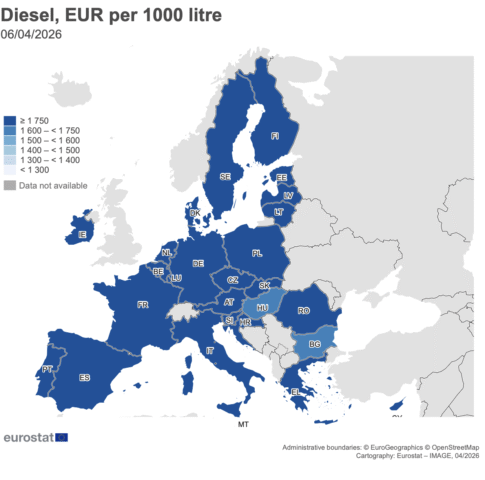
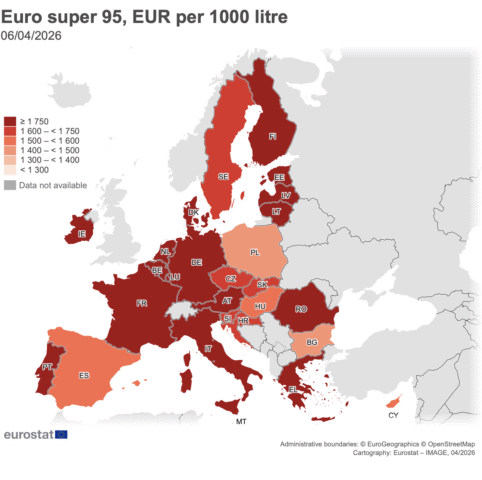
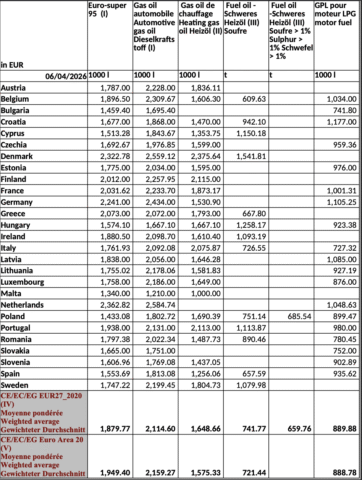
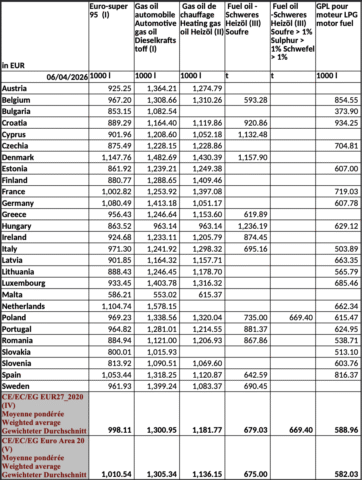
Image. Prices with and without tax, from Weekly Oil Bulletin.